 Guide On Map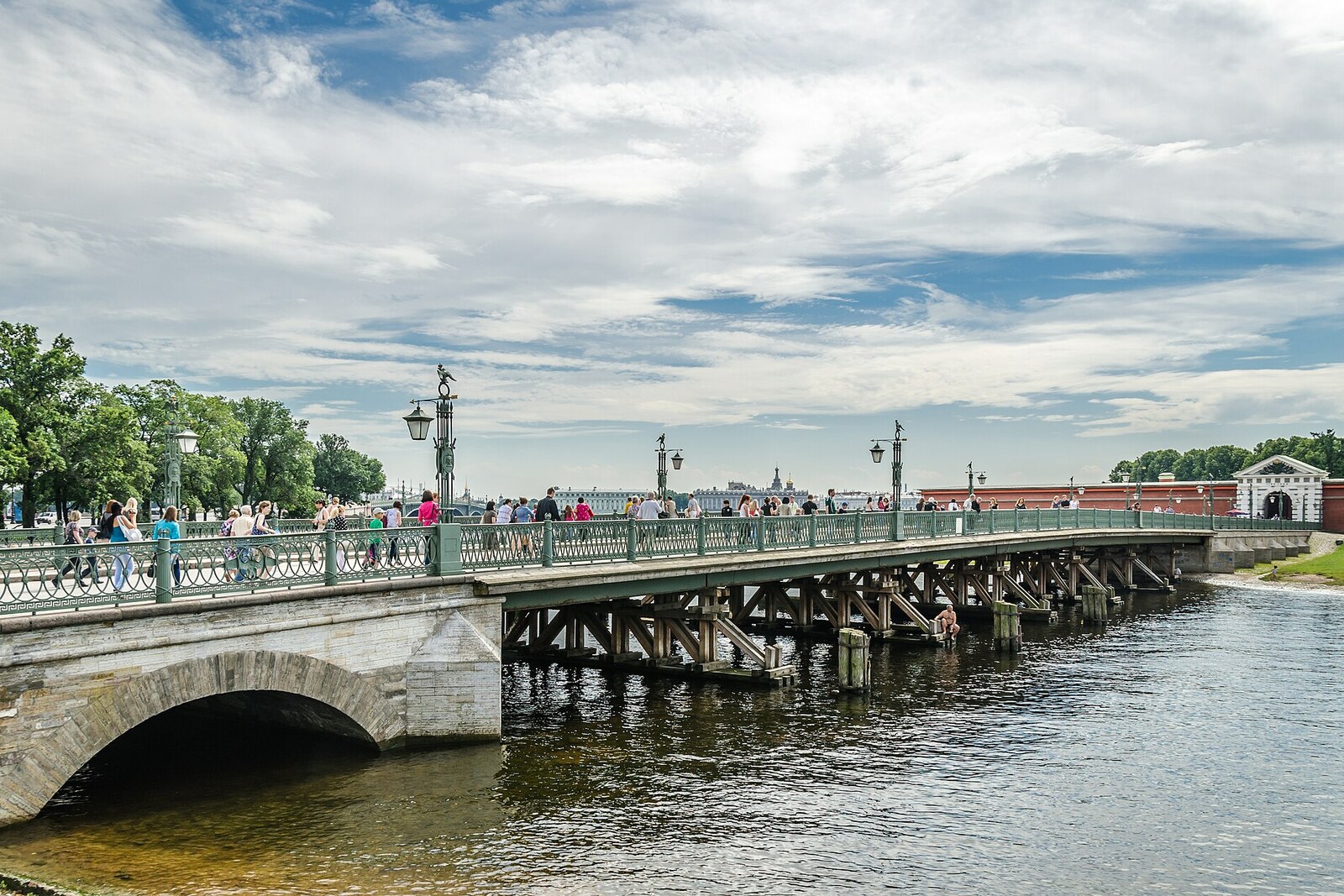
Look around first
What to notice
- Ioannovsky Bridge
- Ioannovsky Gate
- Peter's Gate
- Carved panel above the arch
The story of the place
Ioannovsky Bridge is considered Saint Petersburg's oldest bridge by lineage, rather than by the age of its present structures. In the spring of seventeen oh three, builders laid a wooden crossing over the Kronverk Channel. Without it, it would have been difficult to bring people, earth, and materials to Hare Island for the fortress. Later, the pontoon bridge was replaced by a pile-supported bridge and then rebuilt many times. What remains here from the first crossing are its location and purpose: it is still the eastern entrance to the island.
The name appeared much later than the bridge itself. In seventeen thirty-one, construction began on a ravelin in front of the fortress's main gate—an independent outer fortification meant to take fire upon itself and protect the passage through the wall. Construction took place under Empress Anna Ioannovna, and the ravelin was named after her father, Tsar Ivan the Fifth. Ioann is the church form of the name Ivan. Pyotr I's elder brother formally shared the throne with him, but died seven years before Saint Petersburg was founded and never saw this city. At the end of the nineteenth century, the bridge was named after Ioannovsky Ravelin.
This is how the present entrance with two successive gates came about. The modest Ioannovsky Gate lets visitors inside the outer fortification. Beyond it stands Peter's Gate, the fortress's former main façade, which the ravelin later shielded from direct fire.
Pyotr I ordered ceremonial gates to be built here in seventeen oh seven, when the Great Northern War with Sweden was still underway and the outcome of the struggle for the banks of the Neva remained unresolved. Losing this stretch would have meant losing the new fortress, the shipyard, and the city that had only just begun to be built. Yet Pyotr required the entrance to be designed as a triumphal arch, modeled on the gates of recently captured Narva. The victorious façade appeared before the peace treaty.
The architect and military engineer Domenico Trezzini erected the first gates with a stone base and a wooden upper section. The sculptor Conrad Osner carved for them a large panel, which has survived above the arch. It depicts an early Christian legend, not a reliable event. Simon Magus wanted to prove his superiority and rose into the air with the help of demons. Saint Peter began to pray; the demons abandoned Simon, and he falls headfirst before the assembled people. On the relief, the fall takes place above a fortress resembling early Saint Petersburg.
This scene is often explained as an image of the defeat of the Swedish king Karl XII by Pyotr I. Such an interpretation is possible, but the gates themselves bear no inscription directly naming the king. A text composed by the hieromonk Gavriil Buzhinsky and presented to Pyotr together with a panorama of the city in seventeen seventeen interpreted the subject more broadly. Saint Peter appeared as the heavenly protector of Saint Petersburg, while Simon's fate was intended for any enemy who might attack the new fortress.
In seventeen twenty-one, the Treaty of Nystad secured for Russia the lands by the Neva. By then, Trezzini had already replaced the wooden gates with stone ones, but Osner's carved panel was moved to the new façade. Above it then stood a two-meter wooden statue of Saint Peter with keys. It was from this statue that the gates received their name. Saint Petersburg, too, was named after the apostle—the heavenly patron of the tsar—and not directly after Pyotr I.
The statue with keys later disappeared. Above the arch remained a lead double-headed eagle and a wooden Simon, still falling from the height to which the carver had raised him during the unfinished war.
Useful on site
From 1 May to 30 September 2026, Hare Island is open 06:00–21:30, with complete closure at 22:00; inside the fortress walls, entry is 09:50–20:30, with complete closure at 21:30.
Checked: June 24, 2026. Check the official source before visiting.On the narrow bridge, do not block the passage for other visitors. It is best not to throw coins by the hare: the figurine itself is enough to explore the city legend.