 Guide On Map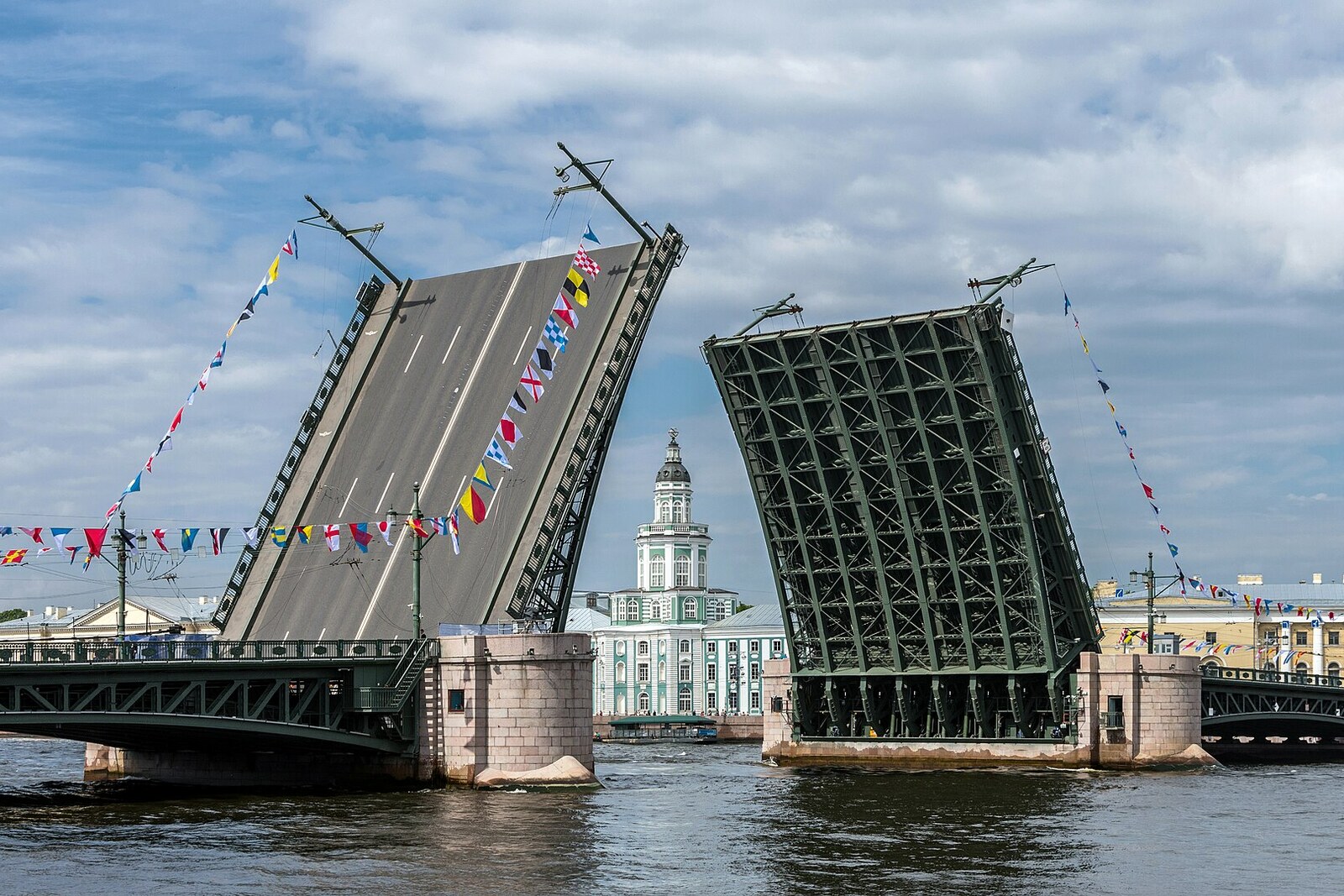
Look around first
What to notice
- The two leaves of the draw span
- The central joint between the leaves
- Riveted metal structures
- The bridge railing
The story of the place
The two movable leaves in the middle of Palace Bridge close together so that by day the crossing carries the city's traffic as a single arch. Shafts with counterweights are hidden inside the piers: at night they descend, clearing the passage for ships, while the leaves rise. The fixed parts are assembled from riveted metal; the later railing merely conceals this working structure. The bridge's height was deliberately kept low so that it would not compete with the line of the Winter Palace, the Main Admiralty, and the Stock Exchange along the banks.
This crossing appeared at the request of people who needed to cross the Neva every day on business. In eighteen fifty-three, representatives of Saint Petersburg's merchant community asked Nikolai I to move the floating St. Isaac's Bridge here. They wanted a direct route from the city center to the Stock Exchange and the institutions of the Commercial Port on Vasilevsky Island. Three years later, wooden pontoon barges were placed between Palace Passage and Exchange Square.
The crossing was moved to its present alignment in eighteen ninety-six. On April twenty-first, eighteen ninety-nine, two pontoons began to leak. Workers closed the roadway, started pumping out the water, and summoned steamships with pumps. The first pontoon sank within fifteen minutes, and by one thirty six were already lying on the bottom. The bridge was restored, but the City Duma no longer wanted to leave a commercial route on old wooden vessels.
A permanent crossing had to be combined with a navigable river. Carriages and trams were to cross it by day, while at night the passage had to be cleared for ships. At the same time, the engineers were instructed to preserve the low line of the Neva embankments: the Winter Palace, the Main Admiralty, and the Stock Exchange already stood nearby. Over eight years, fifty-four designs were submitted to competitions. The commissions found individual solutions interesting, but accepted none of them as a whole.
In the final competition, Andrei Pshenitsky, an engineer with the Department of City Bridges, presented the Society of Kolomna Works design. He sought to make a heavy permanent bridge open in the middle of the wide river and, once closed, become a rigid structure again. Pshenitsky divided the central span into two leaves. In the lowered position, they locked together and carried the load as a three-hinged arch. To open the bridge, workers disengaged the connections, while counterweights descended into wells inside the piers and helped raise both halves. The commission selected this design in nineteen oh nine. The calculation for the draw span earned Pshenitsky an academic title at the Institute of Railway Engineers.
Architect Robert-Friedrich Meltzer wanted to place four enormous lantern towers around this mechanism. Elevators for electrical workers were planned inside them; outside there were to be crowns, sculptures, and wrought-iron decoration. The towers would have been taller than the Winter Palace. At an expert commission meeting in nineteen thirteen, architect Alexander Ghibert demanded that they be removed. The clients agreed, then approved a simplified design.
A flood and World War I delayed construction. In December nineteen sixteen, thirty-four trucks, each weighing more than nine and a half tons with its load, simultaneously occupied all the spans. The structure held. A week later, traffic was opened across the bridge, although wooden railings, plywood parapets, and temporary lanterns stood in place of the planned decorations.
Now, in its closed position, the bridge continues the route from Palace Passage to Vasilevsky Island. During the navigation season, a drawbridge crew clears the central passage for ships: the counterweights descend and the leaves rise. Meltzer's towers never appeared here, the current railing was installed later, and the fixed spans still retain the riveted metal structures tested by those thirty-four trucks.
Useful on site
Pedestrian passage is open outside technical and navigation closures. In 2026, the regular drawbridge schedule: 01:10–02:50 and 03:10–04:55; the operational schedule may change.
Checked: June 24, 2026. Check the official source before visiting.View the structure from the sidewalk or the embankment. Do not expect to see the bridge opening without checking the current schedule.