 Guide On Map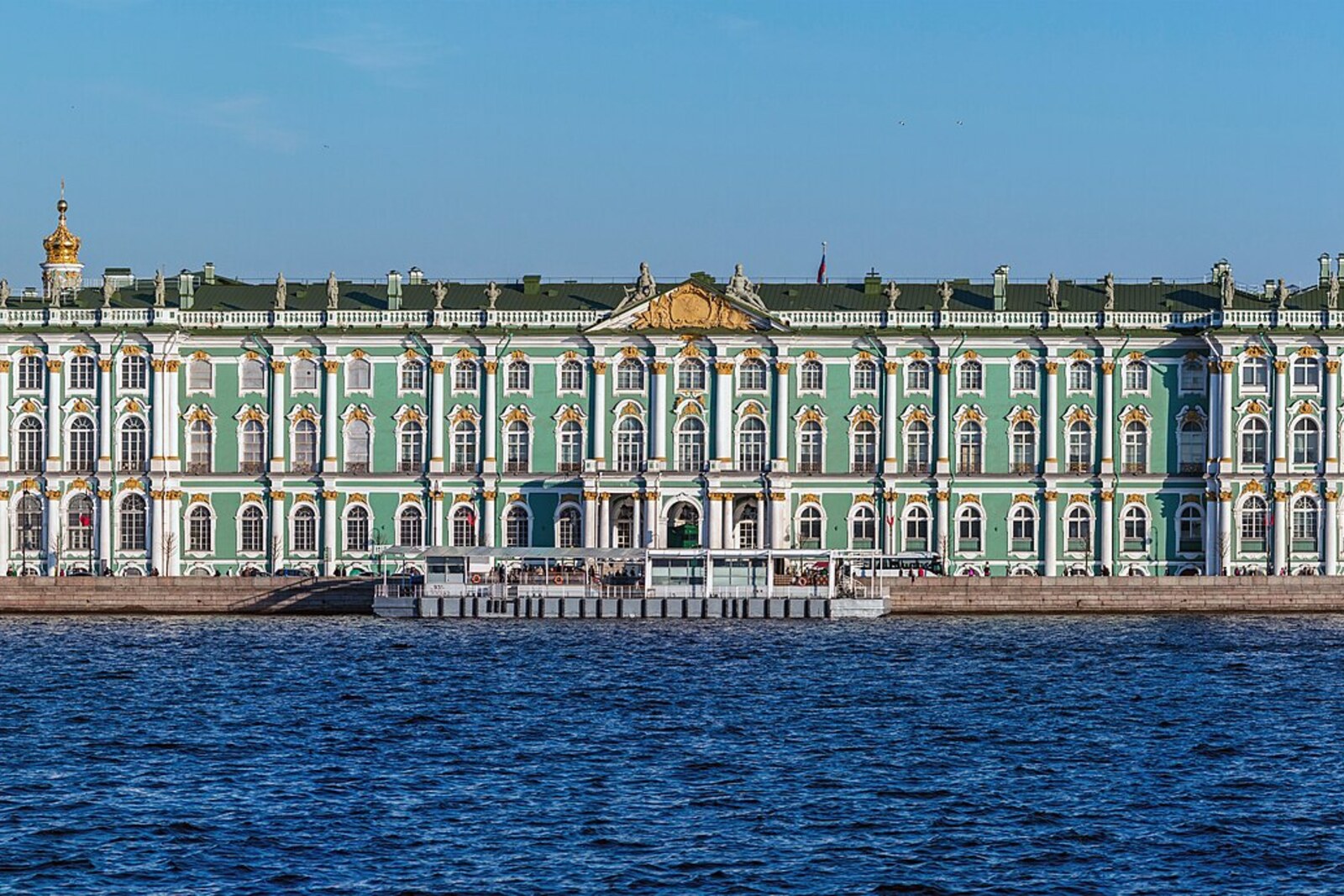
Look around first
What to notice
- The Neva façade of the Winter Palace
- The eastern end of the palace
- The neighboring Hermitage buildings
- The Neva in front of the palace
The story of the place
The façade of the Winter Palace facing the Neva retained Rastrelli's composition. Behind it, the ceremonial halls stood alongside kitchens, storerooms, a pharmacy, and workshops; around three thousand people lived and served here at court. Many stoves heated this entire household, while its safety was watched over by its own fire brigade. The main walls and some exterior details survived, although most of the rooms behind the façade were created later.
Beyond the eastern end of the Winter Palace stretch the other buildings of the Hermitage. Today they form a single museum, but in eighteen thirty-seven they were separate parts of the imperial household: the monarch's family lived here and court ceremonies took place, while the art collection was kept next door. The palace was called the Winter Palace because the court moved here for the cold season from its country summer residences.
Together with the family, courtiers, and servants, around three thousand people were here. They were served by kitchens, storerooms, a pharmacy, workshops, and their own fire brigade. This entire vast household had to be heated by many stoves.
Two days before the fire, smoke was noticed near the Field Marshals' Hall. Firefighters checked the attic and the chimneys and doused the suspicious spot with water. In the basement, they found smoldering matting, pulled it out of an opening in the chimney flue, and decided that the source had been eliminated. Captain Shchepetov, commander of the palace fire brigade, was responsible for the safety of the residence; that evening, he reported that there was no longer any danger.
Within minutes, the smoke returned. When the duty staff began opening up the parquet floor and a false door, flames burst from the void behind the wooden wall. The fire had already traveled inside the structural floors and reached the attic. The investigative commission never did name a final cause of the fire, but Shchepetov was dismissed because his team had not stopped the fire at the very beginning.
Emperor Nikolai I, whose family lived in the palace, arrived from the theater and summoned the Guards regiments. Soldiers and palace staff carried out everything that could still be lifted: portraits of military commanders from the Military Gallery, thrones, church vessels, regalia, furniture, and paintings. The rescued items were piled up on Palace Square around the Alexander Column.
By morning, it was clear that the interiors of the Winter Palace could not be saved. Nikolai then ordered the fire cut off from the Small Hermitage, where the collection was kept. Soldiers dismantled the covered passage between the buildings, bricked up the exposed doorways, and continuously doused the masonry with water brought from ice holes in the Neva. The Winter Palace burned out, while the Small Hermitage and its paintings survived.
The imperial family lived in another palace for almost two years. Vasily Stasov, the architect tasked with restoring the ceremonial halls, and Alexander Bryullov, who restored the residential apartments, were given a deadline calculated for the court's quickest possible return. In the autumn of eighteen thirty-nine, Nikolai's family moved back in here.
The main walls and some exterior details survived the fire, so the Neva façade retained Rastrelli's composition. Most of the rooms behind it were created after the disaster. Today, the Winter Palace and the Hermitage buildings saved then are connected by a museum route; that night, one dismantled passage left the burned-out residence to the west and the undamaged collection farther east.
Useful on site
Exterior viewing is available from the city embankment; the museum entrance and a visit to the Hermitage are not included in this route.
Checked: June 24, 2026. Check the official source before visiting.No entrance to the Hermitage is required for this stop. Listen from the embankment, without lingering on the roadway or near service passages.