 Guide On Map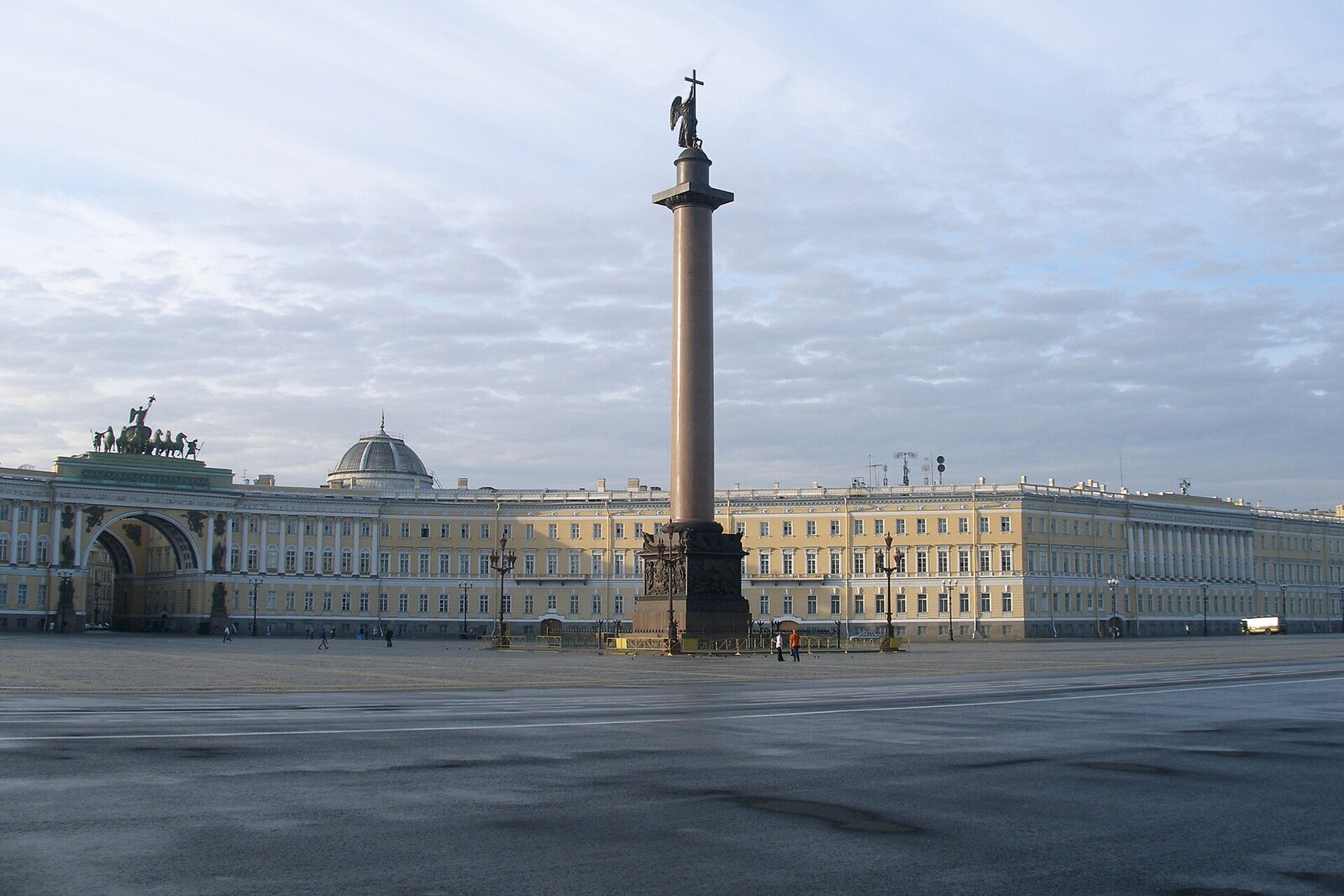
Look around first
What to notice
- The granite shaft of the column
- The angel with a cross
- The bronze reliefs of the pedestal
- The inscription on the Winter Palace side
The story of the place
On August thirtieth, eighteen thirty-two, the center of Palace Square was occupied by wooden scaffolding as high as a multistory building. Inside lay the solid shaft of the future column—almost six hundred tons of red granite. The French architect Auguste de Montferrand was responsible for turning this stone from its horizontal position in a single lift and setting it precisely on the pedestal.
The commission came from Emperor Nikolai I. He wanted to commemorate his late elder brother, Aleksandr I, under whom the Russian army repelled Napoleon's invasion and ended the war by entering Paris. That is where the column's name comes from. On the side of the pedestal facing the Winter Palace, it says so directly: “To Aleksandr I from a grateful Russia.”
The square in front of the imperial residence was chosen for the monument. It is called Palace Square specifically because of the Winter Palace. Opposite it, Carlo Rossi had already built the arc of the General Staff Building with a triumphal arch commemorating the victory over Napoleon. Nikolai wanted to fill the empty center with the same theme. Montferrand first proposed an obelisk, but the emperor demanded a column—taller than the Vendôme Column in Paris, erected in honor of Napoleonic victories. The French architect was to build in Saint Petersburg an answer to the Parisian monument.
Sixty capstans—manual winches with vertical drums—were installed around the scaffolding. Soldiers and workers pushed the handles; sailors above watched the pulleys and ropes. About two thousand five hundred people took part in the lift altogether. A surgeon was stationed by the scaffolding in advance. Montferrand needed not an isolated burst of strength, but the synchronized pace of dozens of teams: if one rope slackened, the load shifted to neighboring ones.
A surviving description of the lift records the moment when the operation nearly fell apart. As the column was lifted from its cart, three capstans stopped because the pulleys had become tangled. One of the upper pulleys burst and fell down into a group of people. Confusion began, yet the teams at the neighboring winches continued at an even pace. The others returned to their positions, the ropes were tightened again, and the granite shaft was slowly turned above the square. Then stonemasons guided it to the base and lowered it onto the pedestal.
When the column was standing, Nikolai I announced before those assembled that Montferrand had immortalized himself. The work, however, continued for another two years: the granite was polished, the pedestal was covered with bronze reliefs, and the sculptor Boris Orlovsky created an angel with a cross. At the imperial family's wish, the angel's face was given the features of Aleksandr I. In September eighteen thirty-four, the monument was unveiled with a military parade—the square before the palace received the ceremonial center for which Nikolai had begun the construction.
The granite shaft is still not attached to the pedestal in any way. It is held in place by its own weight. Above it stands the angel with the face of Aleksandr I, and beneath it remains the spot where two thousand five hundred people lowered the monolith after a pulley had snapped and three capstans had stopped.
Useful on site
The square is usually accessible around the clock; concerts, parades, and the setup of city events may temporarily close off individual areas.
Checked: June 24, 2026. Check the official source before visiting.There is little shelter from wind and sun in the square; watch the movement of people and temporary barriers during events.