 Guide On Map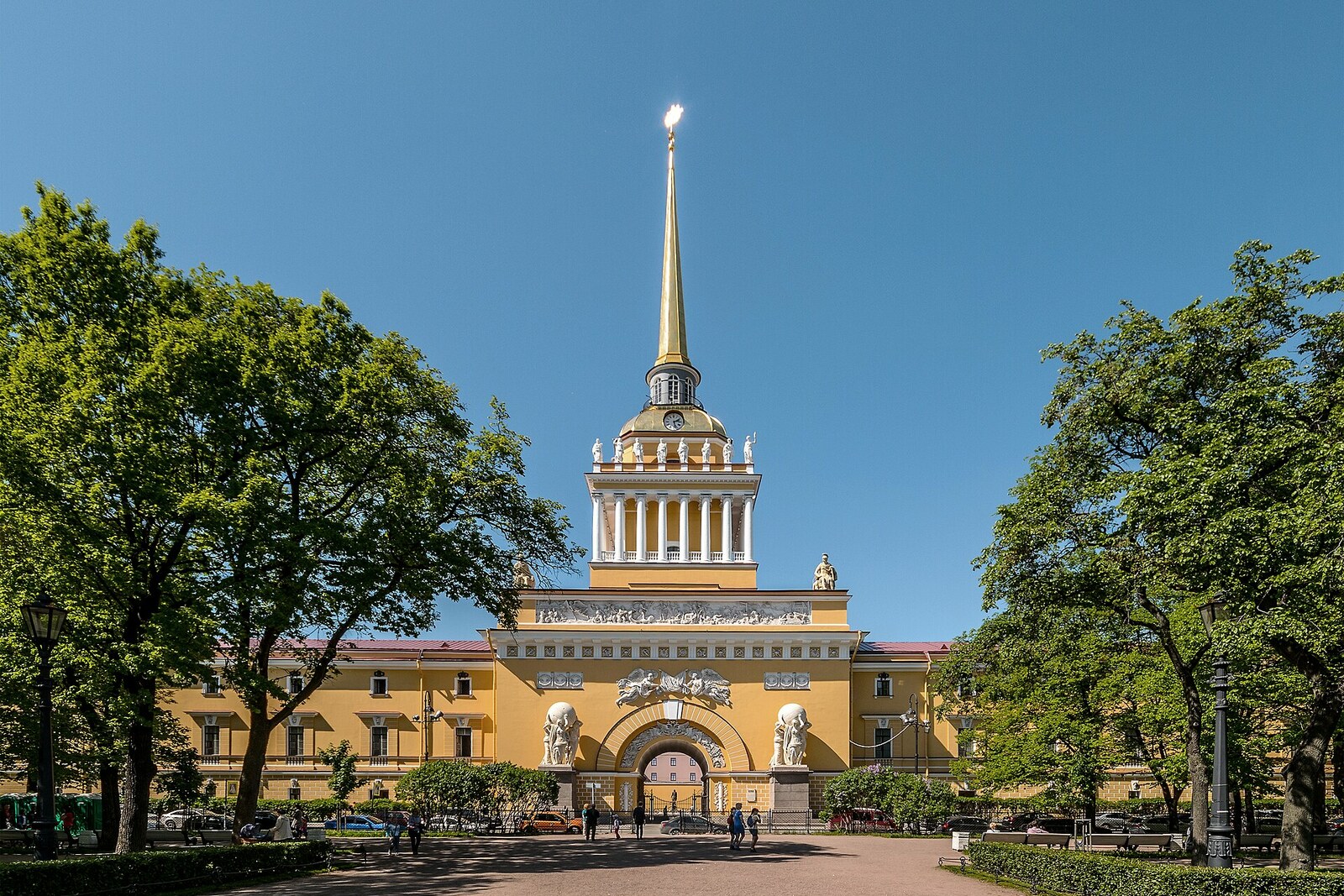
Look around first
What to notice
- The spire with its little ship
- The buildings around the inner courtyard
- The Neva in front of the facade
The story of the place
At the beginning of the eighteenth century, an admiralty was a state shipyard together with workshops, warehouses, and offices. The Saint Petersburg Admiralty became the Main Admiralty when the construction of large Baltic Fleet ships and the administration of the naval department were concentrated here. The yard opened onto the Neva: inclined slipways stood right by the water, from which completed hulls were launched directly into the river.
Pyotr I chose the site after a dangerous crossing in the autumn of seventeen oh four. He was leading fifty vessels to Saint Petersburg, built on the Svir River and the Syas River. A storm scattered the convoy on Lake Ladoga. Pyotr himself spent six days making his way to Shlisselburg, then waited another three days for the vessels that had fallen behind. After that, he decided to establish the main shipyard for the Baltic closer to the sea. Here the Neva was wide enough to launch large ships.
On one of the slipways here, Pyotr began his last ship. In seventeen twenty-three, he laid down the first ship of the line in the Russian Navy, designed for one hundred guns. Ships of the line were large sailing vessels that formed up side by side in battle; first rank meant the largest class. Pyotr drew up the plans and supervised the construction as a master shipbuilder, not as an honorary client. In working documents, he used the name Pyotr Mikhailov.
His chief assistant was Fedosei Sklyaev, a master shipbuilder to whom Pyotr entrusted the calculations and the keeping of the ship's plans. Sklyaev had served at the Admiralty Shipyard since its earliest years and earned nearly one thousand four hundred roubles a year for shipbuilding work, more than any other Russian shipbuilder. This income allowed him to maintain his own stone house on the Neva. When Pyotr died in seventeen twenty-five, the hull remained unfinished.
The Admiralty Board, which managed the navy, ordered the work transferred to the English master shipbuilder Richard Brown. He was to receive Pyotr's plans and bring the ship to its launch. Sklyaev refused to hand over the papers: he pressed for Pyotr's final project to be completed by the masters who had already worked with Pyotr on this slipway.
The dispute reached the ship itself. Filipp Palchikov, a shipbuilder's apprentice to whom Pyotr had entrusted part of the work, stood at the gangway and did not let Brown board. For this, the board deprived Palchikov of one third of his annual salary. Sklyaev was summoned to a meeting, but he declared himself ill, then cited watch duty and again refused to leave the ship. He never handed over the plans. In the end, Sklyaev was granted permission to complete the ship on his own.
On June twenty-ninth, seventeen twenty-seven, the hull slid from the slipway here into the Neva. By then, Pyotr's eleven-year-old grandson had become emperor, so the ship was named “Pyotr I and II.” Sklyaev lived to see the work completed and died the following year.
The ship had time to go on a combat campaign and in seventeen thirty-four took part in the naval blockade of Danzig, present-day Gdańsk. Two years later, lightning struck its mainmast. A fire broke out; the crew saved the hull by cutting down the burning mast together with its rigging, but the vessel never went to sea again. Pyotr's daughter, Empress Elizaveta Petrovna, ordered her father's ship preserved in a special dock. The wood continued to deteriorate, and in seventeen fifty-two the hull was dismantled.
The little ship on the spire has nothing to do with it: the first such weather vane was installed four years before the ship of the line was laid down. Pyotr I and II itself stood where the present-day buildings surround the inner courtyard, with its bow toward the Neva; not even a reliable image of it remains.
Useful on site
Viewing is from outside only at any time; the building serves as the Main Staff of the Navy and is not a stop with public access.
Checked: June 24, 2026. Check the official source before visiting.The story is intended for viewing from outside; move far enough away from the building to see both the spire and the long wings at once.