 Guide On Map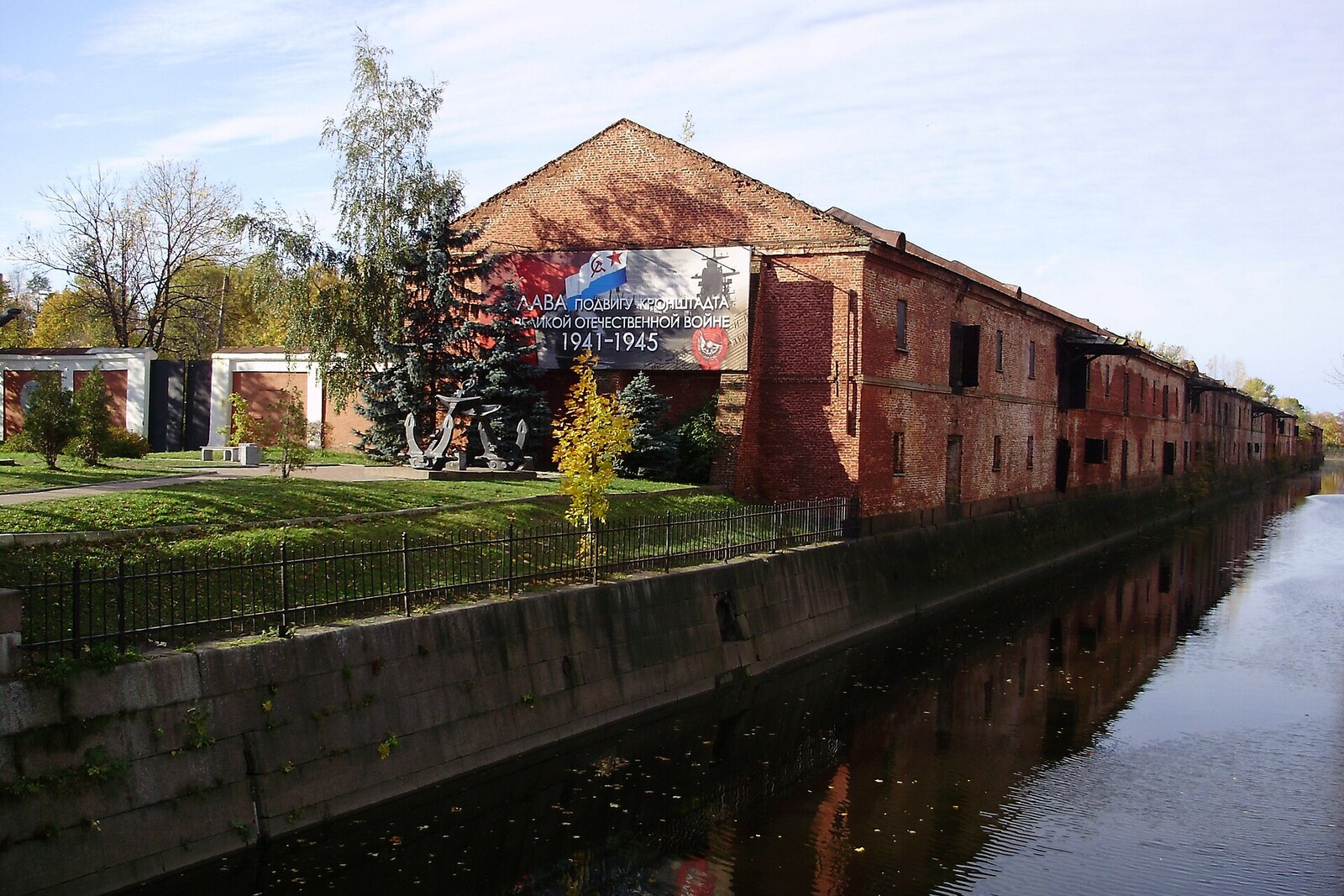
Look around first
What to notice
- Granite channel of the canal
- Long brick walls
- Provision warehouses
- Unplastered brickwork
The story of the place
Long red walls stretch along the granite channel of the Obvodny Canal: these buildings housed naval operations with workshops, warehouses, and factories. On the inner bank, sailmakers and rope makers, blacksmiths, and tar workers were at work, while timber and provisions were stored; a ship could be repaired, fitted out, and supplied without leaving the island. Barges came to the warehouses along the canal, while the water separated fire-hazardous work from the residential town; outside, the site was left open, fenced, and guarded. The exposed red brick was preserved by a direct requirement to economize: instead of plaster and decoration, builders were ordered to save money and build for durability.
On June seventeenth, seventeen eighty-three, a commission of naval commanders inspected Kotlin Island and selected this site by Petrovsky Dock. Admiral Samuil Greig, the chief commander of the Port of Kronstadt, was to place here the services on which the repair and supply of the Baltic Fleet depended.
Greig had seen the reason for such a relocation a month earlier in St Petersburg. On May thirteenth, wooden buildings of the St Petersburg Admiralty caught fire; the blaze threatened the nearby Winter Palace. Empress Ekaterina II, who sought to remove hazardous production from her residence, ordered the Admiralty transferred to Kronstadt fifteen days later.
At that time, “Admiralty” referred to an entire complex of operations: workshops where sails and ropes were made, a tar works, a smithy, a hardtack factory, and timber and food warehouses. For Greig, it was important to gather them beside the harbors and dock, so that a ship could be repaired, fitted out, and sent to sea on one island.
Greig proposed running a U-shaped canal around the future buildings. He placed all production facilities and warehouses on the inner bank. Outside, there were to be an open strip, a metal fence, lanterns, and sentries. The water separated fire-hazardous workshops from the residential town, made unauthorized entry more difficult, and allowed barges to come directly to the warehouses. The canal was initially called Admiralty Canal; its present name, Obvodny, became established later, when it literally encircled the vast service area.
Mikhail Vetoshnikov, architect of the Admiralty Board, was assigned to turn the admiral’s plan into buildings. He was paid for thoroughly practical work: designing workshops, employees’ housing, and warehouses that would have to withstand damp, fire, and heavy loads. The imperial instruction required unnecessary expenses to be reduced and buildings to be sturdy, undecorated, and made of unplastered brick “in the Dutch manner.” Thus, the long red walls by the canal appeared as a direct requirement to economize, not as the result of a later loss of finishing.
Vetoshnikov spent seven years on this construction site. His designs were used to build sailmaking workshops, a rope-spinning factory, servants’ quarters, and provision stores—the word “store” then meant a warehouse. He did not live to see completion: the architect died in seventeen ninety-one. Greig had died three years earlier.
Meanwhile, costs were rising, and officials of the Naval Ministry were in no hurry to leave St Petersburg. After Paul the First came to the throne, the full transfer was halted. The capital’s employees remained by the Neva, but the already-built Kronstadt factories and warehouses continued to supply the fleet.
The St Petersburg Admiralty remained beside the Winter Palace. Here, the granite channel of the former Admiralty Canal and the brick row of provision warehouses built for the relocation that never took place have survived.
Useful on site
The route is designed for exterior viewing from public streets and the embankments of the Obvodny Canal; the interior grounds are subject to separate access rules.
Checked: June 24, 2026. Check the official source before visiting.Most historical functions can be read from the quarter’s exterior layout; access inside individual buildings is not automatically assumed. View the canal from publicly accessible embankments and crossings.