 Guide On Map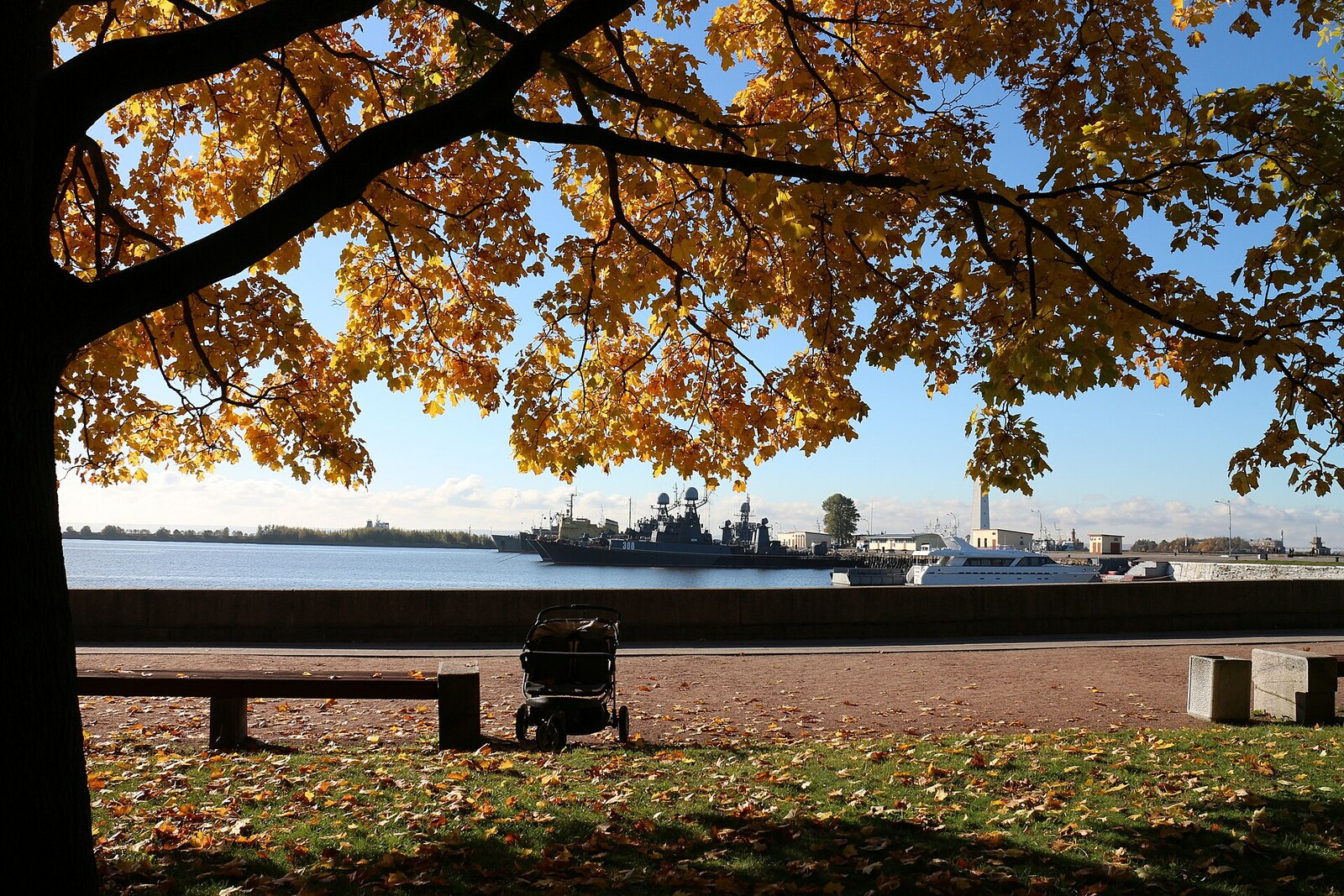
Look around first
What to notice
- Bronze figure of Pyotr I
- Swedish banner beneath the statue’s foot
- Inscription on the back of the pedestal
- Forts along the channel line
The story of the place
Petrovsky Park got its name from the bronze man on its main avenue. Pyotr I never saw this garden. This was Arsenal Square, where the garrison held drills and inspections, while the wooden Winter Pier stood by the water. In eighteen thirty-nine, Emperor Nikolai I designated the exact site for a monument to Kronstadt’s founder. Two years later, Pyotr appeared on the parade ground with a sword and a Swedish banner beneath his foot. Later, a park was laid out around the statue, and Winter Pier came to be called Petrovskaya Pier. The present granite embankment wall with steps was built in the second half of the nineteenth century.
Carved on the back of the pedestal are Pyotr’s words: “Defend the fleet and this place to the last of your strength and life, as the most important matter.” Here, “life” means life. This inscription was not originally on the monument. In eighteen eighty, the naval historian Feodosy Veselago found the phrase in an order Pyotr had given to the commander of the Kotlin Squadron and proposed placing it here instead of the Latin text.
By then, people had already carried out this order in the water before the pier. Large ships could approach Kronstadt only along several deep channels—passages among the shoals. That is why forts were placed on artificial islands along these passages. Their guns covered the water with fire, but corridors remained between the fortifications.
In early eighteen fifty-four, during Russia’s war with Great Britain and France, Academician Boris Jacobi was sent to Kronstadt to close these corridors with underwater mines. Jacobi was an electrical specialist and had spent many years testing a way to detonate a charge with current from shore. Now there was almost no time left for experiments: the British admiral Charles Napier was leading a combined squadron into the Gulf of Finland to threaten the fortress and St Petersburg.
Jacobi’s mine resembled a wooden barrel bound with iron hoops. Inside were a watertight chamber containing gunpowder and an electric detonator; the empty space was filled with tar and tallow. An anchor and a hemp rope held the charge at the required depth, while wires ran to a galvanic battery on shore. The battery was switched off to let their own ships pass. Jacobi wanted to lay three staggered rows, but the Naval Scientific Committee reduced them to two. By late April, sailors had laid one hundred five mines between Fort Emperor Alexander I and Fort Paul I. Another sixty blocked the passage by Fort Peter I and Fort Kronshlot.
Napier carried out reconnaissance, saw the forts ready for battle, and received reports of “infernal machines” under the water. He did not dare force the channels. But after navigation ended, the sailors raised the barrier and discovered an unpleasant truth: of all Jacobi’s mines, only two still had dry gunpowder, while another fifty-three had broken free from their anchors and drifted away. The threat proved more convincing than the devices themselves.
Jacobi did not conceal the failure. He required the officers working with him to report every mistake, even if he himself had caused it. Iron chambers were replaced with copper ones, the wooden outer casing with a metal one, and every part began to be tested under water pressure. In the next navigation season, three hundred one redesigned Jacobi mines were laid at sea; by autumn, the charge had become damp in only one. On the northern channel, British reconnaissance steamships struck contact mines of another type and were damaged. A new combined squadron also chose not to enter between the forts. Throughout the war, Kronstadt was not attacked from the sea.
The underwater rows before Petrovskaya Pier have long been gone. Above the water remain Fort Peter I, Fort Kronshlot, and Fort Emperor Alexander I—the very fixed points between which the sailors ran wires and lowered charges. And behind the bronze Pyotr, the words about defending “this place” are still displayed.
Useful on site
The park and waterfront are freely accessible; the operator marks Winter Pier as temporarily unavailable for water transport.
Checked: June 24, 2026. Check the official source before visiting.The forts are far away, so do not expect to make out their construction without optical equipment. The pier is exposed to the wind; in bad weather, stay by the memorial and shorten your waterfront viewing.