 Guide On Map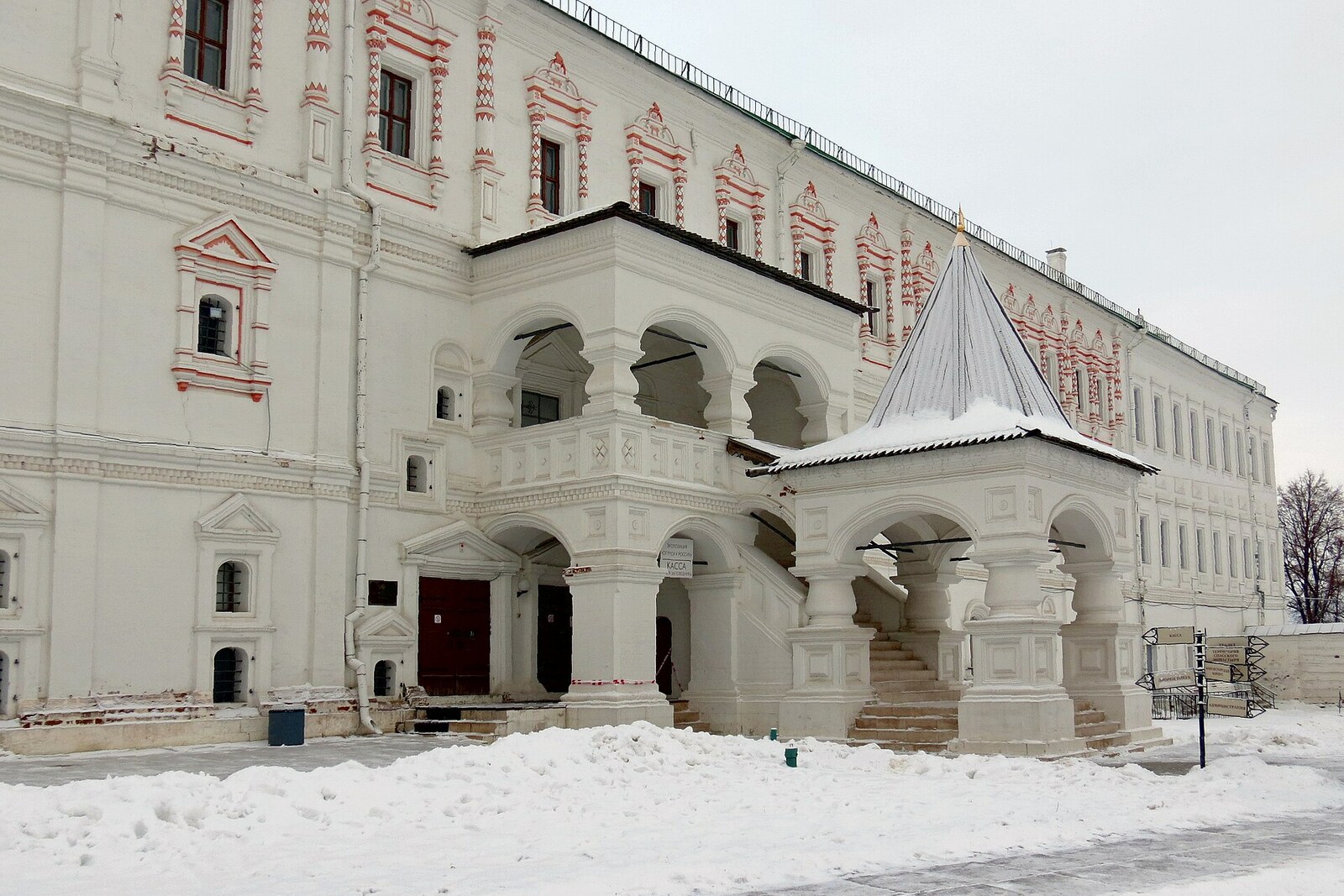
Look around first
What to notice
- Red-and-white window surrounds
- Eleven windows on the southern facade
- Two interior portals
- Western pediment
The story of the place
Ryazan's church leaders maintained their court here for almost two and a half centuries: their chambers, service rooms, household facilities, and a small church stood side by side in one elongated house. The third floor and common roof brought the house's disparate parts together into its present form. The red-and-white window surrounds reappeared after restorers extracted surviving fragments of the old decoration from later masonry.
The name promises a princely residence, but Oleg Ivanovich never lived in this building. The Grand Prince of Ryazan died in fourteen oh two, while the stone chambers appeared two and a half centuries later. Archaeologists only suppose that a princely court once stood on this site. Oleg's name became attached to the house because of his portrait on the western pediment. The image itself has been lost.
After the fire of sixteen forty-seven, Bishop Misail ordered a new residence to be built here. It was meant to combine the bishop's living quarters, rooms for his court, household services, and a house church. Thus the long Oleg's Palace arose, used by Ryazan's church leaders for almost two and a half centuries.
The appearance by which it is recognized today was created and reassembled by people separated by three centuries. In sixteen ninety-two, Grigory Mazukhin set to work—a native of the Kostroma peasantry who earned his living through stone-building contracts. He added a third floor, dismantled the dome of the house church, and covered its vault with a common roof. Mazukhin framed the windows with carved white stone, and craftsmen painted individual details with red lead.
In the nineteenth century, almost all these windows were altered, the openings were shifted, and the old portals were destroyed. By the middle of the twentieth century, the architect-restorer Irina Ilyenko had to decide which of the building's several appearances to restore and how to prove every reconstructed detail. A mistake would have turned scholarly restoration into a fantasy about the seventeenth century.
In nineteen sixty, Ilyenko found authentic traces of red-lead paint on the western facade and restored some of the windows. Five years later, the architect Elena Odinets continued the work. When masons opened the masonry that had filled the old openings, they found inside the chopped-off tops of window surrounds, white-stone brackets, and pieces of molded stringcourses. Some details preserved the same red paint. From these fragments, the restorers returned eleven windows to the southern facade and two interior portals.
The red-and-white window surrounds in front of the building show the result of their work. There was no basis on which to restore Oleg's portrait, so the prince remained only in the name. Museum exhibitions are now held in the former bishops' chambers, while outside you can see windows whose shape was recovered from nineteenth-century masonry.
Useful on site
Exterior viewing is free. Exhibitions: 10:00–18:00, ticket office until 17:15; closed Monday, last Wednesday of the month is for sanitation.
Checked: June 24, 2026. Check the official source before visiting.Exterior viewing is independent of the museum schedule; plan the exhibition inside as a separate visit.