 Guide On Map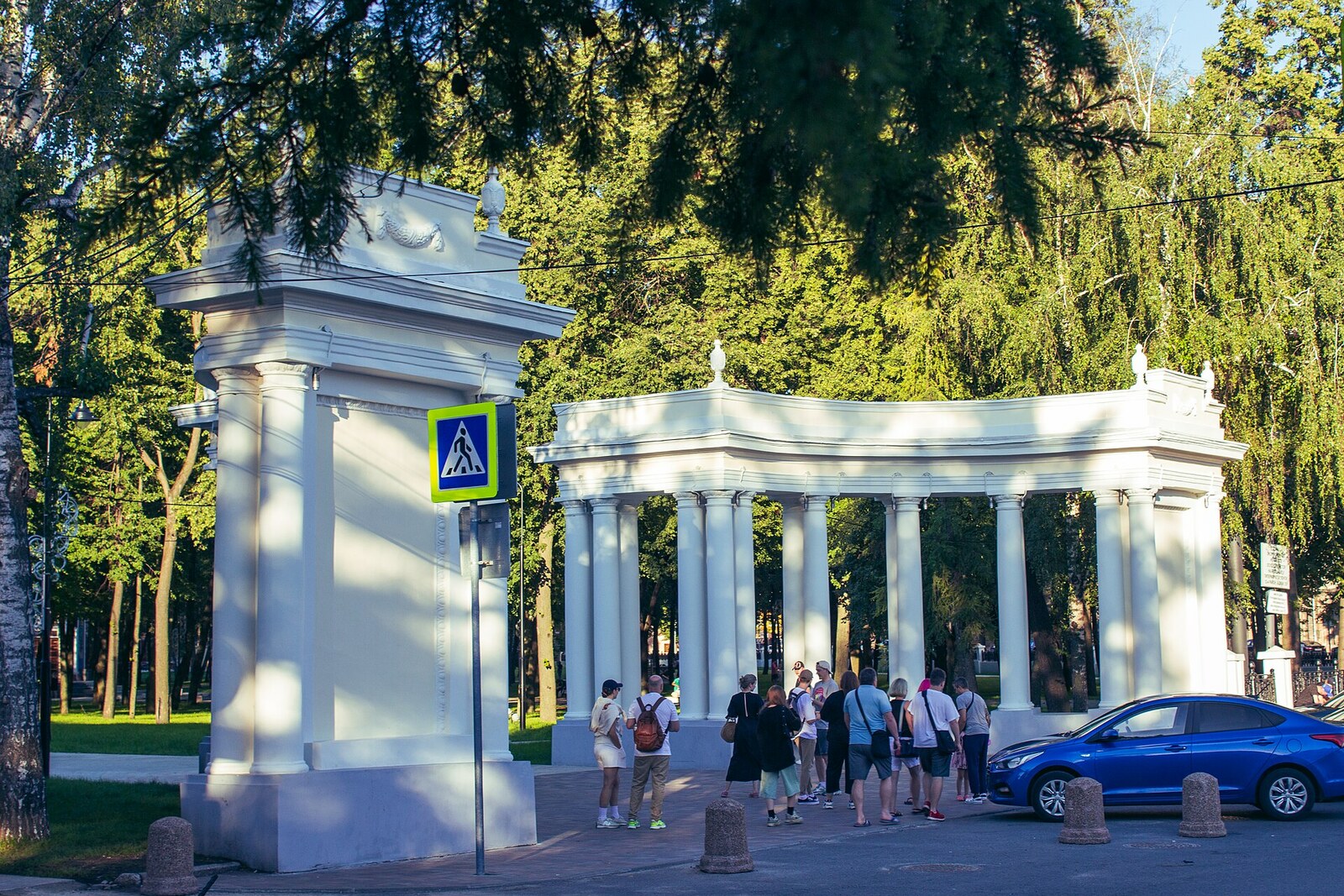
Look around first
What to notice
- The equestrian monument to Oleg Ivanovich
- The government offices building
- The stone entrance to Cathedral Park
- The central avenue
The story of the place
At the edge of Cathedral Park stands a long four-story building, while the avenues conceal the fact that this was once an open space much wider than it is today. The square was laid out in front of the road to the Ryazan Kremlin, and its main building was allocated for a shared office where complaints were heard, court cases were handled, taxes were collected, and orders were carried out. Later, the old two-story building was given extra floors when a shoe factory operated in it, and a stone entrance to the park appeared nearby.
The mounted figure in the center of the square is Grand Prince Oleg Ivanovich, ruler of the Principality of Ryazan in the second half of the fourteenth century. During his rule, Pereyaslavl-Ryazansky—what present-day Ryazan was called at the time—finally became the capital of Ryazan Land. The medieval city lay ahead, beyond today's park. The square around the monument appeared almost four hundred years later.
Under the general plan of seventeen eighty, a straight street was laid from the commercial center to the Ryazan Kremlin, and space for provincial institutions was set aside in front of its entrance. The square was first called Ilyinskaya Square, after the Church of Elijah the Prophet that stood at its edge. Its current name links it with Cathedral Street, which ends at Assumption Cathedral.
Of this grand plan, they managed to build a long, two-story government offices building. This was the shared building for provincial officials: complaints were heard here, court cases were handled, taxes were collected, and the governor's orders were carried out. In the summer of eighteen fifty-nine, these offices were deciding whether the death of a serf child would remain unnoticed.
Ryazan's vice governor at the time was the thirty-three-year-old writer Mikhail Saltykov-Shchedrin, already publishing under the name Shchedrin. The vice governor was the province's second-ranking leader after the governor and was responsible for the day-to-day work of the offices. Saltykov earned his living as a civil servant and spent twelve hours here, including on holidays: when he arrived, the monthly reports listed up to two thousand unprocessed documents.
On September twenty-seventh, two brothers—fourteen-year-old Ivan Afanasyev and eleven-year-old Gavrila Afanasyev—attempted to kill themselves with a table knife in a neighboring garden. They were household serfs of Colonel Kislinskaya: serfs kept at their owner's house as personal servants. The younger brother died, while the elder was saved. The boys feared further beatings from Kislinskaya and the retired Major Velyashev, who lived with her.
The chief of police did not include the incident in his morning report. Saltykov learned of it by other means, placed the chief of police under arrest, began a preliminary inquiry himself, and demanded a formal investigation from the provincial prosecutor. In his order, he specifically referred to rumors in the city of repeated torture. The tragedy itself took place in the garden, but it became a criminal case here, in the offices on Ilyinskaya Square.
The local nobility tried to prevent the matter from becoming public. Saltykov reported the case to the minister of internal affairs; through the minister, the emperor learned of it. The investigation dragged on, and in the spring of eighteen sixty Saltykov was transferred to Tver. After his departure, the uyezd court and the criminal chamber acquitted Kislinskaya and Velyashev. The Senate ordered that the cause of the brothers' act be “committed to God's will.”
Three years later, Shchedrin published the story “Misha and Vanya,” based on the materials of this case. Kislinskaya escaped punishment, Gavrila could not be brought back, but the names of the two household serf boys made it from provincial correspondence into print.
The long government offices building remains at the edge of the square. Its original section was two stories tall; two more stories were added in the nineteen fifties, when a shoe factory operated there. At the same time, avenues took over part of the former Ilyinskaya Square, and a stone entrance to Cathedral Park was built. Behind the trees, the square's former sweep has almost disappeared, while the building where Ivan and Gavrila Afanasyev's case was heard remains on its old boundary.
Useful on site
An outdoor stop without a ticket; the route is best started in daylight.
Checked: June 24, 2026. Check the official source before visiting.Choose a vantage point from which both monuments are visible: their proximity matters more than walking around each pedestal.