 Guide On Map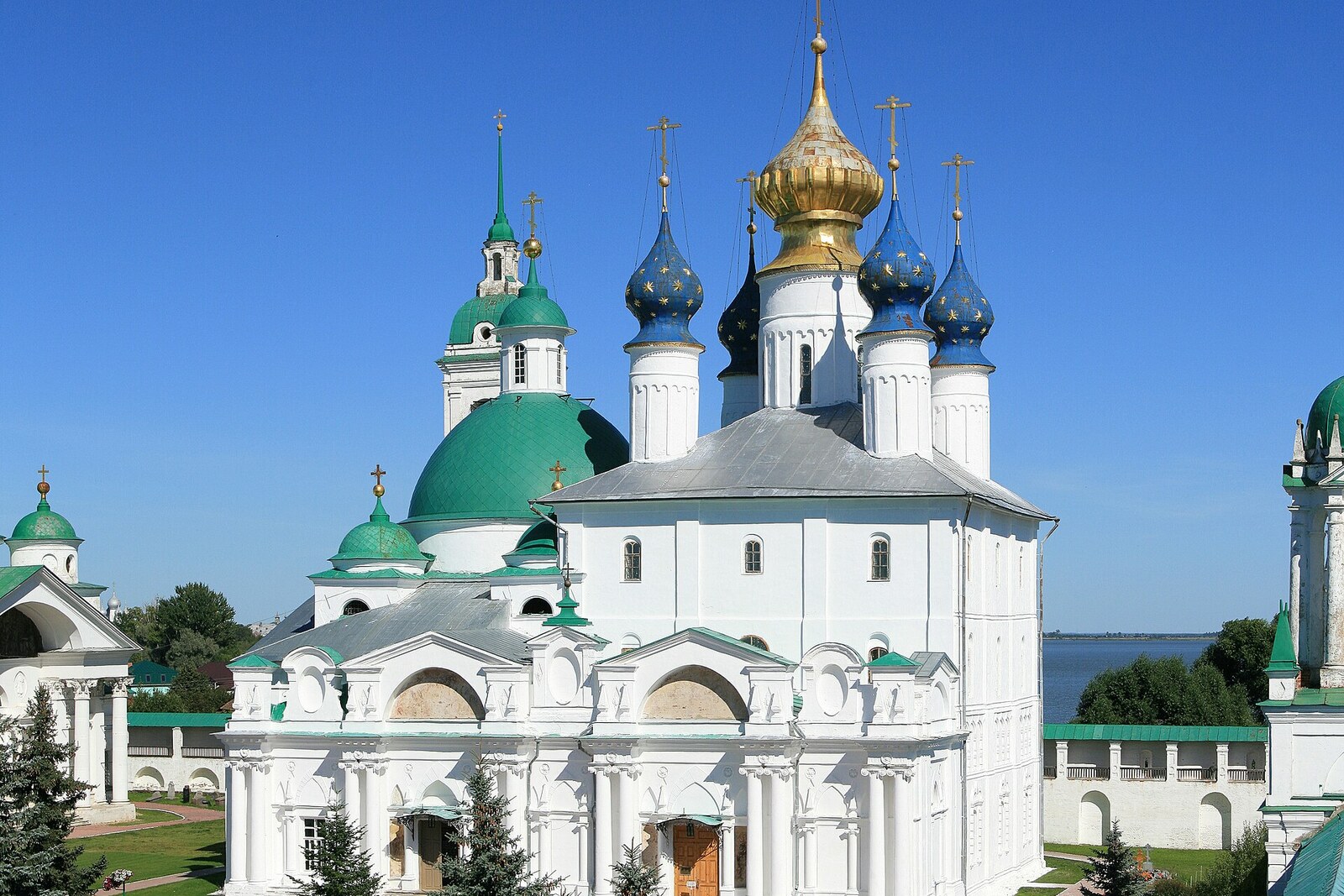
Look around first
What to notice
- Dimitrievsky Cathedral
- Conception Cathedral
- Dimitry's gilded shrine
- The monastery bell tower
The story of the place
Before the stone walls appeared on the shore of Lake Nero, there stood a wooden Church of the Conception, erected by Bishop Iakov after his expulsion from Rostov. A monastery formed around it and received his church name; his grave still lies beneath the floor of the old cathedral. The white Dimitrievsky Cathedral, bell tower, and wall appeared nearby later, while services continue in the monastery itself. Pilgrims come to both sainted hierarchs of Rostov: one rests beneath the floor, while the other's relics are kept in a gilded shrine.
In seventeen oh two, Dimitry, the new metropolitan of Rostov, came to a small country monastery on the shore of Lake Nero and indicated a place for his own grave in the old Conception Cathedral: the southwest corner. Rostov hierarchs were buried in Dormition Cathedral, beside their predecessors. Dimitry ordered otherwise and set down his choice in his will.
Iakov, the bishop of Rostov who founded the monastery here at the end of the fourteenth century, had already been buried in Conception Cathedral. The “Yakovlevsky” in the monastery's name comes precisely from the church form of his name, Iakov. Reliable information about him is scarce: he headed the eparchy, was expelled from Rostov three years later, settled on this shore, and died in the monastery he founded.
Details appeared in a hagiography composed only in seventeen sixty-two, so this is monastery tradition. According to it, a woman whom the prince and boyars had sentenced to death asked Iakov for protection. The bishop refused to hand her over to the executioners and imposed lifelong penance on her. For this, the prince and townspeople expelled Iakov himself. The same hagiography says that he laid his mantle on the water and crossed Lake Nero on it; having seen the miracle, the people of Rostov asked him to return. Iakov stayed here, erected a wooden Church of the Conception, and was buried in it. His grave has never been opened: it lies beneath the floor of the ancient cathedral, while the tombstone is installed in the adjoining Iakovlevskaya Church.
Dimitry chose the church of the exiled bishop, but did not explain the reasons for his decision. He died in seventeen oh nine. He left behind books, manuscripts, a mended cassock, and two denga—two small coins. According to Rostov tradition, the townspeople and clergy nevertheless wanted to bury their beloved metropolitan in Dormition Cathedral. His friend Stefan Yavorsky, who was temporarily leading the Russian church in place of the patriarch, came to conduct the funeral service. He insisted that the written will be carried out. Dimitry was laid in a wooden coffin in the very corner of Conception Cathedral that he had indicated.
Forty-three years later, the cast-iron floor above the grave subsided. Workers removed the slabs, cleared away the soil and crushed stone, and opened the log-lined burial vault. The coffin lid had rotted away; beneath it they found the preserved vestments and body. Arseny Matseevich, metropolitan of Rostov, came to the monastery that same day, inspected the discovery, and reported it to the Holy Synod.
Then a long investigation began. People spoke of healings at the coffin; monks recorded the testimony of illiterate pilgrims, while literate people wrote for themselves. The Holy Synod required such accounts to be confirmed by witnesses and oaths. Five years later, in seventeen fifty-seven, Dimitry was canonized.
Pilgrims and donations changed the monastery's fate. When many monasteries were being closed and stripped of their lands in seventeen sixty-four, Ekaterina II forbade the abolition of Yakovlevsky precisely because Dimitry's relics were kept here. The following year, the neighboring Saviour on the Sands Monastery was incorporated into it: the “Spaso” in the name came from its Church of the Transfiguration of the Saviour. With money from devotees, a stone wall, bell tower, and residential buildings were erected, and Count Nikolai Sheremetev paid for the large white Dimitrievsky Cathedral. In eighteen thirty-six, the Holy Synod established the full name: Spaso-Yakovlevsky Dimitriev Monastery.
Monks still hold services here, and pilgrims come to both sainted hierarchs of Rostov. Iakov's relics remain beneath the floor of the old cathedral. Since two thousand nine, Dimitry's relics have been kept in a gilded shrine in Dimitrievsky Cathedral—opposite the church in whose corner he ordered himself buried three centuries ago.
Useful on site
Active monastery; no single tourist schedule for the grounds has been published in the checked primary sources. The monastery museum offers tours by prior appointment.
Checked: June 24, 2026. Check the official source before visiting.This is an active monastery: keep quiet, observe church rules in your dress and behavior, and arrange any indoor photography on site. During services, view the architecture without passing between worshippers.