 Guide On Map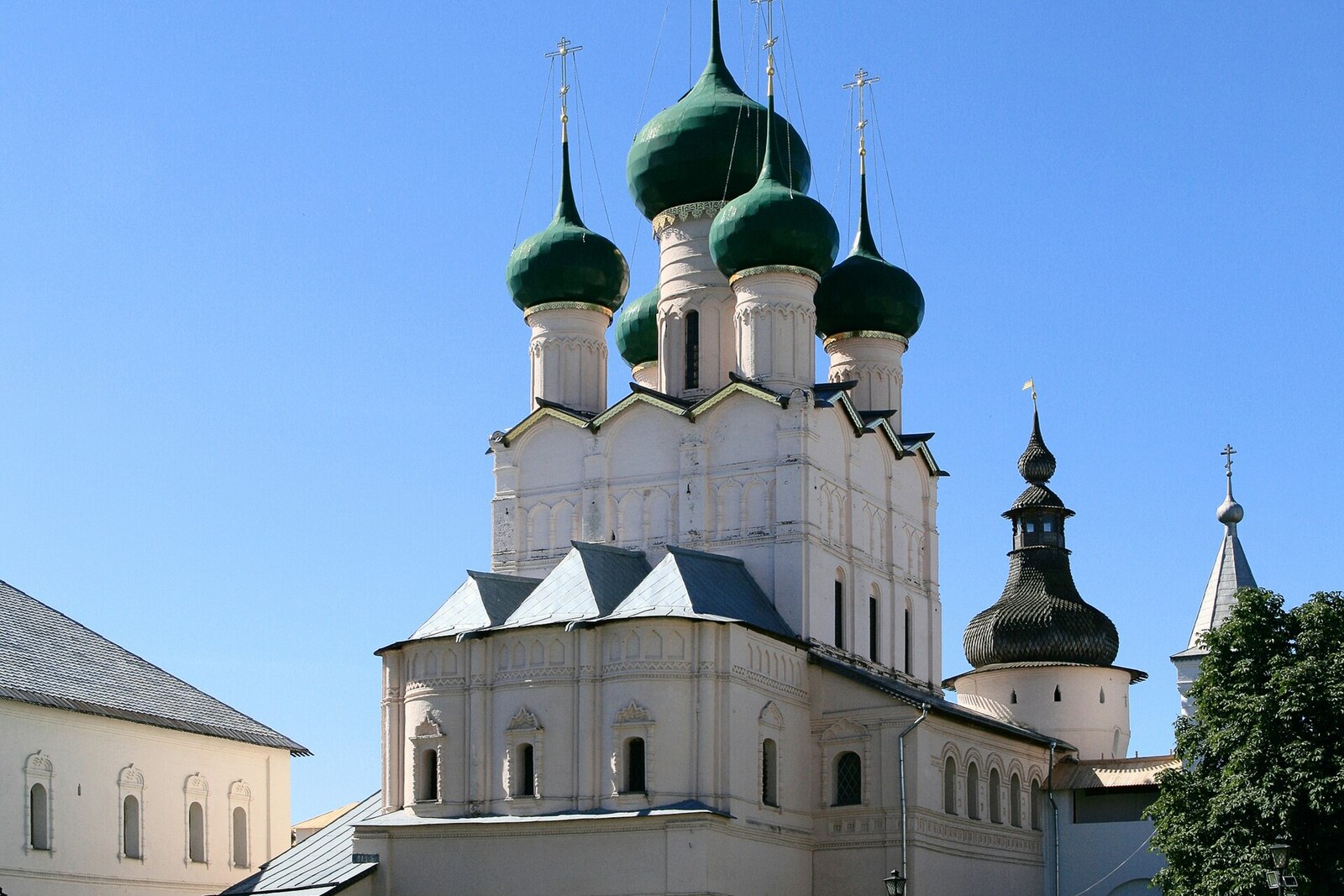
Look around first
What to notice
- Large windows above the western gate
- Vaults of the narrow galleries
- Stone staircase
- Church frescoes
The story of the place
The dedication to Ioann the Theologian came from the monastery that had previously stood on this site. Later, Metropolitan Iona Sysoyevich completed the church, raised above the western entrance in the enclosure. The frescoes inside tell of the apostle to whom church tradition attributes the fourth Gospel and Revelation. Outside, the church is visible above the gate, with vaulted galleries extending along its sides.
The narrow passageways above the walls were internal corridors of the bishop’s residence. They are too narrow for real combat, and the large windows above the gates make this part of the enclosure vulnerable. The passageways connected the chambers and churches of the metropolitan’s court; today, a museum route runs along them.
Metropolitan Iona Sysoyevich completed the church above the western gate around sixteen eighty-three. He retained the dedication of the monastery that had previously stood here. Ioann the Theologian was an apostle to whom church tradition attributes the fourth Gospel and Revelation; frescoes inside tell his story.
When the episcopal see was transferred from Rostov Veliky to Yaroslavl, services here ceased. Wine and salt were stored in the church. In eighteen oh seven, the archpriest of Dormition Cathedral, who managed the active cathedral’s household, asked for the Churches of Ioann the Theologian and Grigory the Theologian to be dismantled and their bricks used for other buildings. The Holy Synod agreed.
The Rostov town society submitted a counter-petition: the townspeople demanded that all five churches of the former metropolitan’s court be preserved and restored. The dismantling was cancelled, but the people of Rostov now had to find the money themselves for buildings that continued to deteriorate.
Eighteen years later, the town society unanimously resolved to allocate five thousand rubles from fair revenues to the Kremlin buildings for four years. The money came from shops, market trading, and merchants arriving for the fair. The Church of Ioann the Theologian was chosen first: cracks had opened in its towers and galleries, the staircase had fallen apart, and part of the vaulting had collapsed.
The estimate immediately showed that the promised five thousand would not be enough. The cheapest bid exceeded eight thousand, while an experienced contractor asked for thirteen. No one was willing to carry out the entire repair at the city’s price. The governor ordered that at least the most necessary work be done. In the summer of eighteen twenty-six, peasants and Rostov townspeople installed new domes, roofed the church with iron, and repaired the crosses. There was again not enough money for the cracked vaults of the passageways.
By the end of the century, the galleries had to be saved anew. Andrei Titov, the warden of the Kremlin churches, asked Aleksei Kekin for help—a native of Rostov Veliky who had grown wealthy through wholesale grain trading via the port of St Petersburg. Kekin gave eighteen thousand rubles. An artel of thirty masons from Vladimir worked here for two summers. They rebuilt the galleries’ vaults, ran iron ties through the load-bearing walls, and restored the stone staircase and brick floors. After the repair, the lower rooms began to be rented out, and the payments were directed toward maintaining the Kremlin buildings.
Above the western entrance still stands the church that they had intended to turn into bricks. Galleries run along its sides, their vaults paid for by a Rostov merchant with money earned from grain.
Useful on site
The church and passageways are open seasonally from early May; the grounds are open Sun—Thu 09:00—20:00, Fri—Sat 09:00—21:00, exhibitions 10:00—17:30.
Checked: June 24, 2026. Check the official source before visiting.The passageways have stairs, thresholds, and narrow sections; walk calmly, do not overtake in narrow places, and keep away from the edge. Access may be restricted in rain or strong winds.