 Guide On Map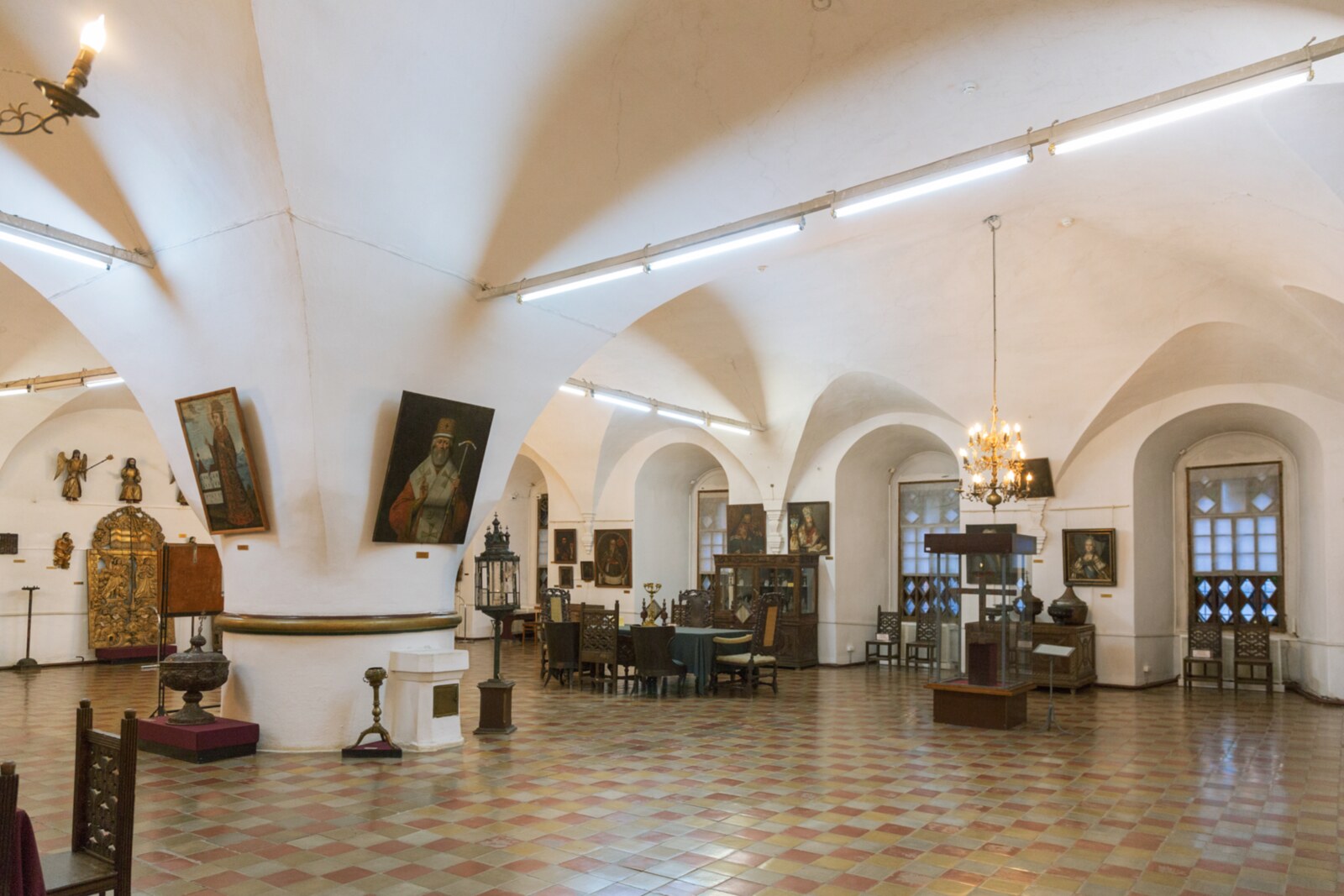
Look around first
What to notice
- Shared stone staircase
- Tiled parapets of the passageways
- Display cases in the White Chamber
- Old bookcases
The story of the place
The Church of the Saviour on the Seni, the White Chamber, and the former chambers form the upper part of the former episcopal residence. One stone staircase leads to all three premises, and covered passageways run between them; tiles are visible on the parapets, some found during excavations in the courtyard and some made from old models. Earlier, the stone connections had fallen into ruin, and only a wooden staircase remained between the upper premises. In the White Chamber, the display cases, bookcases, and part of the furniture from the end of the nineteenth century are still in place; the current exhibition was assembled from old documents and photographs.
Here, “Saviour” refers to Christ the Saviour. The church was dedicated to His Image Not Made by Hands—an image that church tradition considers to have appeared without the hand of an artist. Around sixteen seventy-five, Iona Sysoyevich, Metropolitan of Rostov, was building this part of his residence for his own worship and receptions. On the upper floor, he connected living chambers, a private church, and a large Refectory, later called the White Chamber. Between them were the seni—covered passageways and entrance rooms. That is where the church’s name comes from: the Church of the Saviour on the Seni. Below, the bakehouse and other service rooms operated; above, the metropolitan prayed, received guests, and held ceremonial dinners.
When the main residence of the Rostov bishops was moved to Yaroslavl in seventeen eighty-eight, people stopped maintaining this complex as a single household. In the middle of the nineteenth century, the wine tax farmer Bykov, who had received from the state the right to profit from the alcohol trade, placed wine and beer warehouses in half of the former Bishops’ Court. Beneath the church, his workers sank large wooden vats into the ground and washed wine vessels in them. They released the water through holes in the bottoms directly into the soil. It seeped toward the foundations of the Church of the Saviour on the Seni and the White Chamber.
After wine tax farming was abolished, the warehouses were removed, but the cellars remained occupied for a long time by an icehouse, salt, and household stores. The stone passageways between the church, the chamber, and the former metropolitan’s quarters were crumbling. In the end, only a wooden staircase remained of the former connection; in eighteen ninety-one, it too collapsed.
The Rostov merchant and historian Andrei Titov, who was seeking to establish a museum here, and Ivan Shlyakov, who undertook to restore the White Chamber, began saving the complex. Shlyakov was not a qualified architect. He graduated from a three-grade municipal school, earned his living in Moscow as an accountant in a banking office, and studied ancient architecture on his own. He directed the restoration without payment and, together with Titov, spent his own money.
Through merchant acquaintances, Titov found the main sum: the Korolyov brothers, natives of Rostov who traded in Tomsk, donated four thousand rubles. Shlyakov drew up the project, designed the windows, and spent seven months almost continuously at the construction site. On October twenty-eighth, eighteen eighty-three, Old Style, the restored White Chamber was consecrated and the Museum of Church Antiquities opened there. Shlyakov became its first curator and, for more than thirty years, collected exhibits, arranged exhibitions, and guided visitors. Titov continued to look for objects and donors.
Opening the chamber proved easier than reconnecting the entire complex. After the wooden staircase collapsed, donations were insufficient for a full repair of the Church of the Saviour on the Seni, so the restorers first restored the shared stone staircase: one staircase once again led to the church, the White Chamber, and the former metropolitan’s quarters. The parapets of the passageways were decorated with tiles—some found during excavations in the courtyard, some made from old models.
The current exhibition in the White Chamber recreates the first museum from documents and photographs, but the display cases, bookcases, and part of the furniture have stood here since eighteen eighty-three. The restored staircase and passageways once again show what the words “on the Seni” mean: this is a private church on the upper route between the metropolitan’s chambers and his refectory.
Useful on site
Summer schedule: grounds Sun–Thu 09:00–20:00, Fri–Sat 09:00–21:00; exhibitions 10:00–17:30. The Church of the Saviour on the Seni and the White Chamber are included in the seasonal route along the walls and through the interiors.
Checked: June 24, 2026. Check the official source before visiting.To understand the layout of the complex, look at the adjoining structures from outside before entering. Access to the frescoes and museum rooms depends on which exhibitions are open; do not use flash without permission.