 Guide On Map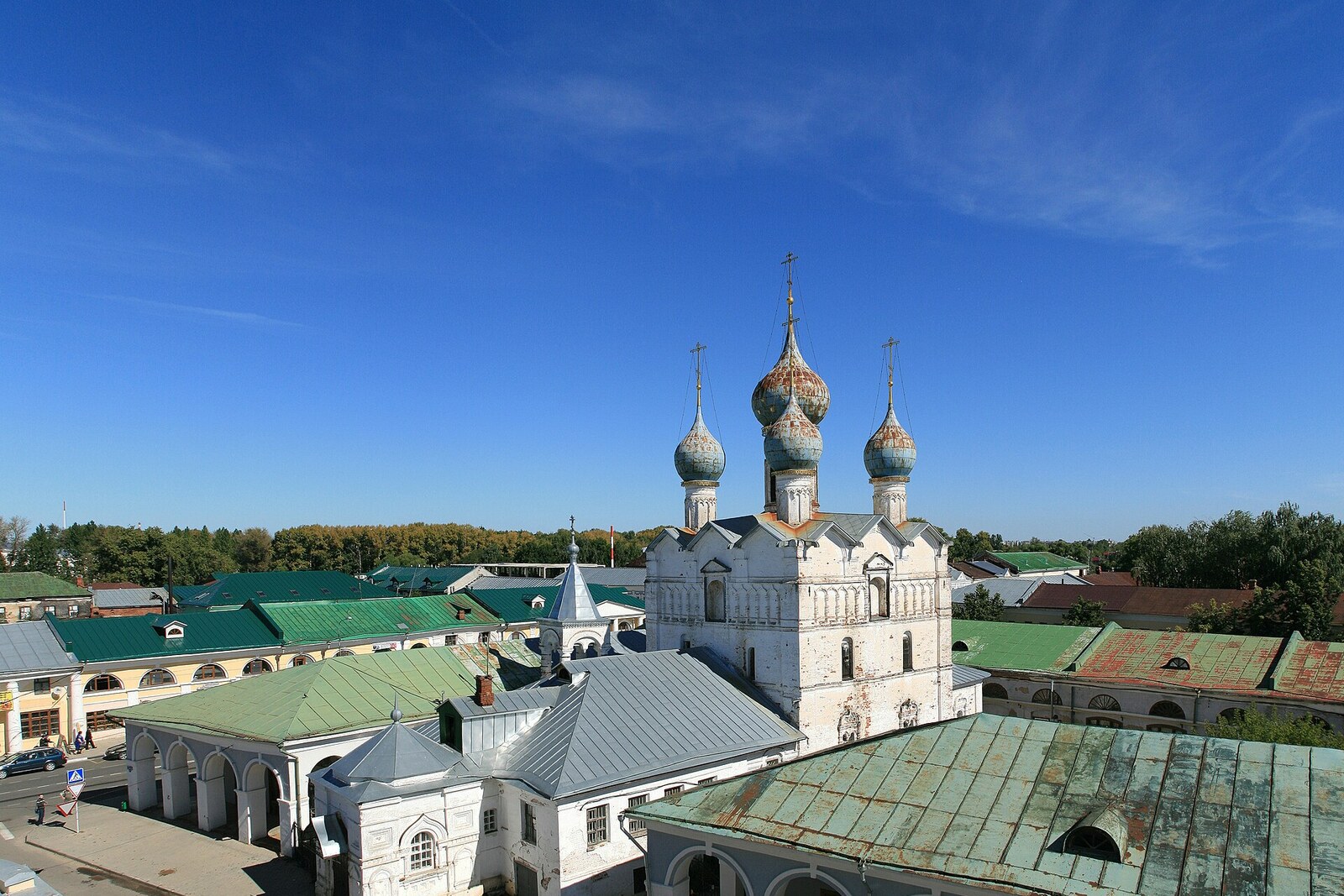
Look around first
What to notice
- The white arcades of Gostiny Dvor
- The upper part of the church above the rows
- The storage chambers of the lower tier
The story of the place
The white arcades of the Trading Rows stand so close around the church that only its upper tier can be seen above them. Below, the church has nine storage chambers: one later held the papers of the city magistracy, while the others were rented out for merchandise. The stone complex around it replaced dismantlable wooden booths assembled for the duration of the fair. Here, trade went on right beside the church, while merchants’ supplies remained in its lower tier.
In sixteen eighty-five, the elected municipal elder Fyodor Stepanov convened a public assembly of Rostov townspeople. A municipal elder was an elected manager of common posad affairs. Stepanov sought a decision that required money from people who had barely restored their households after a great fire: the Church of the All-Merciful Saviour had to be rebuilt on Market Square.
Why it had to be rebuilt was explained by a church tradition recorded by the local priest Mikhail Rzhevsky almost two centuries after the event. In sixteen fifty-four, a plague struck entire families in Rostov. The townspeople vowed to build a church in the name of Christ the Saviour if the calamity ceased. The epidemic receded, and the people of Rostov erected a wooden church here. The connection between the vow and the end of the plague belongs to tradition, but the church itself stood for seventeen years and burned down in sixteen seventy-one.
Posad people of the “best, middle, and lesser rank” came to Fyodor Stepanov’s assembly—this was how townspeople were distinguished by their wealth. They made their living through crafts and trade, paid common levies, and now had to contribute again toward the church. The assembly elected church wardens, issued them books for recording donations, and resolved to build in stone this time. The money collected was not enough.
Then the people of Rostov asked two co-ruling tsars, Ivan V and Peter Alekseyevich, and Tsarevna Sofya Alekseyevna, who managed affairs of state while they reigned, for help. They did not ask for money. Iron left over from municipal works lay in Gostiny Dvor. In sixteen eighty-nine, a tsarist charter permitted eighty poods of iron to be issued for the church, along with shovels, spades, nails, crowbars, and bolts weighing almost another sixty poods. One pood was an old measure weighing a little more than sixteen kilograms. A year later, the stone church was complete.
Trade became part of the church’s very structure. It was built above a lower story containing nine storage chambers—rooms for merchandise. Later, one of them housed the archive of the city magistracy, while the others were rented to merchants. Services were held above; below, records were kept and goods were stored. Thus, the church’s full name joins the two reasons for its appearance: the All-Merciful Saviour is Christ, from whom the townspeople asked deliverance from the plague; “on the Market Square” is an exact indication of the city’s market square.
The white arcades around the church appeared much later. Gostiny Dvor did not mean a hotel, but a complex of shops and warehouses for visiting merchants, or “guests.” From the end of the eighteenth century, Rostov society tried to replace temporary wooden booths with stone municipal Trading Rows. The booths were assembled for the fair each year and then dismantled, while the owners of private stone shops charged high rents. More than half of the five hundred fifteen such shops belonged to the Emelyanov and Serebrennikov families. When the city proposed a shared Gostiny Dvor, the owners demanded that construction be halted: without income from the shops, they faced losses. They offered to sell their premises to the city, but the price they set did not suit the people of Rostov.
Over the following decades, the townspeople discussed nine more projects. One provided for four hundred shops, but the estimate exceeded the city’s entire capital, and construction was canceled. In eighteen thirty-nine, the wooden shops around the Church of the Saviour on the Market Square burned down; the fire damaged the church roof and domes. Two years later, the present stone Gostiny Dvor was built in their place. It contained one hundred five separate shops. The builders brought the northern and western wings close to the church, so its upper part rises above the trading arcades. The storage chambers from sixteen ninety remained beneath the church: goods were put away below, worshippers went upstairs for services, and customers were received in the shops around it.
Useful on site
Gostiny Dvor states daily opening hours of 09:00—19:00; individual tenants and the church follow their own schedules.
Checked: June 24, 2026. Check the official source before visiting.The square and exterior decoration can be viewed without entering the interior. Do not linger in the passageways of operating shops, and view the tiles from a distance without touching the masonry.