 Guide On Map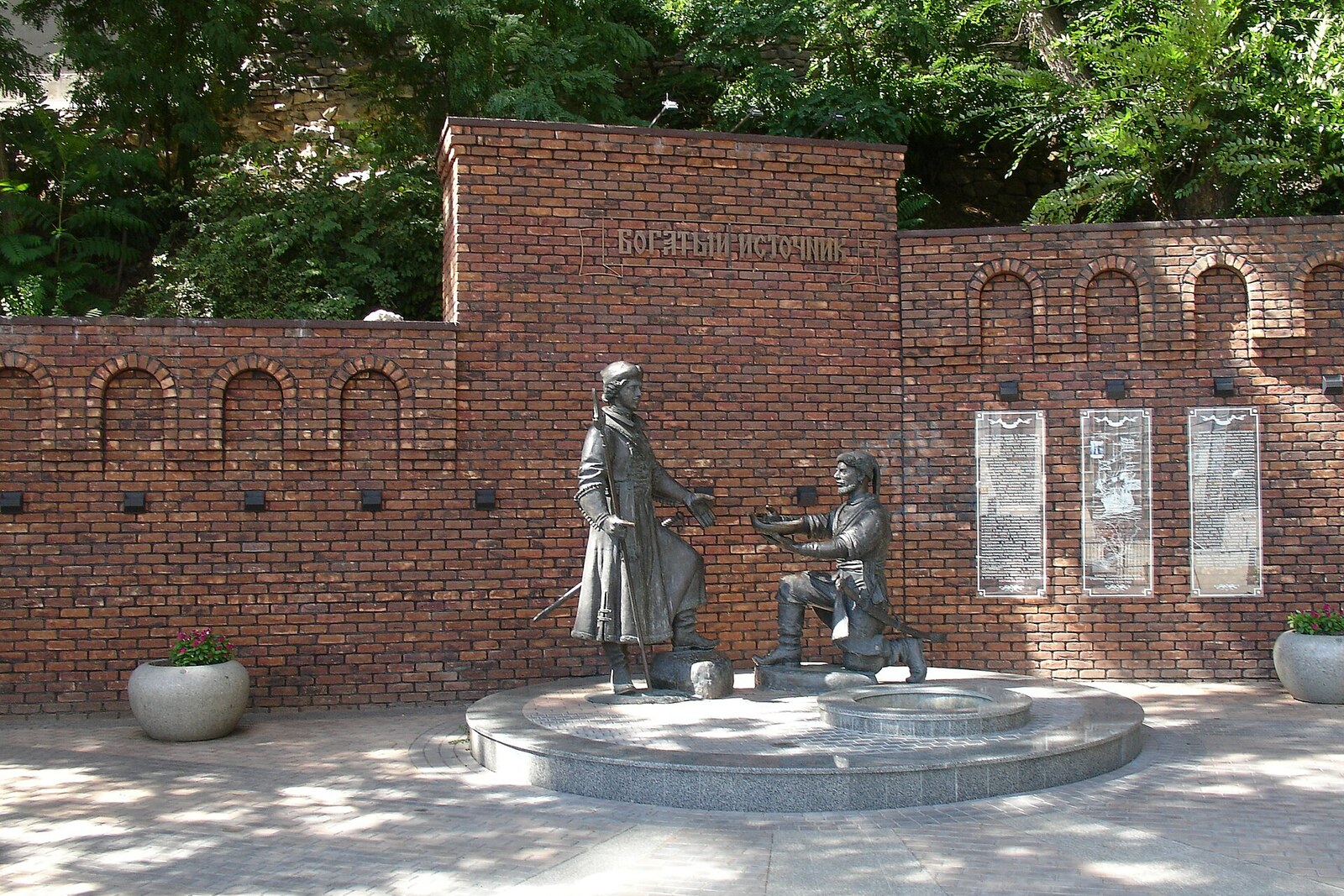
Look around first
What to notice
- Brick wall with arches
- Two bronze figures
- A bowl in an outstretched hand
The story of the place
Long before the city existed, people knew this tract with its spring at the mouth of the Temernik River. When a customs house was established nearby, traders began coming to the spring, and warehouses and houses grew up around it. In a city without a network of pipes, spring water remained especially important even in the middle of the nineteenth century. The brick arches and two bronze figures appeared here after many rebuildings of the old stone rotunda, while the spring itself now serves only technical needs.
At the brick wall, a Don Cossack holds out a bowl to the young Peter I. The sculptor Sergey Oleshnya installed this composition in two thousand eighteen, turning a city legend into bronze. According to the legend, during the Azov Campaign of sixteen ninety-five, Peter drank spring water here and called the well Bogaty. There is no documentary confirmation of this scene.
The name itself is older than Rostov. An edict of Empress Elizabeth of Russia from seventeen forty-nine already ordered that Temernitskaya Customs House be established at the mouth of the Temernik River, opposite the Bogaty Kolodez tract. Don Cossacks, Greeks, Turks, and Armenians were to come here to trade. So the officials did not have to invent a name for a new point on the map: they tied the customs house to a long-known spring. Warehouses and houses appeared around Temernitskaya Customs House, and later the Fortress of St. Demetrius of Rostov was built nearby.
By the middle of the nineteenth century, this spring was still supplying Rostov residents with water, but it had to be delivered without a citywide network. A report from eighteen forty-eight lists the Don River, wells, and Bogaty Kolodez in particular—and separately states that there were no water pipes in Rostov.
The first person to try to profit from building a water supply system was the English entrepreneur Alexander Malcolm. He received a concession—the right to build the system at his own expense and then recoup the investment through water charges—but soon died. His venture passed to the Swede Otto Vatman. The Kursk merchant Pyotr Mikhalev provided the money, the facility was put into operation in eighteen fifty-three, and just a year later it collapsed.
After this failure, Andrei Baikov took on the project. The future mayor of Rostov was seeking a permanent water supply. Together with the engineer Apollon Belelubsky and Mikhalev himself, he founded a joint-stock company. For three years they sold shares, but the money raised was not enough for construction. Baikov then persuaded his partners to liquidate the company and free up the concession for other entrepreneurs.
The risk was accepted by the trading Cossack Semyon Koshkin, the Yeisk merchant of the first guild Grigory Dmitriev, and the Rostov merchant of the second guild Timofey Kuksa. In exchange for the right to operate the water supply system for fifty years, they were required to install steam engines at the spring, build catchment reservoirs, lay cast-iron pipes, construct a pressure reservoir, eight street basins with taps, and a fountain in the city garden.
On January fifth, eighteen sixty-six, water began flowing through the network. Baikov's failed venture disappeared, but his refusal to retain the concession allowed the three merchants to complete the system. Later, Kuksa transferred the water supply system to a French concessionary company, and as Rostov grew, Bogaty Kolodez alone was no longer enough. Since the middle of the nineteen twenties, its water has been used only for technical needs.
The present brick arches do not remain from the first water supply system. The old stone rotunda was rebuilt many times, and at the end of the nineteen nineties it was replaced by a memorial complex in the forms of industrial architecture. The bronze bowl preserves the legend of Peter; the drinking spring for which Malcolm, Vatman, Baikov, and the Rostov merchants risked their money one after another no longer operates here.
Useful on site
The spring catchment structure and the surrounding public space can be viewed from outside; no official confirmation of the water's drinking quality for the route was found.
Checked: June 24, 2026. Check the official source before visiting.Treat the well as a historic structure, not a drinking fountain: the water's safety requires a current check.