 Guide On Map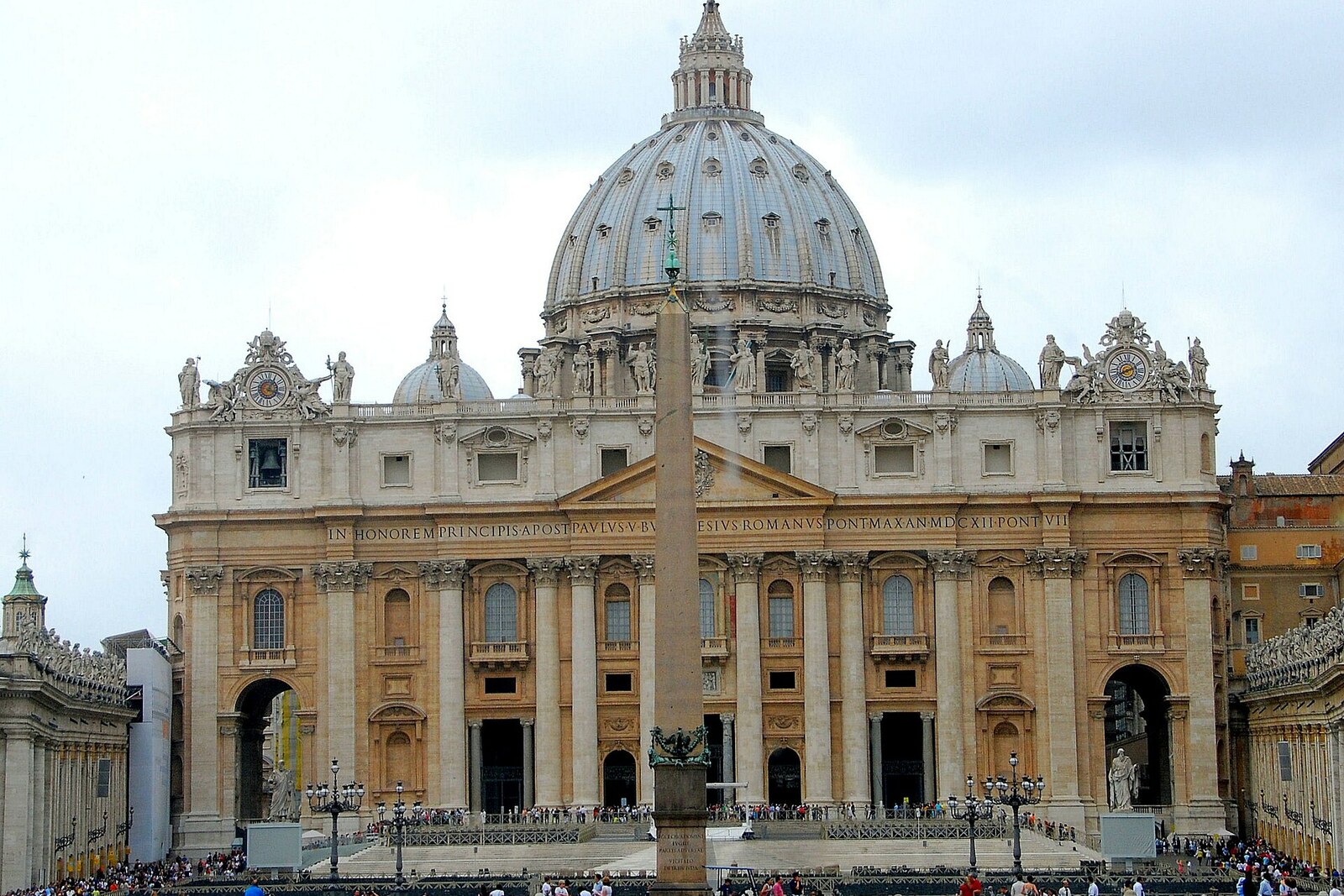
Look around first
What to notice
- Bronze baldachin
- High altar
- Columns of the baldachin
The story of the place
Beneath the bronze baldachin at the high altar, people gather for the most important papal services. The present building replaced a church that stood here for many centuries, but the altar retained its central point. So the church serves not only as a place for grand ceremony: for centuries, pilgrims came here and sought to be buried beside the revered shrine.
At the beginning of the fourth century, Emperor Constantine, planning an enormous church for Rome's recently legalized Christian community, chose an extremely inconvenient site. A Roman cemetery was still in use here, on the slope of Vatican Hill. Creating a level platform required cutting away the upper parts of the mausoleums and moving more than forty thousand cubic meters of earth. It would have been easier to find open space. Constantine needed one particular tomb.
The basilica is named after Peter—the Galilean fisherman Simon, who left his trade, became a disciple of Jesus, and preached Christianity in Rome. Catholic tradition considers him the city's first bishop, that is, the head of the Roman community, and the predecessor of the popes. According to church tradition, Peter was executed in the sixties of the first century under Emperor Nero in a nearby circus and buried in the cemetery here. The story that he was crucified upside down also belongs to tradition, rather than to a contemporary event with a detailed eyewitness record.
Christians remembered the burial place. About a century later, a small monument appeared above the revered tomb: a marble slab on two small columns beside a wall with red plaster. Pilgrims scratched invocations to Christ and Peter nearby. By the beginning of the fourth century, it was already a well-known shrine, although ordinary Romans continued to be buried around it.
Constantine ordered the monument enclosed in marble and an altar placed above it. The upper parts of the neighboring tombs were dismantled, while the rest were filled in and turned into the church's foundation. For the necropolis, this meant the end: new burials here ceased. But the structures buried beneath the church were sealed and survived where an open site would long ago have been dismantled and rebuilt.
The floor of the first basilica was raised to the level of Peter's monument. Pilgrims came to the altar, Christians sought to be buried nearby, and the church itself stood for about twelve centuries. When the popes of the sixteenth century dismantled it for the present building, they changed its size and plan but did not move its central point. The new altar was again placed above the spot that previous generations had considered the apostle's tomb.
Twentieth-century excavations uncovered a Roman road, mausoleums, and the second-century monument below. They confirmed that Christians revered a particular burial here at a very early date. It is impossible to prove with the same certainty that the human remains found belonged to Peter himself: the church considers them his relics, while researchers speak more cautiously of an attribution.
Today, the most important papal services take place at the high altar beneath the bronze baldachin. Below it stand, one above another, the earlier altars, the marble enclosure from Constantine's time, the early monument, and the tomb in the ground of the Roman cemetery. It was this revered burial that gave the basilica the name of Saint Peter.
Useful on site
The basilica is open daily 07:00-20:00; admission is free, but security screening is required, and restrictions are possible during services.
Checked: June 25, 2026. Check the official source before visiting.Observe the dress requirements and keep quiet near places of prayer. The climb to the dome and special underground visits are planned separately and are not needed for the main account.