 Guide On Map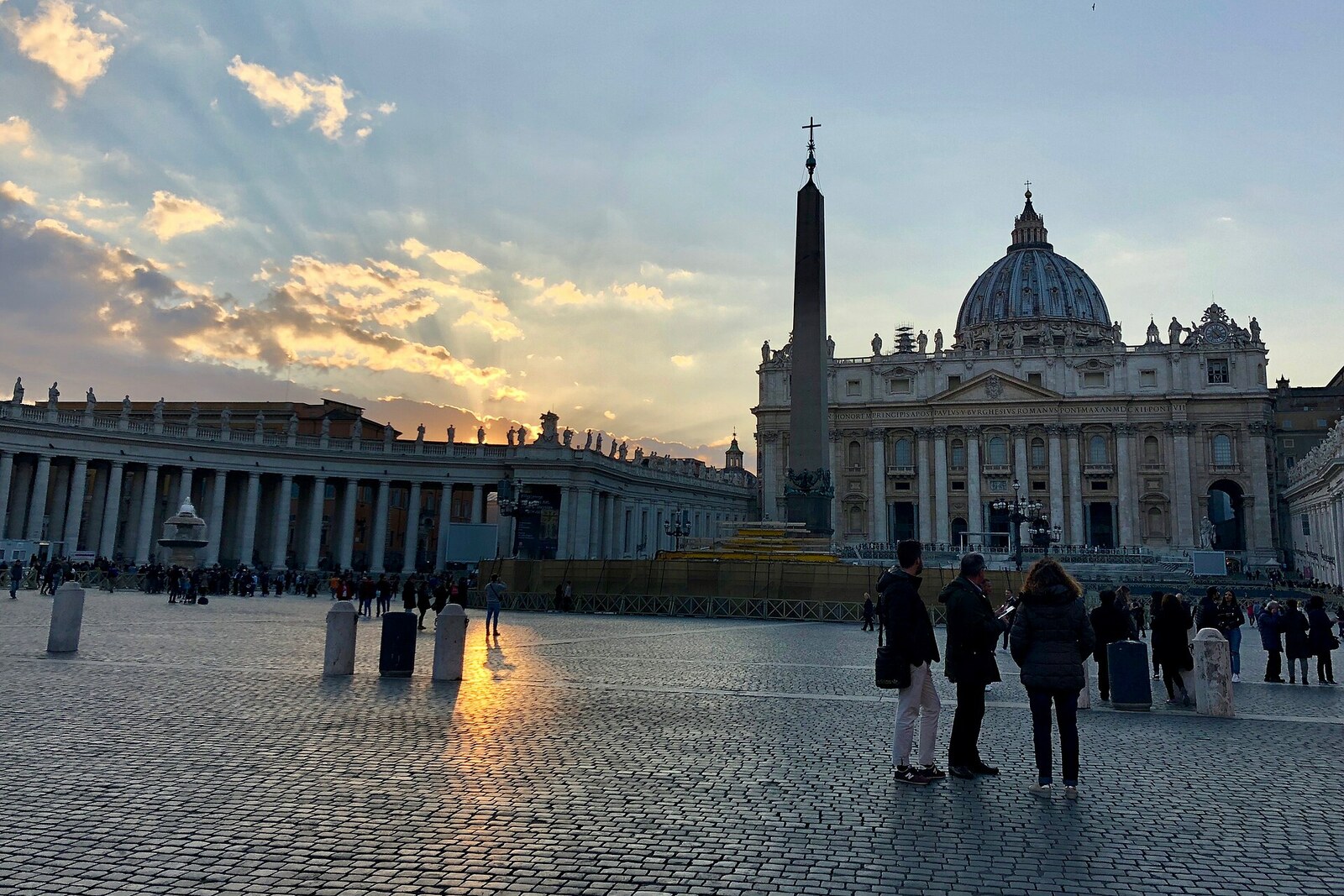
Look around first
What to notice
- Four rows of columns
- The basilica façade
- Bronze Gate
- White marble slab with the papal coat of arms
The story of the place
The basilica’s façade is visible beyond four rows of columns, and near the Bronze Gate pilgrims gather who have come to the principal shrine of Catholic Rome. The square is named after the basilica dedicated to the apostle Peter, whom the Catholic Church considers the first Bishop of Rome and the predecessor of the Roman popes. Christian tradition links the surroundings of Vatican Hill with his execution and burial.
On May thirteenth, nineteen eighty-one, an ordinary general audience was being prepared here—a gathering at which the pope addresses pilgrims and blesses them. For such gatherings, in the middle of the seventeenth century Pope Alexander VII commissioned Gian Lorenzo Bernini to surround the space in front of the basilica with four rows of columns. Papal audiences, Masses, and canonizations are held in the resulting oval.
The square takes its name from the basilica dedicated to the apostle Peter. Christian tradition links the surroundings of Vatican Hill with his execution and burial, and the Catholic Church considers Peter the first Bishop of Rome and the predecessor of the Roman popes.
Before the audience, John Paul II was driving around the assembled crowd in an open white car. The pope wanted to greet people up close: the car was stopped, and children were brought to it. He had just returned a little girl to her parents when the car set off again.
Among the pilgrims stood twenty-three-year-old Mehmet Ali Ağca. He had escaped from a Turkish prison, where he was held in connection with the murder of a newspaper editor; he was internationally wanted and had already threatened to kill the pope. Ağca came to the square to carry out that threat. It was not possible to establish reliably who directed him, if there was a mastermind at all: later, he repeatedly changed his testimony.
At five nineteen in the afternoon, Ağca fired. Two bullets wounded John Paul II; one passed through his abdomen and severely damaged his intestine. The papal car sped to the Arch of the Bells, from where the injured man was taken to Gemelli Polyclinic. The operation lasted five and a half hours. The doctors saved his life.
Ağca was seized right in the square, and an Italian court sentenced him to life imprisonment. Four days after the assassination attempt, John Paul II publicly said from the hospital that he had forgiven the shooter. In December nineteen eighty-three, the pope came to Ağca at Rome’s Rebibbia Prison and spoke with him in private for about twenty minutes. They did not disclose the content of their conversation. Ağca spent nineteen years in an Italian prison, then he was pardoned and handed over to Turkey, where he was to serve a sentence for the earlier murder.
After the assassination attempt, papal cars began to be fitted with armor and bulletproof glass. And near the Bronze Gate, a small white marble slab bearing the coat of arms of John Paul II is set into the square’s paving. It marks the point to which the open car allowed Ağca to approach on May thirteenth, nineteen eighty-one.
Useful on site
The square is accessible as an urban space, but barriers and security checks may be in place during audiences, services, and events.
Checked: June 25, 2026. Check the official source before visiting.Walk around the edge of the square and look at the colonnade from different points. To enter the basilica, you will need to pass through security; during ceremonies, the direction of the queues and the accessible areas change.