 Guide On Map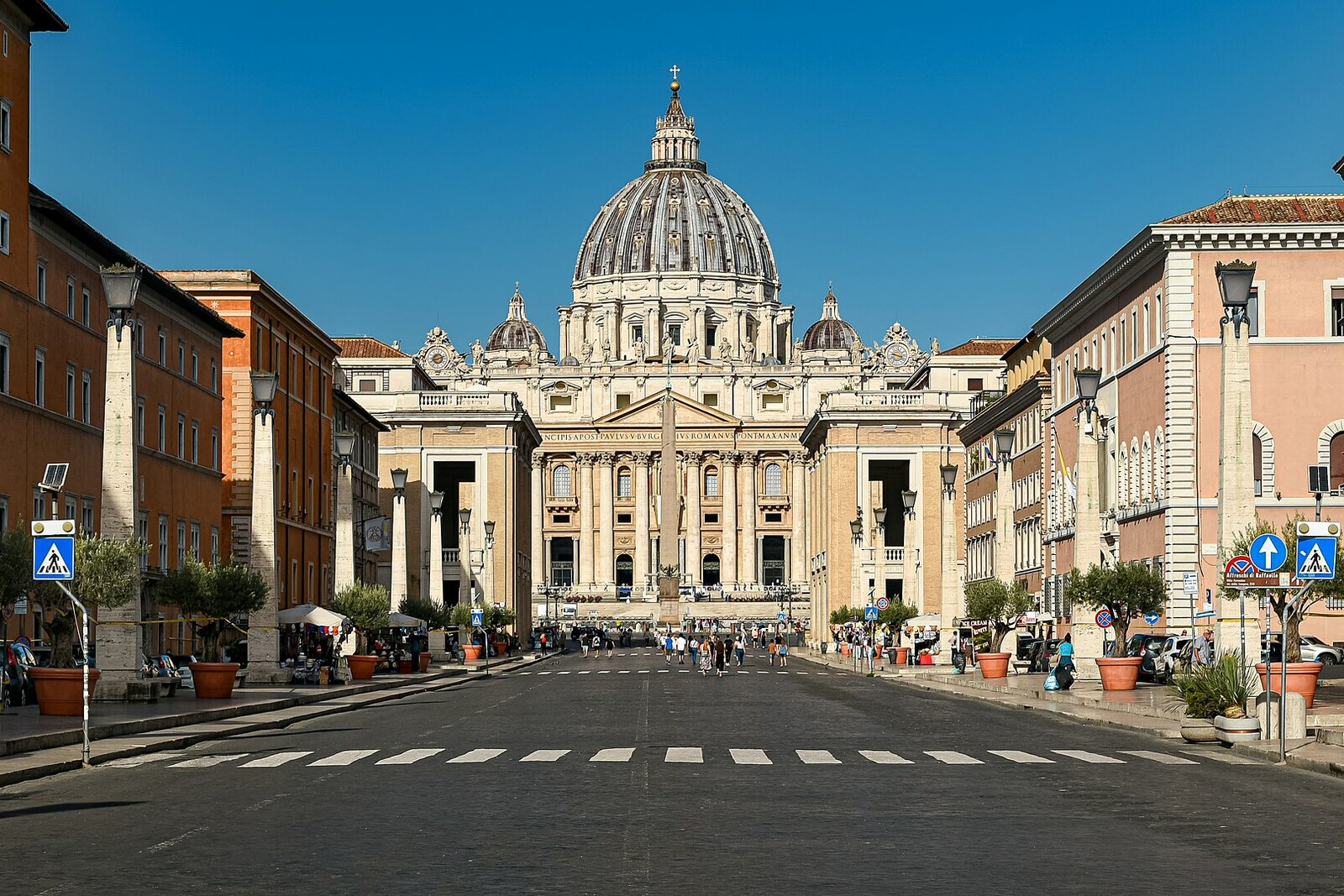
Look around first
What to notice
- A direct view of the basilica
- The broad roadway
- Tall travertine lamps
- Palace façades along the avenue
The story of the place
The broad Via della Conciliazione leads from the Tiber to the Vatican’s main basilica and serves as a route for pilgrims and major ceremonies. Its name refers to the Conciliation, after which Italy recognized the independence of Vatican City and the Holy See agreed to regard Rome as the country’s capital. Palace façades stand along both sides of the roadway, and above them rise twenty-eight travertine lamps, elongated like obelisks. They were installed when the road was being prepared for the Holy Year.
On October twenty-ninth, nineteen thirty-six, Benito Mussolini, head of the Italian Fascist government, climbed onto the roof of Palazzo Sauve near Piazza Pia. He arrived in the uniform of a militia commander, accompanied by ministers and representatives of the Holy See. He picked up a pickaxe and struck the cornice. With this ceremony, Mussolini began the demolition of the district where Via della Conciliazione now runs.
The broad avenue did not exist then. Between two narrow streets, Borgo Vecchio and Borgo Nuovo, stretched a wedge of houses called Spina di Borgo—the “thorn of Borgo.” Shops and workshops operated below, while families lived above; many generations of local residents earned their living here through trade and crafts. Before the demolition, officials recorded the owner, purpose, and income of every building. After the evictions, the tax office was informed that a house had stopped bringing in money. Most residents were sent to distant new settlements, while the view of the basilica was cleared where their apartments and shop counters had stood.
The word “conciliazione” means reconciliation and refers to a specific agreement. In eighteen seventy, the Kingdom of Italy annexed Rome. The Holy See refused to recognize the loss of the papal lands or the very status of the new state with Rome as its capital. The popes considered themselves prisoners of the Vatican. This dispute lasted for almost sixty years.
Pope Pius the Eleventh needed legal guarantees of the Church’s independence. Mussolini sought the Church’s recognition for his regime in a country where most of the population remained Catholic. On February eleventh, nineteen twenty-nine, Mussolini and Cardinal Pietro Gasparri, Pius the Eleventh’s secretary of state and representative, signed the Lateran Pacts. The Holy See recognized the Kingdom of Italy and Rome as its capital. Italy recognized the sovereign city-state of Vatican City and paid compensation for the lost papal lands. A separate Lateran Concordat defined the status of the Catholic Church in Italy. This settlement was called the Conciliation.
A few years later, the Italian government and the Holy See decided to give the treaty a visible form. The architects Marcello Piacentini and Attilio Spaccarelli proposed clearing a direct approach from the Tiber to the Vatican; both Mussolini and Pius the Eleventh approved the project. The pickaxe on the roof of Palazzo Sauve became the first public blow.
By October eighth, nineteen thirty-seven, Spina di Borgo was already gone. Piazza Scossacavalli, the Church of San Giacomo a Scossacavalli, and dozens of residential houses had disappeared. Several palaces were dismantled and rebuilt elsewhere, and their façades and proportions changed. Palazzo Sauve itself, from which the ceremony had begun, was completely destroyed.
Pius the Eleventh died before the work was completed. The war halted construction, Mussolini’s regime fell, and Mussolini himself was killed. The avenue was completed under Pope Pius the Twelfth, who was preparing Rome for the Holy Year of nineteen fifty. At that time, twenty-eight tall travertine lamps in the form of obelisks were installed along the road. The completion date is carved on their metal lanterns.
Now pilgrims, official processions, and crowds attending major ceremonies travel along Via della Conciliazione. Near Piazza Pia, where the open view of the basilica begins, Palazzo Sauve once stood. Its cornice was directly above the present-day roadway.
Useful on site
The city street is always accessible, but it may be closed during papal ceremonies and major events.
Checked: June 25, 2026. Check the official source before visiting.There is little shade on the avenue, and the long view deceptively shortens the distance. Cross the roadway only at marked crossings.