 Guide On Map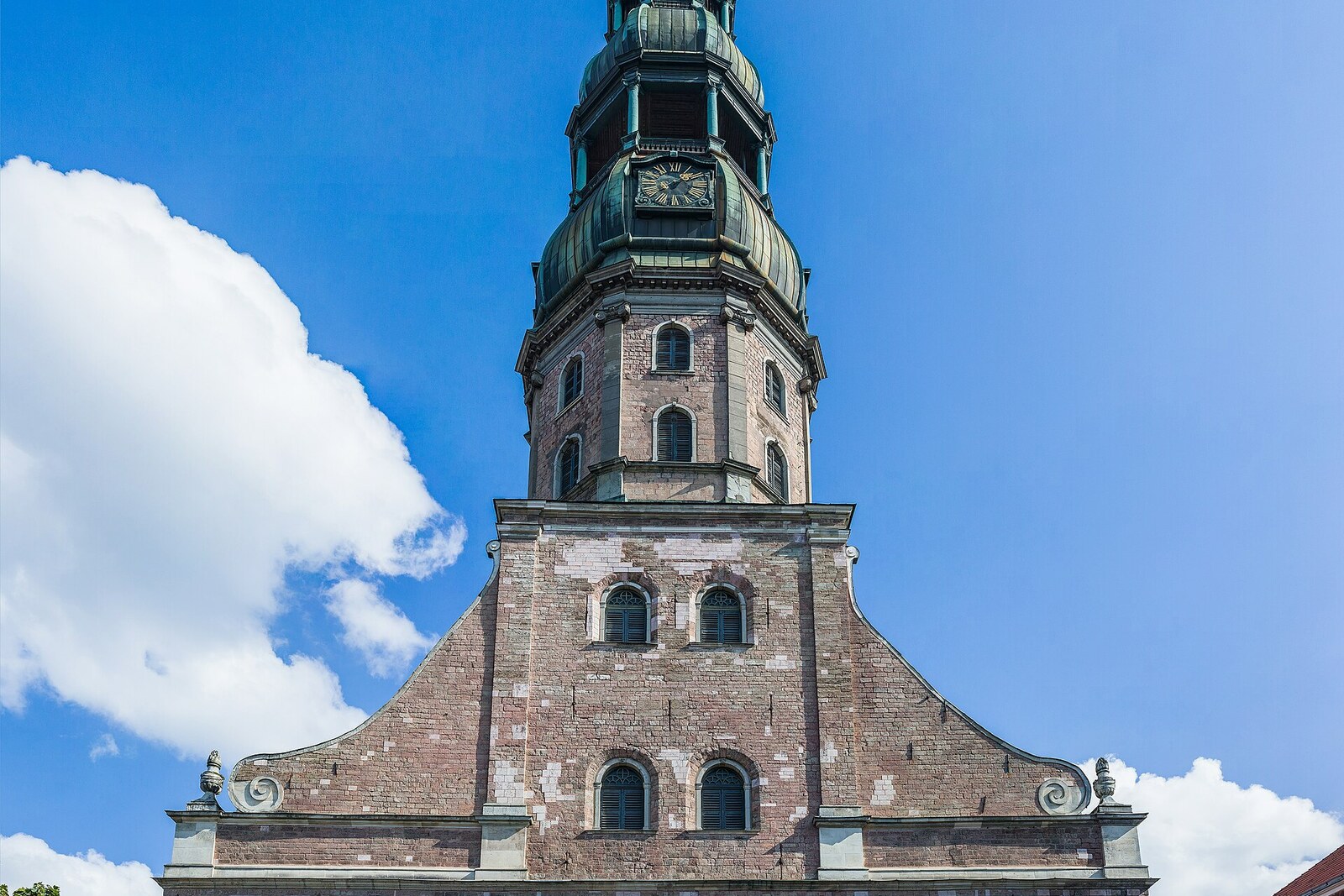
Look around first
What to notice
- Tombstone of Andreas Knopken
- Image of Christ with a victory banner
- Church tower
The story of the place
The tower of St. Peter's, visible above the roofs of Old Riga, belongs to a church maintained for centuries by the city's merchants and craftsmen. Medieval Riga residents considered the Apostle Peter, a fisherman and Christ's disciple, the city's heavenly patron; the main church of the townspeople was named after him. Brotherhood altars stood inside, so craftsmanship, trade, and Riga's religious life came together under one roof. A tombstone damaged by fires survives in the wall: Christ emerges from the tomb with a victory banner that pierces a dragon.
Andreas Knopken, an assistant priest at this church, wanted to prove to Riga residents that salvation depends on faith, and that paid masses, donations, and erected altars cannot buy it. The dispute also concerned his own earnings. In fifteen seventeen, a brotherhood of non-German salt porters paid Knopken for services at its altar here in St. Peter's Church. He received twelve Riga marks for this work.
Brotherhood altars explain the church's purpose. The cathedral was the archbishop's residence, while St. Peter's was maintained mainly by the city's merchants and craftsmen. The church was dedicated to the Apostle Peter—a fisherman who became Christ's disciple and, according to the Gospel, received from him the keys to the Kingdom of Heaven. Medieval Riga residents considered Peter the city's heavenly patron, so the main church of the townspeople bore his name.
On June twelfth, fifteen twenty-two, Knopken entered into a public dispute with the Franciscans in the church choir. Before the burgomaster and members of the rat—the city council—he defended twenty-four theses. One of them directly rejected the hope of salvation through commissioned masses, religious brotherhoods, and the construction of altars. It meant that the priest was challenging the benefit of the very service that brought him income.
The city council had its own reason to support him: the rat was seeking greater independence from the archbishop and the Livonian Order. In the autumn of that same year, the council installed Knopken as pastor of St. Peter's, bypassing the chapter of canons at the cathedral, which was supposed to approve such an appointment. Knopken kept his position and received a pulpit for his sermons. Their text formed the basis of his commentary on the Epistle to the Romans, printed in Wittenberg in fifteen twenty-four.
Knopken himself sought gradual change and tried to prevent disorder. But the radical preacher of St. James's Church, Sylvester Tegetmeyer, demanded that the churches be cleared of Catholic images. On March tenth, fifteen twenty-four, his supporters from the Brotherhood of Blackheads came to St. Peter's Church and smashed most of their own altar. They managed to carry out the valuable silver statuette-reliquary of Saint George; it is now in a museum in Bremen. A few days later, a crowd destroyed other altars, crosses, relics, and tombstones here. In November, the rat banned Catholic services and confiscated church property. Catholic priests were expelled, and the building was handed over to the Lutheran congregation.
Knopken served here until his death in fifteen thirty-nine and was buried before the altar. His tombstone, damaged by later fires, is now set into the church wall. On it, Christ rises from an empty tomb, while the shaft of a victory banner pierces a dragon. Such an image did not contradict Knopken's theses: the sign could recall a Gospel event, but it did not itself grant salvation. The medieval altars disappeared, the old Catholic dedication remained, and today Lutheran services, concerts, and exhibitions take place in the very same Church of the Apostle Peter.
Useful on site
The height and structure of the spire are clearly visible from outside. Climbing it and viewing the preserved old rooster are part of visiting the church—entry conditions should be checked in advance.