 Guide On Map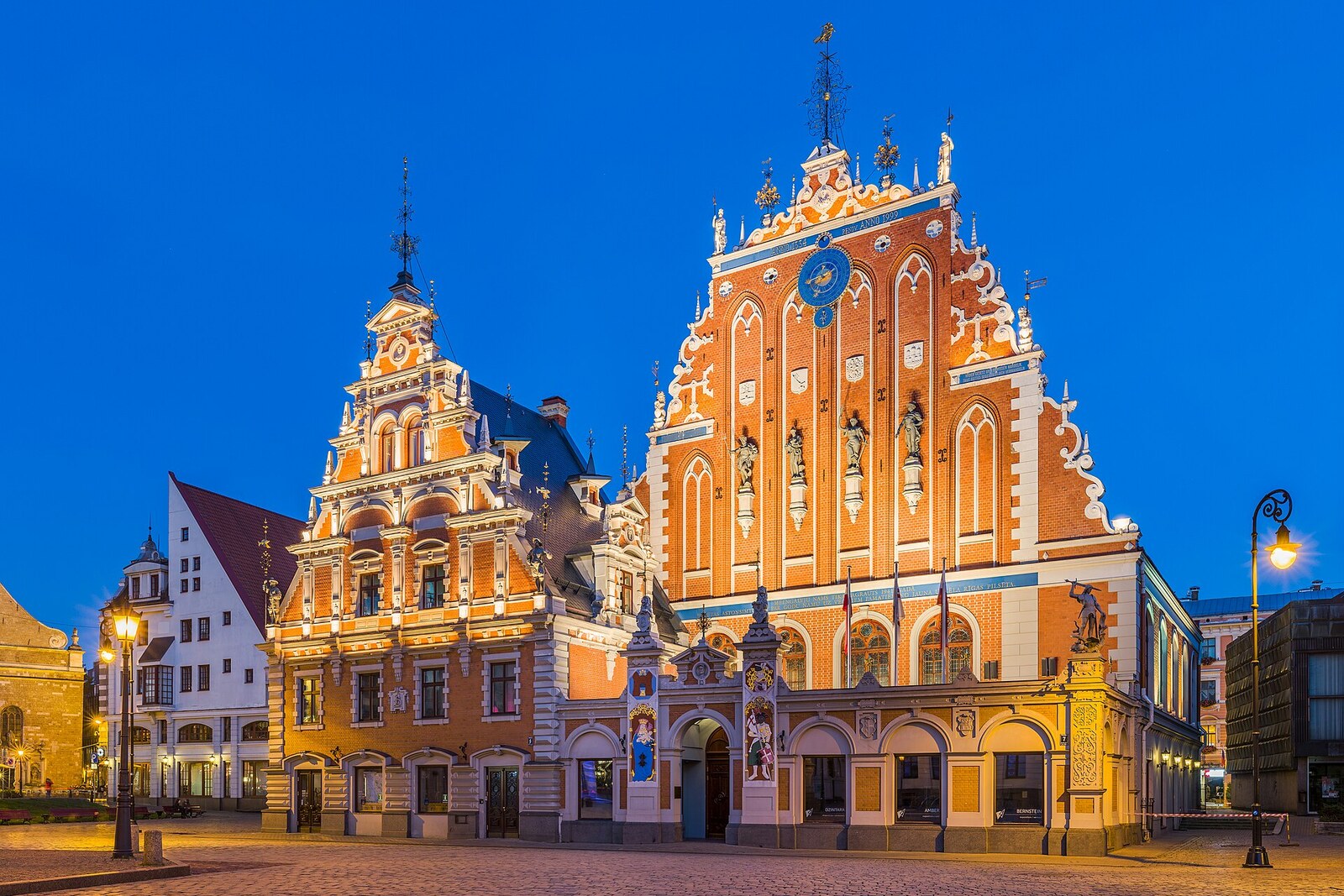
Look around first
What to notice
- The reconstructed facade of the House of the Blackheads
- The coat of arms with the black profile of Saint Maurice
- The medieval cellars
The story of the place
Above Town Hall Square rises an ornate facade with a black profile on its coat of arms; behind its reconstructed wall, stone cellar spaces from the Middle Ages have survived. Here, Riga associations first held meetings and celebrations, while the square in front of the house served as the city market and the Riga City Council held its sessions opposite. This proximity made the building a working part of the trading city: goods were left downstairs, while deals and common affairs were settled one floor above. The facade returned to the square only at the end of the twentieth century, based on old survey measurements, images, and the foundations that had been found.
In the early fifteenth century, a young merchant arrived in Riga with goods and found himself in an awkward position. His money was tied up in bales of flax, wax, grain, or hides; part of the cargo was stored in the stone cellars beneath this house. But the Great Guild, which brought together independent married townsmen, would not usually admit a visitor or an unmarried merchant. He still had to make a fortune, obtain the rights of a Riga burgher, and find a family here.
The Brotherhood of Blackheads brought such people together: young merchants, trade apprentices, captains, and foreigners living in Riga temporarily. They learned prices and routes from one another, found partners, kept a common fund, held feasts, and, when necessary, took part in the city’s defense. The risk began even before a deal was made: a ship might not return, cargo might be lost, and a visiting merchant could be left in a foreign city without money or relatives. The Brotherhood gave him a circle of people responsible for one another.
The city built the house itself in thirteen thirty-four for the meetings and celebrations of Riga associations. It was then called the New House. From the middle of the fifteenth century, the Blackheads rented rooms here; later, they occupied the whole building, and by seventeen thirteen they had become its owners. The location was chosen deliberately: the city market stood in front of the house, while the Riga City Council held its sessions opposite. A merchant could store goods downstairs, discuss a deal in the hall, and step straight out onto the main market square.
The Blackheads took their name from their coat of arms. It showed the black head of Saint Maurice, a Roman commander whom medieval artists portrayed as a dark-skinned man. According to Christian tradition, Maurice commanded the Theban Legion and was executed with his soldiers after refusing to offer sacrifice to the Roman gods. The Brotherhood venerated several warrior saints, but Maurice’s head became its identifying sign. Medieval documents explicitly call this sign a “black head,” and the association’s name came from it.
Membership required money. At first, a newcomer paid a silver half-mark. In the seventeenth century, the contribution was joined by a custom of giving the house a valuable silver object bearing the owner’s name, coat of arms, and year of admission. This is how cups, dishes, and candlesticks accumulated in the halls: each object showed who had managed to establish himself in trade. When a Blackhead married and took the burgher’s oath, he moved into the Great Guild. For many, this house became a place between arriving in Riga and living in the city with full rights.
The building above ground has now been reconstructed. The old house burned down in nineteen forty-one, and its ruins were demolished in nineteen forty-eight. Riga residents recreated the facade from nineteen ninety-six to nineteen ninety-nine, using survey measurements, images, and the foundations that had been found. The medieval cellars remained authentic. Above them, the black profile on the coat of arms is visible again—the sign of young traders whose goods lay below while they themselves worked to earn the right to stay in Riga.
Useful on site
The facade and the square are available for independent viewing. The authentic cellars and interior halls can be seen only by visiting the building; check the possibility of entry separately.