 Guide On Map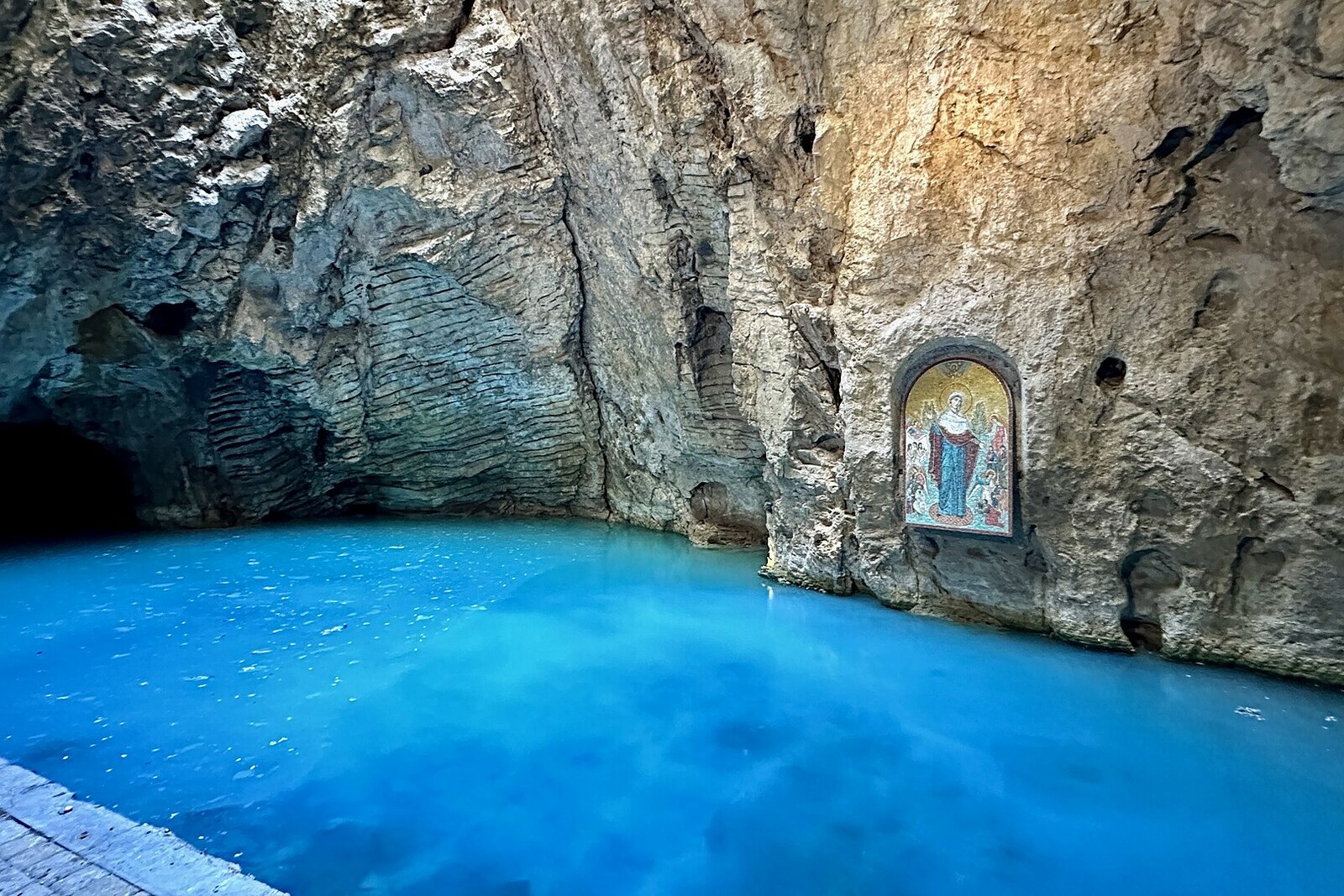
Look around first
What to notice
- The horizontal tunnel
- The turquoise water of the lake
- The round opening above the lake
- The discharge channel
The story of the place
High above the turquoise water, a round opening remains in the vault; people once looked down through it into the natural shaft on the slope of Mount Mashuk. Warm mineral water collects at the bottom of the cave and, when the level is high, flows out through the discharge channel onto the slope. Sulfur bacteria create the turquoise hue. People bathed in the lake, and a separate wooden bathing structure on the water was arranged for seriously ill people.
Until the middle of the nineteenth century, this lake could not be reached over land. Warm mineral water rises here along a tectonic fault. It dissolved limestone and marl, the cave vault collapsed, and a deep shaft formed in the slope of Mount Mashuk. The lake lay at its bottom, and people looked down at the water from above or dared to descend by rope.
In eighteen fifty-seven, the naturalist Fyodor Batalin descended here. He had been assigned to study Pyatigorsk's mineral waters and determine whether they could be used for treatment. Instead of a cabin, Batalin was given a rope and a round log to sit on. Below, he measured the depth and temperature, took water for analysis, and examined the rock. The descent had to be repeated. That same year, Batalin published the study The Great Proval in Pyatigorsk and calculated a horizontal passage to the lake: if the slope were pierced from the side, the water could be reached without a rope.
The administration of the Caucasian Mineral Waters had no money for this work. Batalin's calculation was taken up by Pyotr Lazaryk, an honorary citizen of Moscow who earned his living through a private dental practice. He treated and extracted teeth, made dentures, and promised to see poor patients free of charge. Lazaryk often came to the Caucasian Mineral Waters and decided to pay for the passage to the lake from his own funds.
He expected to manage it in about a month and a half. Work began in November of eighteen fifty-seven and ended only seven months later. Lazaryk directed it himself. The tunnel workers first blew up the rock overhanging the entrance, then moved inward with drills and gunpowder charges. Soft layers gave way to hard ones. Hydrogen sulfide fumes forced the workers to stop and go outside.
When only a few sazhens remained to the lake, water rushed into the excavation after an explosion. The tunnel workers decided that they had emerged below the lake's surface and would now flood the entire tunnel. The water was pumped out, the floor was raised, and they continued tunneling higher up. Some of the workers refused to return underground; Lazaryk hired new ones and paid for the prolonged work. In the end, the tunnel cost him about twenty thousand rubles, considerably more than the original estimate.
On July fifteenth, eighteen fifty-eight, the final gunpowder charge opened a passage into the cave. A road along the slope and an almost fifty-meter horizontal tunnel now led to the lake. Batalin gained a source accessible for further observation, and Lazaryk's money and decision became a route cut inside Mount Mashuk.
After the opening, people began bathing directly in the lake. There were so many who wanted to do so that a separate wooden bathing structure on the water was arranged for seriously ill people. The turquoise color, still visible today, is created by sulfur bacteria in the warm mineral water. It continues to arrive along the fault; when the level rises high enough, the water overflows from the lake into the discharge channel and emerges on the slope of Mount Mashuk.
Today's passage to the water follows the very line calculated by Batalin and paid for by the dentist Lazaryk. Before their descent and construction, the entrance to Lake Proval was a round opening high above the lake. It now remains overhead, while a person reaches the bottom of the natural shaft through the tunnel of eighteen fifty-eight.
Useful on site
The current guide in the map directory is from 08:00 to 20:00, but hours change because of work and bad weather; check on the day of your visit.
Checked: July 12, 2026. Check the official source before visiting.After heavy rains, first assess access at the entrance. If the tunnel is closed, remain in front of the barrier: the account does not require approaching the water.