 Guide On Map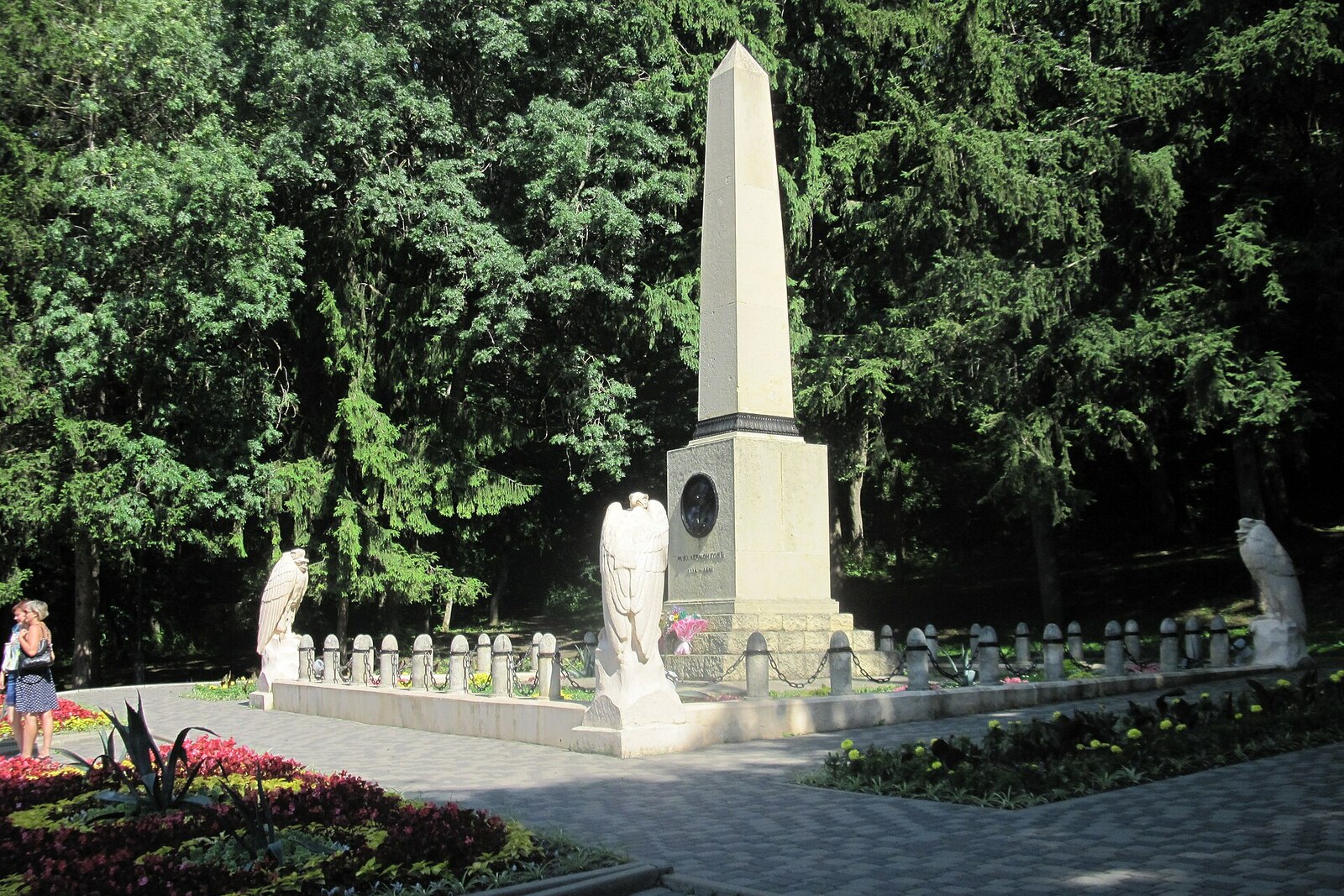
Look around first
What to notice
- Stone obelisk
- Bronze bust
- Chain fence
- Clearing beside the road
The story of the place
A stone obelisk, a bronze bust, and a chain fence stand in the small memorial clearing; the monument is dedicated to the poet. It is slightly more than four kilometers from Pyatigorsk, along the road to Nikolayevskaya Colony, present-day Inozemtsevo. Before the monument appeared, this was simply a clearing beyond the city limits, where people could arrive without an audience.
On July thirteenth, eighteen forty-one, at the Verzilin family home, Nikolay Martynov, a major who had retired from service several months earlier, was talking by the piano with one of the host’s daughters. Martynov wore a Circassian coat and a large dagger. Mikhail Lermontov, a twenty-six-year-old army officer with the rank of lieutenant and already a well-known writer, called him “a mountaineer with a large dagger.” At that moment, the piano fell silent, and everyone in the drawing room heard the mockery.
Martynov wanted Lermontov to stop making him look ridiculous in front of women. He reminded Lermontov that he had already asked him not to make such jokes in the presence of ladies. After the evening, the men spoke face to face. This conversation is known mainly from Martynov’s own testimony: Lermontov supposedly replied that Martynov could not forbid him to speak, and that if Martynov considered himself insulted, he should demand satisfaction. Officers used “satisfaction” to mean an armed duel over an insult. Martynov issued the formal challenge.
The seconds—mediators who arranged the terms of the duel and were supposed to try to reconcile the opponents—urged Martynov to withdraw his challenge. He refused: backing down after a public mockery and a direct invitation to a duel would have meant another loss of honor for him.
On July fifteenth according to the old style, July twenty-seventh in the current calendar, the opponents arrived at a small clearing beside the road from Pyatigorsk to Nikolayevskaya Colony—a settlement on the site of present-day Inozemtsevo. It was slightly more than four kilometers from the city. Beyond the city limits, they could measure out the distance for a duel forbidden by law without an audience.
The exact terms are difficult to reconstruct because, after Lermontov’s death, all the remaining participants faced trial. A draft of Martynov’s testimony mentioned the right of each opponent to fire up to three shots; this detail disappeared from the final version. The distance between the barriers also varies in different accounts, from ten to fifteen paces.
After the signal, Martynov stepped up to the barrier and fired. The bullet entered Lermontov’s right side, pierced both lungs, and exited through the left side of his chest. He fell unconscious and died a few minutes later.
Witnesses later gave differing accounts of whether Lermontov fired himself. In the official testimony, his pistol remained loaded, and a second later discharged it into the air. However, the first report, drawn up immediately afterward, said that Lermontov had refused in advance to aim at Martynov. Many years later, one of the seconds recalled that the poet raised his pistol with the barrel pointing upward. Only one thing can be stated with certainty: Lermontov did not fire at Martynov. It can no longer be established whether he had time to fire upward or only prepared to do so.
The next day, the investigating commission found trampled grass, carriage tracks, and blood where Lermontov had lain. Martynov was arrested that same evening. The military court ruled that he be stripped of his rank and the rights of his estate—the legal status of a nobleman. The final punishment was milder: three months in a military detention cell at Kyiv Fortress and church penance. The two recognized seconds were pardoned.
The commission left no permanent marker. Only in eighteen seventy-eight did the Pyatigorsk photographers Aleksandr Engel and Grigory Raev place the first commemorative stone beside the road. A few years later, a commission that included Pavel Viskovatov, Lermontov’s first biographer, concluded that it was already impossible to determine the exact location of the barrier. The current obelisk with a bronze bust appeared in nineteen fifteen at the presumed duel site.
In eighteen forty-one, there was a clearing beside the road here. The trampled grass, wheel tracks, and blood recorded in the report the next day have disappeared. The chain fence outlines the site later chosen for the monument, rather than the no-longer-extant barrier Martynov stepped up to.
Useful on site
Open memorial site with no ticket; visit in daylight.
Checked: July 12, 2026. Check the official source before visiting.Do not go down the slope looking for a “more exact” clearing: different accounts point to different places, and the memorial itself serves as the route stop.