 Guide On Map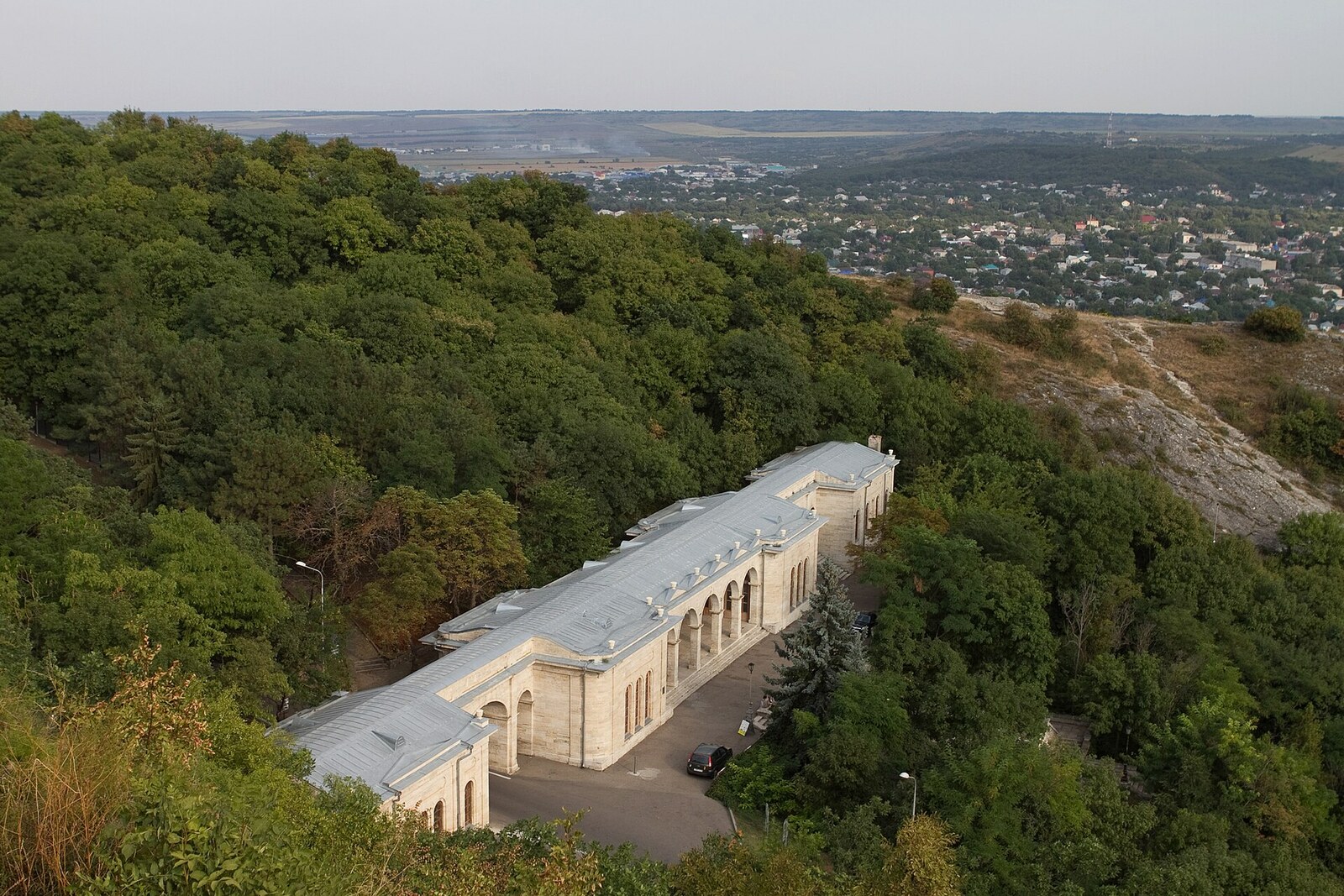
Look around first
What to notice
- Long covered arcade
- Arched bays
- Side pavilions
- Broad staircase
The story of the place
An elongated chain of arched bays beneath a roof crosses a gully on the slope of Mount Mashuk, with pavilions adjoining it on either side. A permanent building became necessary when so many spa visitors were already gathering around the local water that wooden shelters and benches could no longer accommodate them. Treatment here was not hurried: beneath the roof, people walked between doses of water, waited, used the baths, and drew water at the pump rooms. The spring for which all this was arranged disappeared as early as the end of the nineteenth century; the pump room closed later as well.
In eighteen oh nine, there was neither a stone arcade nor a broad staircase here. Twenty-nine-year-old Fyodor Gaaz, chief physician at Moscow Pavlovsk Hospital, took leave after recovering from two hospital fevers and came to Mount Mashuk to study the mineral waters. He lived for his hospital service and private medical practice; now he had to decide which of the local springs could truly be recommended to patients.
On this slope, Gaaz noticed horses eagerly drinking warm, sourish water. Local residents insisted that the horses became healthier after drinking it. For a doctor, this was an observation that still needed to be verified. Gaaz examined the water and was the first to propose using the spring for drinking. His prescription began with two glasses a day and went up to ten to twelve, with slow walks prescribed between them. This is a historical treatment regimen from the early nineteenth century, not advice for today’s visitor.
Gaaz named the spring Elizavetinsky Spring, in honor of Elizaveta Alekseyevna, the wife of Emperor Alexander I. After his second trip, he published a book with the results of his observations. The spring quickly became Pyatigorsk’s main drinking spring: at first, water was drawn from a deepened well, then a platform and wooden galleries with benches were arranged around it. People came here to drink their prescribed portion, wait until the next glass, and meet other spa visitors. This was how Pyatigorsk’s “water society” emerged.
Lermontov described this very well and wooden gallery in Princess Mary. He never saw the present building. By the middle of the nineteenth century, the temporary structures could no longer accommodate the visitors. Mikhail Vorontsov, the viceroy of the Caucasus, ordered them replaced with a permanent gallery, and the resort architect Samuil Upton built it in eighteen fifty-one. The long covered arcade served as a promenade hall; the pavilions contained baths, waiting rooms, and pump rooms—places where mineral water was drawn. The gallery stands across the gully precisely because Gaaz’s spring emerged beside it.
The modern name appeared in nineteen twenty-five, for the two-hundredth anniversary of the Academy of Sciences. The gallery was named Academic in memory of the scientists who studied the composition of Caucasian waters and turned spa procedures into medical treatment.
Elizavetinsky Spring itself disappeared as early as the end of the nineteenth century. Later, water from other boreholes was piped into the gallery, but this pump room too eventually closed. At the platform where Gaaz saw the drinking horses, his water can no longer be drawn. What remains is the arcade above the gully and the building that grew from a medical recommendation beside a small warm spring.
Useful on site
Exterior viewing is free. A restaurant complex operates in the building daily from 11:00 to 22:00; events may restrict access inside.
Checked: July 12, 2026. Check the official source before visiting.It is convenient to listen to the story in front of the façade: visiting the restaurant complex inside is not required for this stop.