 Guide On Map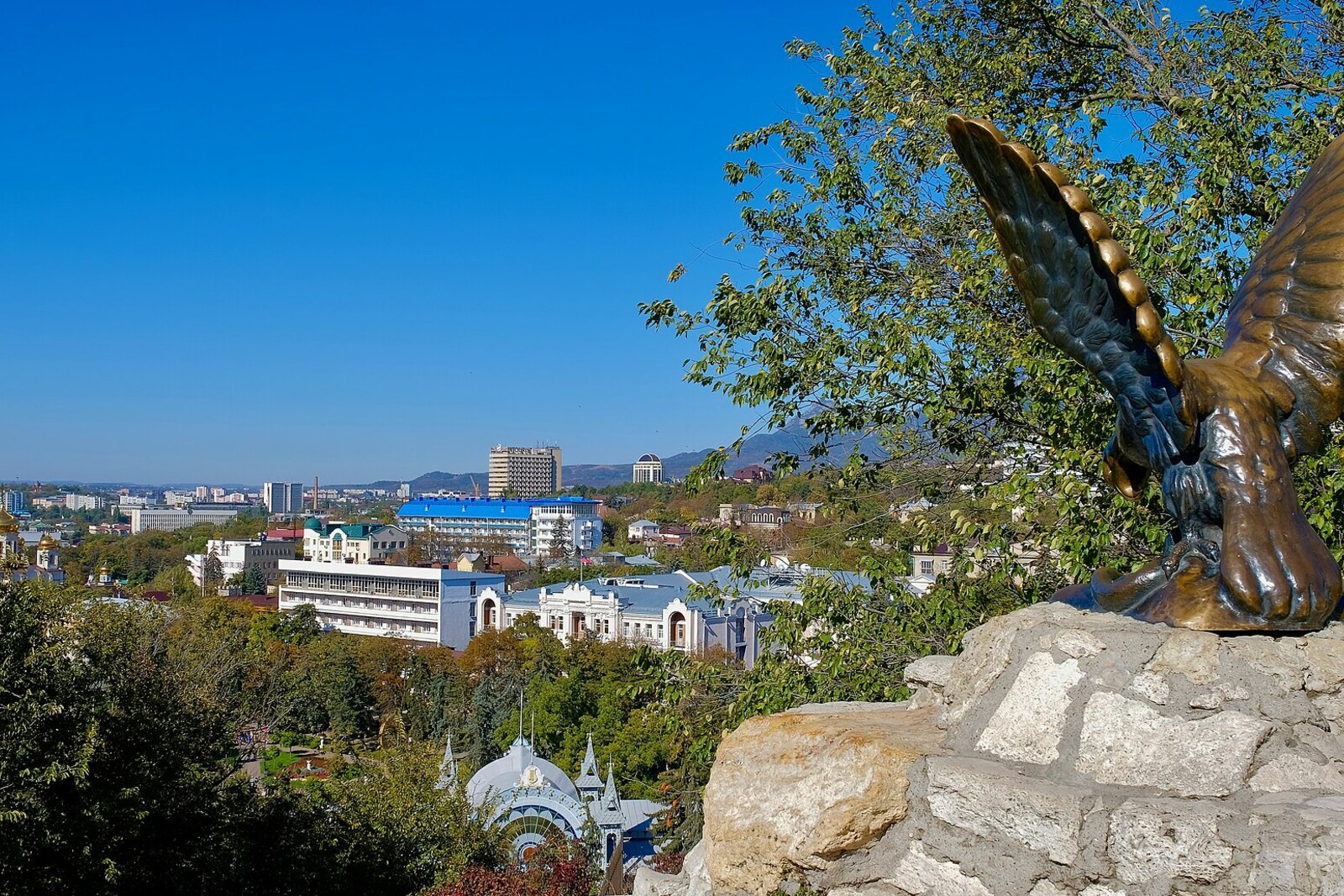
Look around first
What to notice
- Bronze eagle
- Snake in its talons
- Closed beak
- Mound of broken stone
The story of the place
The upper platform on Goryachaya Gora was laid out directly above a fissure from which hot mineral water emerges. Paths and stairways in the new resort park brought here those who came for treatment and walks. On a mound of broken stone, a sculpture was placed for them, intended to speak of the health and strength of the Caucasus through a single silhouette.
The bronze eagle has its head lowered and its beak closed. It holds a snake in its talons. Ivan Krylov, a painter from Novocherkassk who devised this scene, drew the bird differently: with its wings spread wide, its head turned to the right, and its beak half open.
In nineteen hundred, Vladimir Khvoshchinsky, director of the Caucasian Mineral Waters Administration, ordered a new resort park laid out on Goryachaya Gora. Paths and stairways led to an upper platform above a fissure from which hot mineral water emerged. A symbol was needed here that would immediately explain why people came to Pyatigorsk.
Krylov came to the Mineral Waters as a patient and at the same time earned money from artistic commissions for the resort administration. He proposed depicting a golden eagle overcoming a snake: the bird represented the health and strength of the Caucasus, and the snake, illness. The story of an eagle that was bitten, healed by spring water, and then defeated the snake is considered a legend. It has no reliable early source; researchers allow that it may have been invented around the finished sculpture.
At that time, the sculptor Ludwig Shodky was making alabaster vases for the new park. From Krylov's drawing, he made a full-sized eagle from a cement mixture then called artificial stone. On May first, nineteen hundred one, the figure was unveiled on a mound of broken stone. That evening, it was illuminated with red Bengal fire. The resort administration intended to install a searchlight so the bird could be seen from the city, but there was barely enough electricity even for Tsvetnik Park itself.
The first reviews were merciless. A correspondent for the Kazbek newspaper declared the eagle crude, inappropriate, and damaging to the mountain's appearance; he particularly disliked its “incredibly thick and short neck.” Yet publishers of guidebooks and postcards began printing the new silhouette. Photographers took pictures of resort visitors beside it, other towns of the Caucasian Mineral Waters ordered eagles of their own, and the work of Krylov and Shodky became a recognizable emblem of the entire region.
The cement bird did not survive such popularity. In winter it was covered with a wooden box, but the figure still deteriorated. Unknown craftsmen remodeled its head, neck, and wings; once, the eagle was even left without its snake. After the war, it was given its present, calmer appearance.
In November nineteen seventy-two, the Pyatigorsk Resort Council signed a contract with the Leningrad Sculpture Combine. Workers removed the postwar cement eagle from its pedestal and made a mold from it. At first, the new figure was to be cast in iron, but bronze was then chosen. On October fifteenth, nineteen seventy-three, it took this place, and in nineteen ninety-five the eagle with the snake was placed on the official emblem of the Caucasian Mineral Waters.
Before us is a bronze cast of the postwar version. Of Krylov's design, the eagle's fight with the snake and its position above the former spring remain here; the open beak and the original spread of the wings are gone.
Useful on site
Open viewing platform without a ticket; there are no formal visiting hours.
Checked: July 12, 2026. Check the official source before visiting.View the composition from the platform, and do not climb onto the stone base for a photograph.