 Guide On Map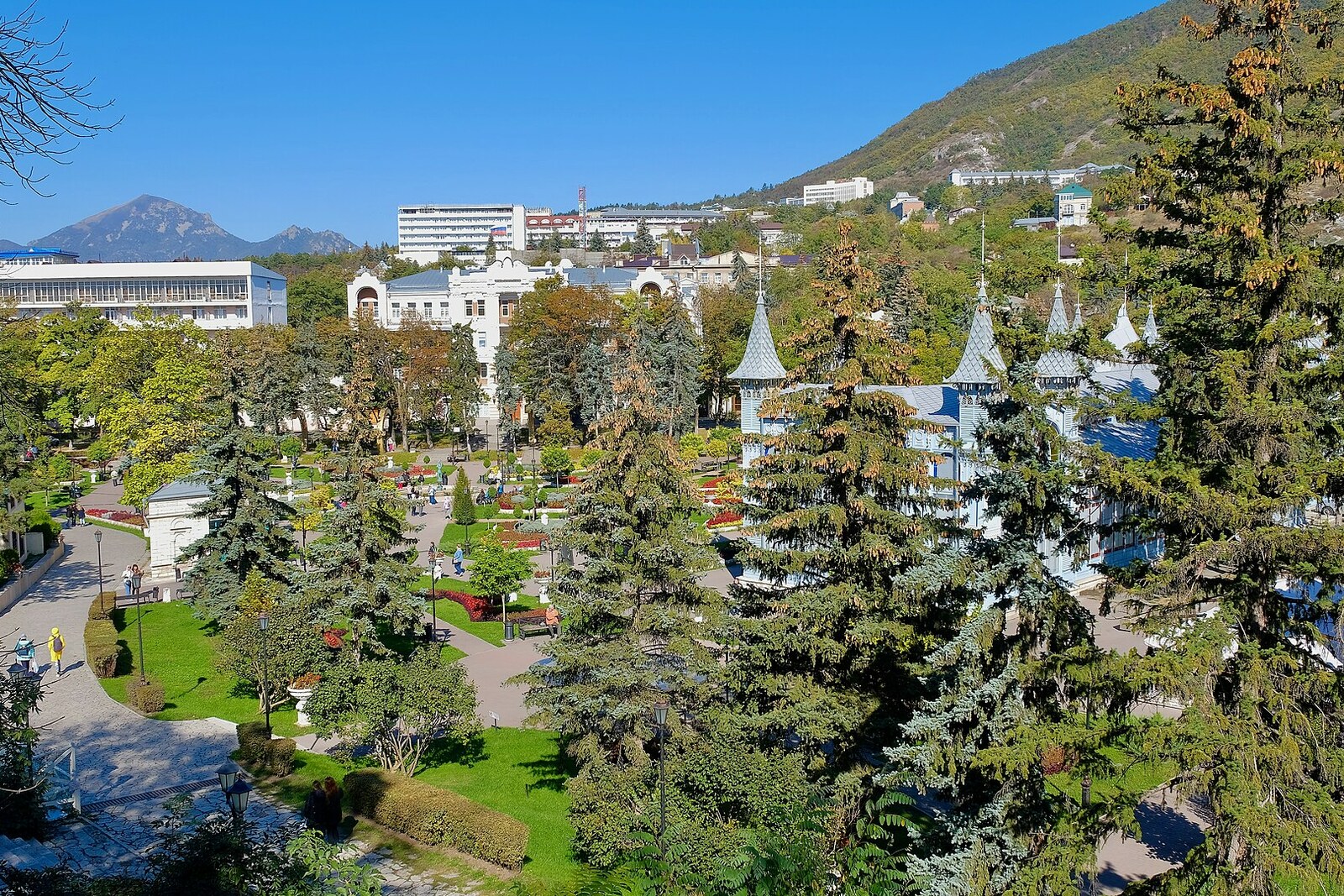
Look around first
What to notice
- Metal entrance arch
- Former coffee house building
- Resort flowerbeds
- Lermontov Baths
The story of the place
The resort garden stretches in front of the Lermontov Baths; a metal arch, installed in the two thousands, leads to its entrance. The paths, flowerbeds, and benches are meant for a pause between treatments: people walked here, listened to military musicians, and a season ticket gave access to the parks and public springs. When the garden was called Nikolayevsky Tsvetnik, the first part of the name referred to the bath building and the second to its flowerbeds; the former name was shortened to simply “Tsvetnik Park.” Beside the arch now stand a resort museum, a gallery, and a coffee house.
In nineteen oh five, the local confectioner Aleksandr Gukasov decided to build a large coffee house near the entrance to Nikolayevsky Tsvetnik. He already had a small establishment: Gukasov earned money from baked goods and coffee sales. The number of vacationers was growing, and the most profitable clientele for him passed through the park entrance every day.
The proposal appeared cautious: the building was to become the city's property, while Gukasov himself would remain its tenant. The city council approved the project. The Caucasian Mineral Waters Administration opposed it—the agency responsible for the springs and resort land. The law prohibited private construction where mineral water came to the surface. The coffee house stood exactly on the disputed boundary.
The reason for such strictness is hidden by today's flowerbeds and paths. In eighteen twenty-eight, this place was an uneven wasteland with marshy patches: water flowed down from Goryachaya Mountain and collected in front of the new Lermontov Baths, then called the Nikolayevsky Baths. General Georgy Emmanuel commissioned the transformation of this land into a place for resort strolls. The architects Giuseppe and Johann Bernardazzi leveled the site, gave the natural basin a regular shape, laid out sandy paths, flowerbeds, benches, and a low wooden fence. In eighteen twenty-nine, the first visitors entered the site.
The garden in front of the Nikolayevsky Baths was called Nikolayevsky Tsvetnik. The flowers gave it the second part of its name, while the first referred to the bath building. By the middle of the century, people walked here between treatments and listened to military musicians. From eighteen seventy-two onward, admission was charged: a season ticket allowed visits to public parks, listening to music, and drinking water from the public springs. The flow of people passed through one fenced resort area—this is why Gukasov chose its edge for his new establishment.
The dispute with the Water Administration delayed construction for almost four years. On July first, nineteen oh nine, Gukasov finally opened Gukasov's Coffee House. It quickly became popular; his vanilla buns were especially celebrated. The confectioner gained a spot by the main entrance, but he was not allowed to place the building inside the protected resort land.
After the revolution, the coffee house was turned into a cafeteria, and the interiors and individual parts of the facade were altered. Later, restorers returned the building to its former appearance. Today, a resort museum and an art gallery occupy the first floor, while a coffee house operates again on the second.
The present metal arch was installed in two thousand one beside Gukasov's building. The word “Nikolayevsky” disappeared from the park's name, while “Tsvetnik Park” remained. The coffee house still stands beside the arch—on the very boundary that made the confectioner wait four years.
Useful on site
An open urban area with no ticket required; individual passageways may be temporarily closed because of works or events.
Checked: July 12, 2026. Check the official source before visiting.You can explore the park directly from the avenues: no traces of the former marsh remain on the surface, so it is more important to compare the account with the level terrain.