 Guide On Map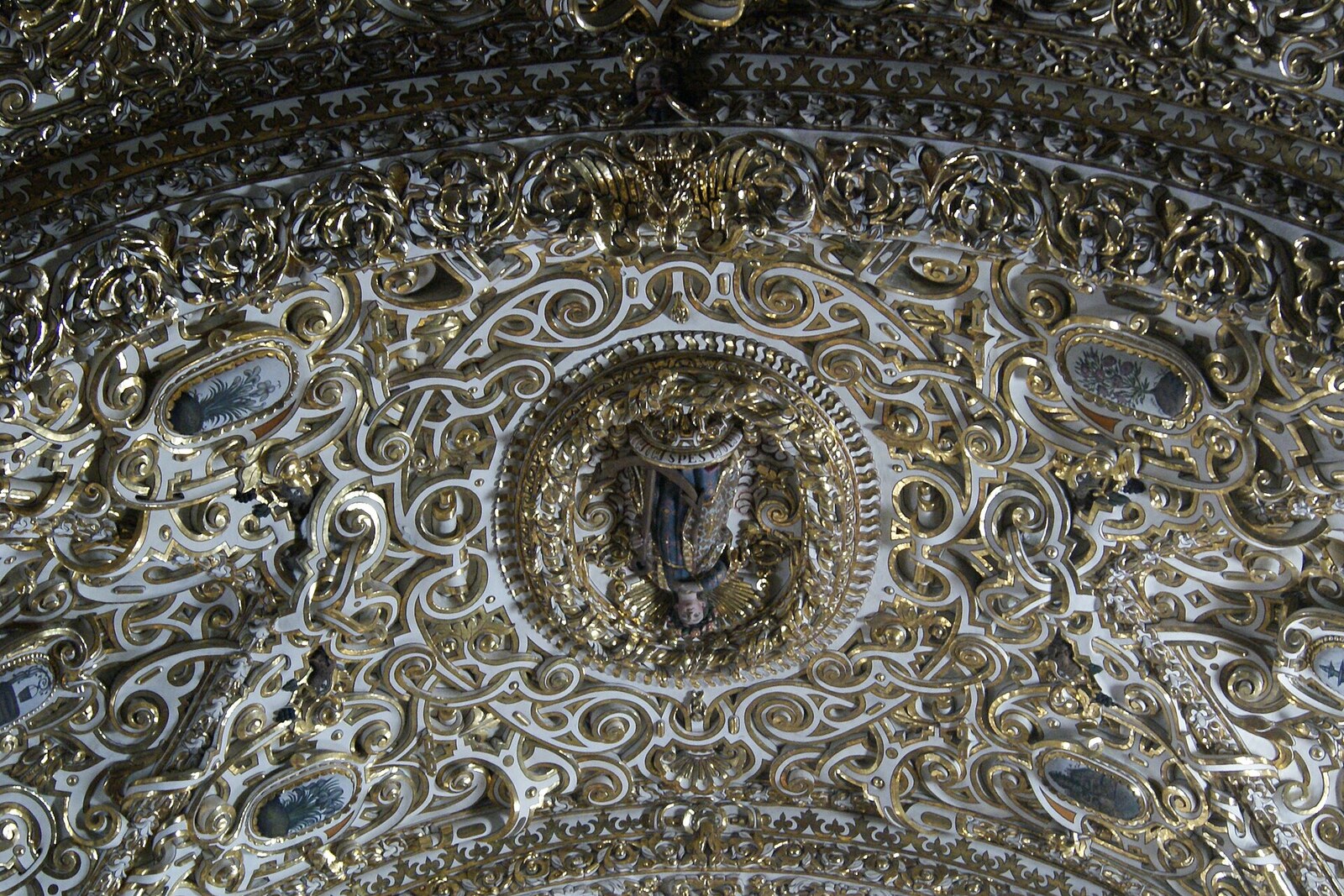
Look around first
What to notice
- The figure of Dominic on the façade
- Gilded stucco
- Nine canvases
- Dome medallions
The story of the place
On the façade is a depiction of Dominic de Guzmán, the Castilian preacher who founded the Order of Preachers, or Dominicans. Strictly speaking, the church itself is dedicated to Archangel Michael; the name Santo Domingo became attached to it through the convent and its friars.
Rosary means a rosary—both prayer beads and a cycle of prayer during which the faithful recall episodes from the lives of Jesus and Mary. According to a later Dominican tradition, Mary handed the beads to Dominic himself and told him to spread this prayer. Historically, this meeting has not been proven, but the Dominicans did make the rosary one of the main practices of their order.
In sixteen fifty, the friar Juan de Cuenca conceived a separate chapel beside the main church: here, images were to teach prayer. Cuenca did not carry the plan through to the end. The work was continued by the leaders of the local Dominicans, Agustín Hernández and Boecio de Ceballos, and completed by Diego de Gorozpe. Construction stretched over forty years.
The Rosary Confraternity collected the money—an association of laypeople who prayed together, held services, and maintained the altar. People who earned their living from pearl fishing also donated. Gorozpe emphasized that poor residents brought a significant part of the alms. The gilded decoration was not paid for by a single unnamed rich man: members of the confraternity pooled donations for decades while craftsmen covered the walls with stucco and gold leaf.
In sixteen eighty-six, the Dominican administrator Bernardo de Andía hired the painter José Rodríguez Carnero. By then, Carnero had been widowed twice, remarried, and was burdened with debts. Later, he wrote in his will that he had no capital: commissions for paintings supported his wife and her relatives. For the enormous canvas The Institution of the Rosary, Andía undertook to pay him four hundred fifty pesos.
In the main painting, Mary distributes rosary beads to the gathered people. Another six large canvases along the walls show the joyful episodes of the rosary: the Annunciation, the Visitation, the Nativity, the Adoration, the Presentation of Jesus at the Temple, and Jesus as a boy, found among the Doctors. Closer to the altar, Carnero painted the Assumption, the Coronation of Mary, and Mary’s triumph. There are no sorrowful episodes of the Passion here. A person moved through the prayer cycle by way of the images, while the figures, golden reliefs, and dome medallions helped keep the prayer cycle in mind.
On April sixteenth, sixteen ninety, Bishop Manuel Fernández de Santa Cruz consecrated the chapel. Eight festive days were accompanied by separate sermons. A few months later, they were printed together with a description of the decoration under the title The Eighth Wonder of the New World. Thus, the nickname appeared during the chapel’s creators’ own time.
This commission strengthened Carnero’s position in Puebla. Soon, he took part in creating a local association of painters and became the leader of a circle of masters who shaped the city’s painting in the following century. Among those receiving rosary beads in the main canvas, one long-haired man looks directly out of the painting. Researchers allow that Carnero may have painted himself there, but there is no documentary confirmation.
Carnero died in seventeen twenty-five. According to him, only a painter’s reputation passed to his children as an inheritance. His nine canvases still hang in the Chapel of the Rosary.
Useful on site
The municipal page lists Tuesday–Friday 09:00–13:30 and 15:30–18:00; another official program for 2025 listed Tuesday–Sunday 11:00–13:30 and 15:00–18:00. Check access on the day of your visit.
Checked: June 24, 2026. Check the official source before visiting.The chapel is inside an active church, so access may change. During a service, postpone your visit; take photographs only where permitted.