 Guide On Map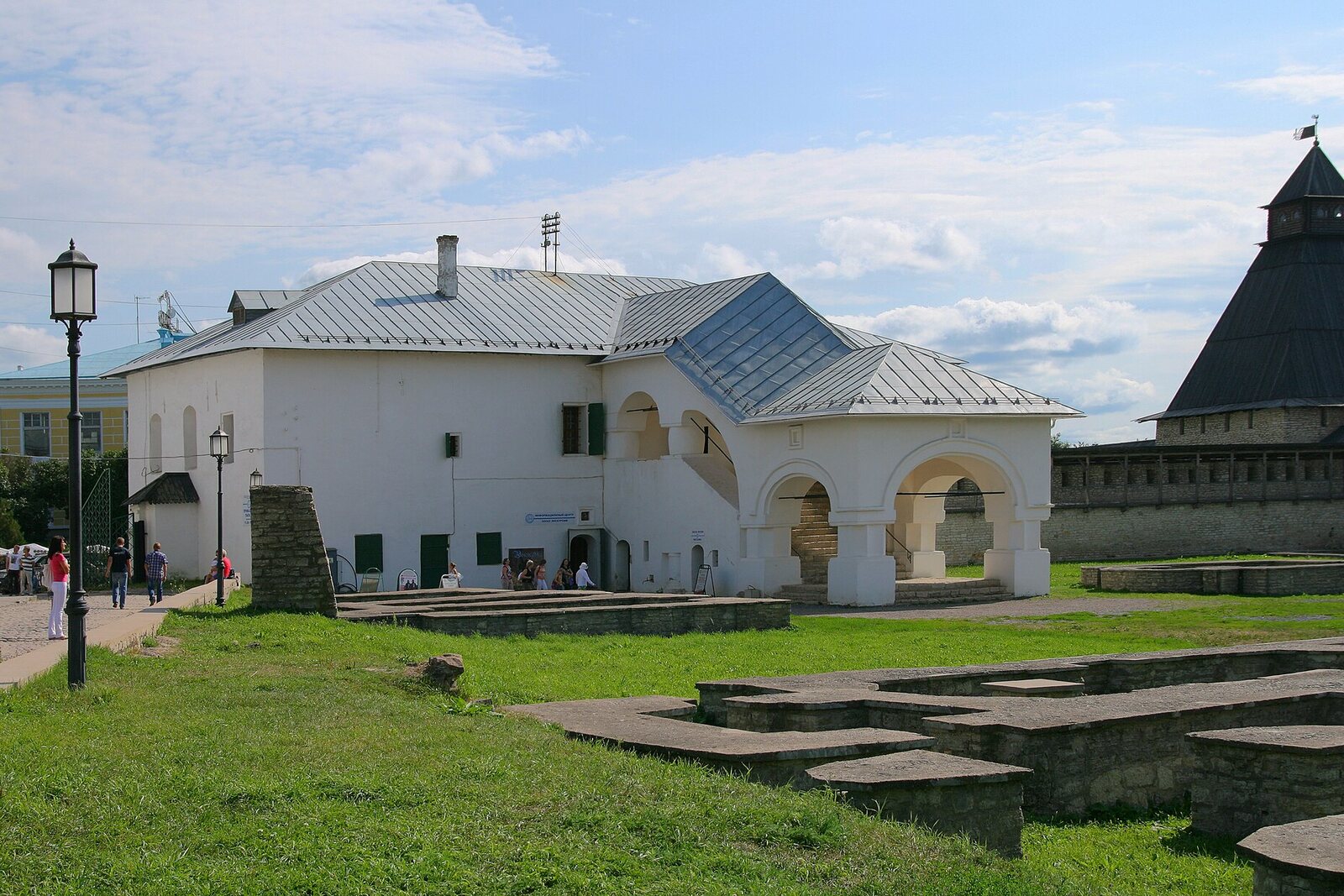
Look around first
What to notice
- White walls
- Stone porch
- Door and window openings
The story of the place
On September fourteenth, sixteen eighty-eight, the wooden Prikaz Chamber caught fire from its stoves and stove chimneys. Voivode Pyotr Golovin, appointed by the tsar to govern Pskov and its district, immediately asked the sovereigns Ivan Alekseyevich and Pyotr Alekseyevich to build a stone building. He listed what the next fire could destroy: the state seal, the monetary treasury, border affairs records, land registers, and books of income and expenditure.
Golovin added a practical argument: Pskov craftsmen built in stone more cheaply than Moscow craftsmen. Moscow ordered an estimate to be drawn up, while the officials were temporarily housed in a new wooden chamber paid for from customs and tavern duties. Stone construction was postponed for nearly four years.
In January sixteen ninety-two, the new Pskov voivode, Pyotr Matveyevich Apraksin, repeated the request. This time, permission came through. The tsar's decree named two reasons: Pskov stood on the border, and major fires often broke out in the city.
The townspeople and district people—the residents of the city and its surroundings—were to pay. A little more than two thousand rubles was collected from them. At the same time, Moscow required masons and laborers to be hired as cheaply as possible, forbade false additions to the accounts, and ordered every purchase and every payment to be entered in the expense book. The accounts were supervised by the nobleman Alexey Velyaminov, the clerk Gury Deshkov, and two elected Pskov residents. Apraksin had to report to Moscow and prove that the building was sound and that the money had not gone on unnecessary expenses.
The masons completed the main structure in two summer seasons. The porch was finished by sixteen ninety-five. The cost came in below the amount collected, and Apraksin sent a report: the chamber had been built with “good workmanship,” and there had been no overpayment.
The layout showed exactly what people did here. Downstairs, on one side of the entrance hall, chests of documents were stored; on the other, prisoners—people held in custody—were kept. Upstairs stood the voivode's small chamber, with the treasury and the sovereign's seal, and a large room for clerks. Clerks were employees who drafted, copied, and recorded documents. Their earnings depended on the cases that passed through the chancery; a regular salary from the treasury was granted only after long service.
The work was divided among five departments. At that time, a department was called a stol: the judicial department handled debts and minor criminal cases; the estates department processed land matters and searched for runaway peasants; the monetary department collected taxes and duties; the military records department kept track of servicemen. The embassy department dealt with the Swedish border, passes, embassies, intelligence, and the search for people who had gone abroad. Its interpreter had to speak Swedish, German, and Polish. In that era, a prikaz was a state institution; that is where the name Prikaz Chamber comes from.
This chancery was given only a very short span of time. In seventeen oh one, during the war with Sweden, the same Pyotr Alekseyevich ordered Pskov to be fortified. Builders dismantled the chamber's high wooden roof and used its parts in the new fortifications. The stone vaults were covered with turf, the documents and stoves were removed, and weapons occupied the rooms.
The present roof is no longer the one Apraksin accepted. Three iron flags stood on the first roof: a double-headed eagle, a lion, and a unicorn. They are no longer here. From the building paid for by Pskov residents and accounted for by the voivode, there remain white walls more than two meters thick and the former division of the rooms: the archive and prisoners' quarters downstairs, officials' rooms upstairs.
Useful on site
Daily from 10:00 to 18:00; tickets are sold until 17:30; the last Tuesday of the month is a sanitation day. Changes are possible.
Checked: July 2, 2026. Check the official source before visiting.Visiting the rooms may require a separate museum admission. If you cannot get inside, listen by the façade: the exterior conveys the building's enclosed, bureaucratic character well.