 Guide On Map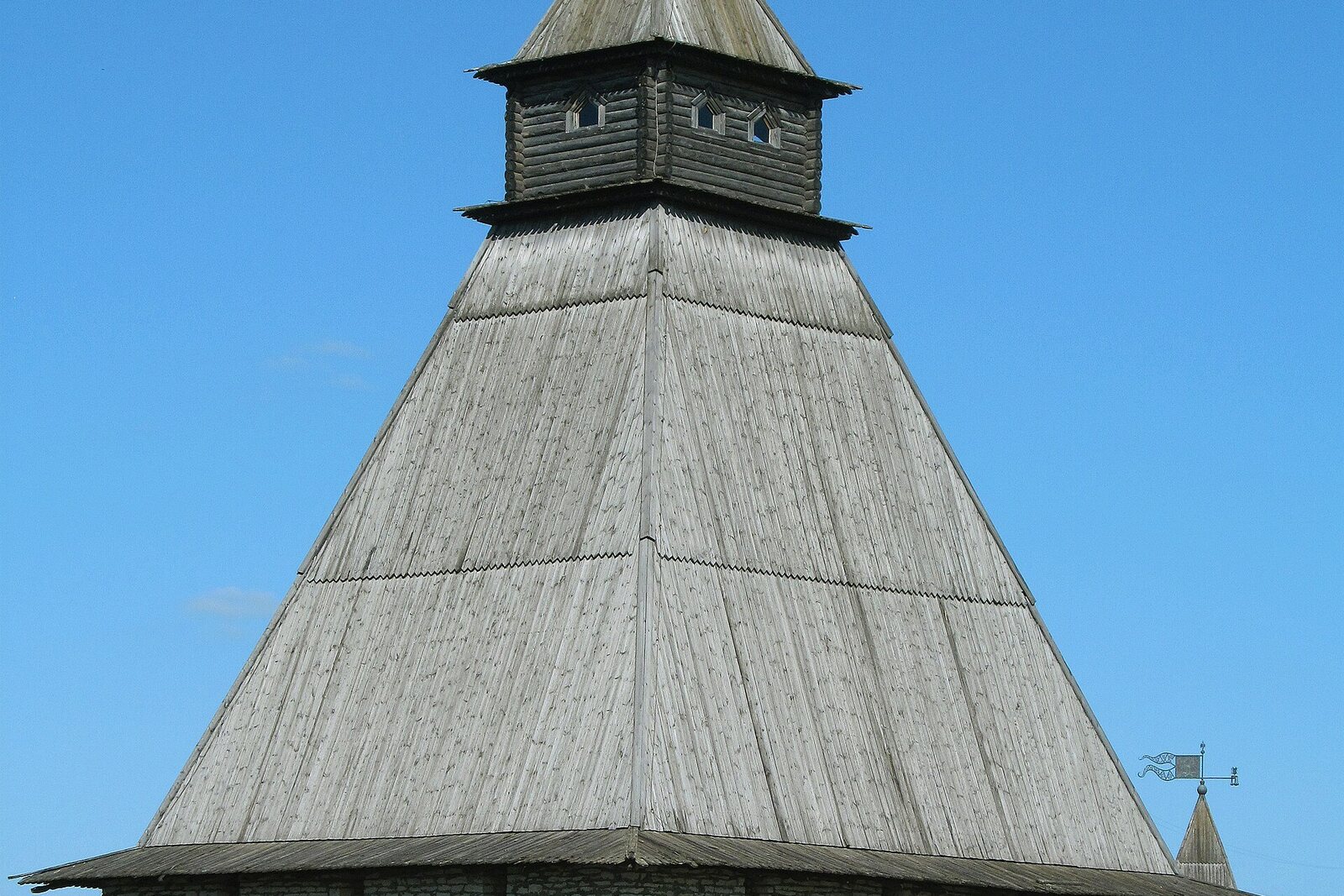
Look around first
What to notice
- Wooden tented roof
- Copper prapor
- Passage arch
- Viewing platform
The story of the place
After the fire on the night of April twenty-eighth, two thousand ten, the artist-blacksmith Dmitry Smirnov held in his hands a copper bird removed from the damaged finial of Vlasyevskaya Tower. The flames began in the restaurant premises inside the tower, destroyed the wooden tented roof, and spread along the roof of the fortress wall to the neighboring tower. People were evacuated before the firefighters arrived. The stone section held, while the copper sheets of the finial curled from the heat; the embossed images were destroyed.
The bird was made by Dmitry's father, the restoration architect and blacksmith Vsevolod Smirnov. In nineteen sixty-six, Pskov craftsmen were completing the reconstruction of Vlasyevskaya Tower. The original structure had been dismantled as early as the late eighteenth century, when its narrow angled gates began to obstruct traffic to the floating bridge. For a time, a chapel stood on its foundation. The present tower was raised anew from old measurements, descriptions, and the foundation uncovered by archaeologists.
Smirnov was given a tall tented roof without its historical finial. His craft was restoring lost metal details to Pskov buildings, and for this tower he forged a two-sided prapor, a metal banner-weather vane. Pskov leopards appeared on its sides, and above it the master set a copper bird with a cross-crown. He assembled the design from information about weapons once kept at these gates.
Weapons were kept here because this was the most dangerous section of the entrance to the city. From the crossing over the Velikaya River, the road rose through the tower straight to the Old Market. For a long time, this was the only passage from Zavelichye to the central part of Pskov. At the gates, a bridge toll was collected; visiting merchants presented their goods to the merchant headmen and could begin trading only after receiving their permission. At night, guards locked the wooden doors and lowered the iron grille; a cannon was positioned on the city side to strike those who managed to break into the passage.
Pskov residents called the tower and the descent Vlasyevsky after the church that stood nearby. It was dedicated to Vlasiy of Sebastia, bishop of the city of Sebastia and a Christian martyr of the early fourth century, who in Rus' was revered as the patron of domestic livestock. The stone church was built here in thirteen seventy-two or thirteen seventy-three, shortly before the first chronicle-recorded construction work on the gate tower. The church has long been gone; archaeologists discovered its foundation near the Prikaz Chamber in nineteen ninety-two. Its name remained with the tower, the descent, and the former gates.
After the fire, Vsevolod Smirnov's son set about restoring his father's work. The original sketches had not survived, so Dmitry Smirnov and other blacksmiths recreated the embossed decoration from old photographs. On January twentieth, two thousand eleven, the prapor was raised again onto the newly rebuilt tented roof. The present bird above the viewing platform is a copy made by the son of the one his father raised here during the tower's first reconstruction.
Useful on site
Daily: from 10:00 to 18:00 from November through April, from 10:00 to 20:00 from May through October; the last Tuesday of the month is a sanitation day.
Checked: July 2, 2026. Check the official source before visiting.For the main story, viewing from outside is enough; check access to the tower separately. Find a point from which the gates and the Velikaya River are both visible—the tower's purpose is harder to grasp without the river.