 Guide On Map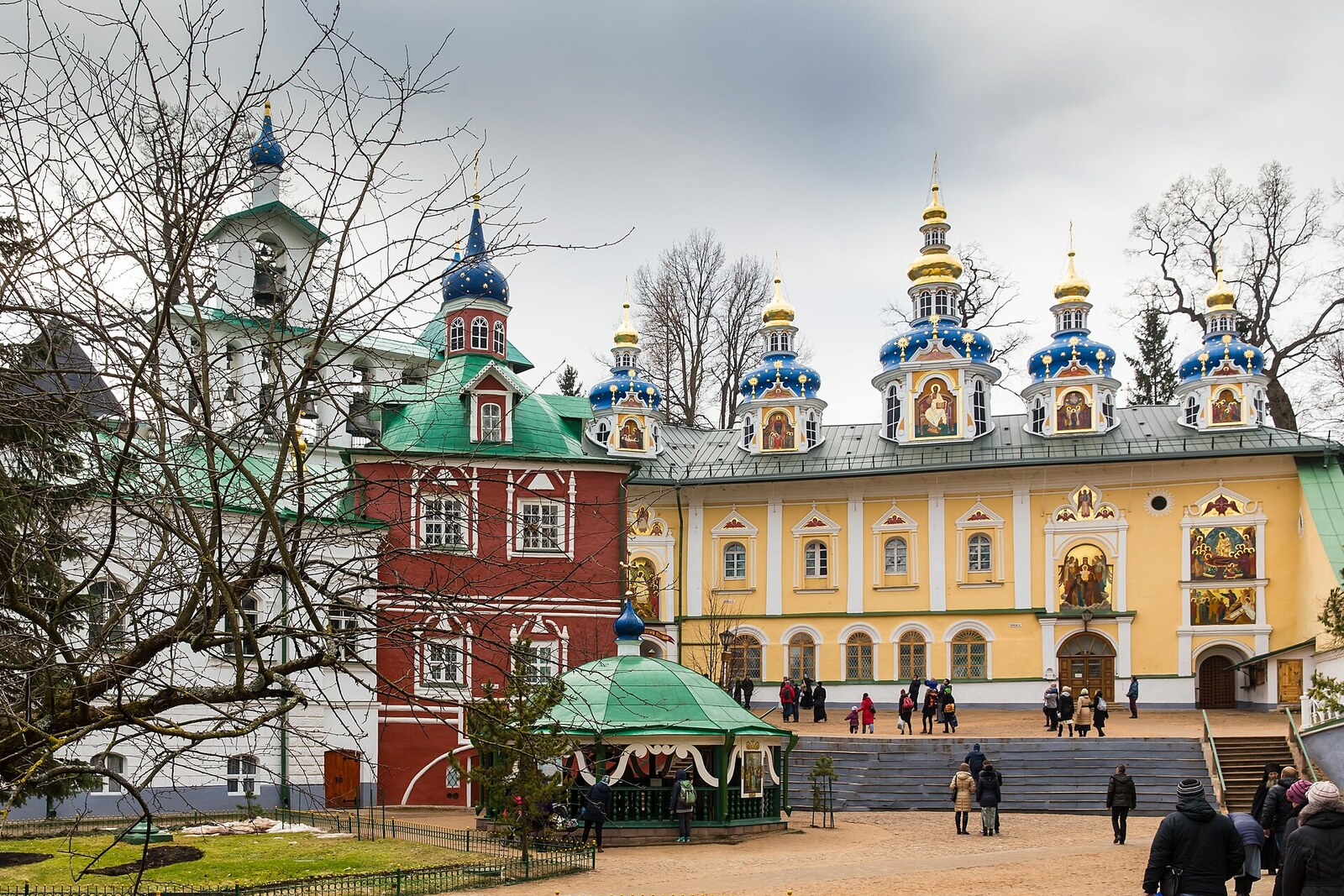
Look around first
What to notice
- St. Nicholas Gate Church
- The descent of Bloody Path
- The white facade of Dormition Church
The story of the place
The descent from St. Nicholas Gate Church to the white facade of Dormition Church is called Bloody Path. The name is connected with Cornelius—the hegumen who, for forty-one years, was responsible for the monastery on a militarized border and worked to ensure that the monks could live, hold services, and take shelter here behind a stone wall.
Cornelius came here in the early fifteen twenties, when the monastery could barely feed the brethren. He recalled that at times the monks received only a little grain or oats, ground it themselves, and baked bread. In fifteen twenty-nine, twenty-eight-year-old Cornelius was elected hegumen. Under him, the monks and invited craftsmen rebuilt and painted Dormition Church and erected a bell tower, workshops, and a fortress wall.
The walls appeared during the Livonian War. A tsarist military commander took part in their construction, while Tsar Ivan the Terrible, hoping to hold this border, granted the monastery charters and made donations. A later account claiming that the tsar first saw the fortress and took it for Cornelius’s secret rebellious scheme oversimplifies matters: the court knew about the fortifications.
Suspicion may have arisen because of another connection. Andrei Kurbsky, a former tsarist military governor, fled to the Grand Duchy of Lithuania and became an opponent of Ivan the Terrible. He asked the monks of Pechory to send him books, and in one letter he sharply criticized the tsar. The letters were intended for a monk close to Cornelius. Historians link the hegumen’s execution to this correspondence, although the documents did not preserve the exact charge.
On February twentieth, fifteen seventy, Cornelius was executed by order of Ivan the Terrible. The Tale of the Pskov-Caves Monastery, compiled soon after his death, puts it evasively: the earthly tsar “sent the hegumen ahead” to the Heavenly Tsar—that is, sent him to his death. The author did not say where or how he was killed.
According to later monastery tradition, Cornelius met the tsar with a cross at the gate. Ivan the Terrible himself cut off his head, immediately repented, lifted the body, and carried it down to Dormition Church. Blood left a trail on the road—hence its name. This scene belongs specifically to tradition: early written evidence confirms neither the place of execution nor the tsar’s blow. Ivan’s own involvement is almost beyond doubt. In the Tsar’s Synodikon—a list of people who were to be commemorated in church after their execution—Cornelius’s name stands first among the people of Pskov.
Dormition Church below is arranged inside a sandy hill; its outer facade covers the entrance to an underground chamber. After Cornelius’s death, his body was placed in the wall of a monastery cave. In sixteen ninety, the metropolitan of Pskov ordered the hegumen’s remains, venerated as holy relics, moved to Dormition Church. The reliquary containing them remains there today—at the lower end of the road named after the tradition of his final journey.
Useful on site
The monastery grounds are open from the morning service until the evening service; entry to individual churches is governed by services and the monastery’s instructions on site. Checked 2026-06-24.
Checked: June 24, 2026. Check the official source before visiting.Do not obstruct the brethren’s movements or services; it is best to keep conversation and filming near the entrance to a minimum. Treat the killing of Cornelius as monastery tradition, not as an indisputably established scene.