 Guide On Map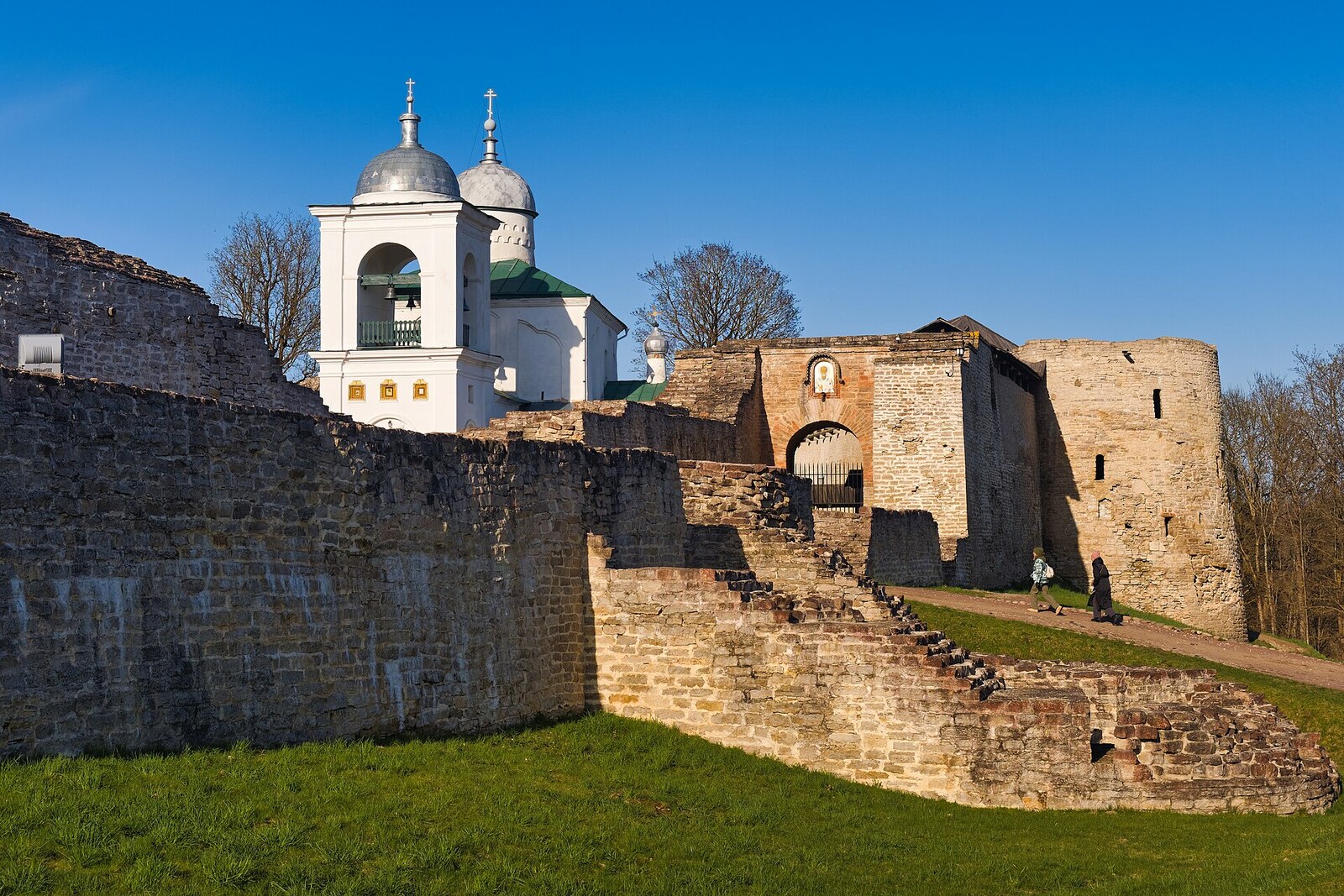
Look around first
What to notice
- Nikolsky Zakhab
- Inner Nikolsky Gates
- Western fortress wall
- St. Nicholas Cathedral
The story of the place
On the western side of the fortress, level ground comes closer than it does at the other slopes, so the densest defenses were concentrated here: towers, a thickened wall, and Nikolsky Zakhab. The road to the courtyard runs for more than ninety meters between two stone walls and passes through several gates; attackers trapped inside could be fired on from both sides. The entrance took its name from St. Nicholas Cathedral beyond the gates, and the present inner gates were rebuilt in the nineteenth century. The western approach, the stone corridor, and the courtyard still form a single defensive route.
On January eleventh, fifteen sixty-nine, the guards at the main entrance to Izborsk saw people in black clothing. The arrivals identified themselves as oprichniki—armed servicemen of the tsar's personal court—and demanded that the gates be opened.
Timofey Teterin rode at the head of the detachment, a former commander of the Moscow streltsy. After falling into disgrace and taking monastic vows, he fled to the Polish king Sigismund II Augustus and was now helping the king's soldiers capture the fortress whose defense he himself might once have commanded. About eight hundred warriors of Prince Aleksandr Polubensky waited behind Teterin. The prince needed to get them inside without a lengthy siege or artillery.
The gatekeeper believed the tsar's clothing and the order. The gate leaves were thrown open, and Polubensky's men entered Izborsk.
This trick could work only at the Nikolsky Entrance. By the sixteenth century, it was the main and probably the only passage into the fortress. The western side was called the assault side: here relatively level ground approached the walls, while steep slopes hindered an approach from the other sides. That is why the people of Pskov placed several towers along the western wall, thickened the masonry, and routed the road to the courtyard through a zakhab—a corridor more than ninety meters long between two lines of walls and several gates.
The zakhab was designed for an enemy breaking through the outer entrance. While attackers crowded between the locked gates, the defenders could fire on them from both walls. On that January night, nothing had to be broken through. The guards themselves let in the people whom they were supposed to obey, and the long corridor led the detachment straight inside.
The zakhab is called Nikolsky after the gates near St. Nicholas Cathedral, dedicated to St. Nicholas the Wonderworker—a Christian saint especially venerated in Pskov Land. There is no military man named Nicholas in this story: the same name links the entrance with the church standing behind it.
Polubensky's detachment held Izborsk for only two weeks. Russian regiments shelled the fortress with cannons and recaptured it; about one hundred warriors from the garrison left behind were taken prisoner. After the town was returned, Izborsk clerks were accused of aiding Teterin and executed. A new order was sent to the border fortresses: no one was to be admitted any longer merely because an arrival called himself an oprichnik.
The gate leaves opened that night have not survived. The present Inner Nikolsky Gates were rebuilt in the nineteenth century. The entrance line itself remains: the western approach, the long stone corridor, and the courtyard beyond it—the route by which the fortress was once taken without making a breach in the wall.
Useful on site
Izborsk Fortress: Monday–Friday and Sunday 09:00–18:00, Saturday 09:00–20:00; adult ticket 200 ₽. Checked 2026-06-24.
Checked: June 24, 2026. Check the official source before visiting.View the entrance both from outside and from within the passage, without lingering in the roadway. The upper sections and certain interior spaces may not always be accessible.