 Guide On Map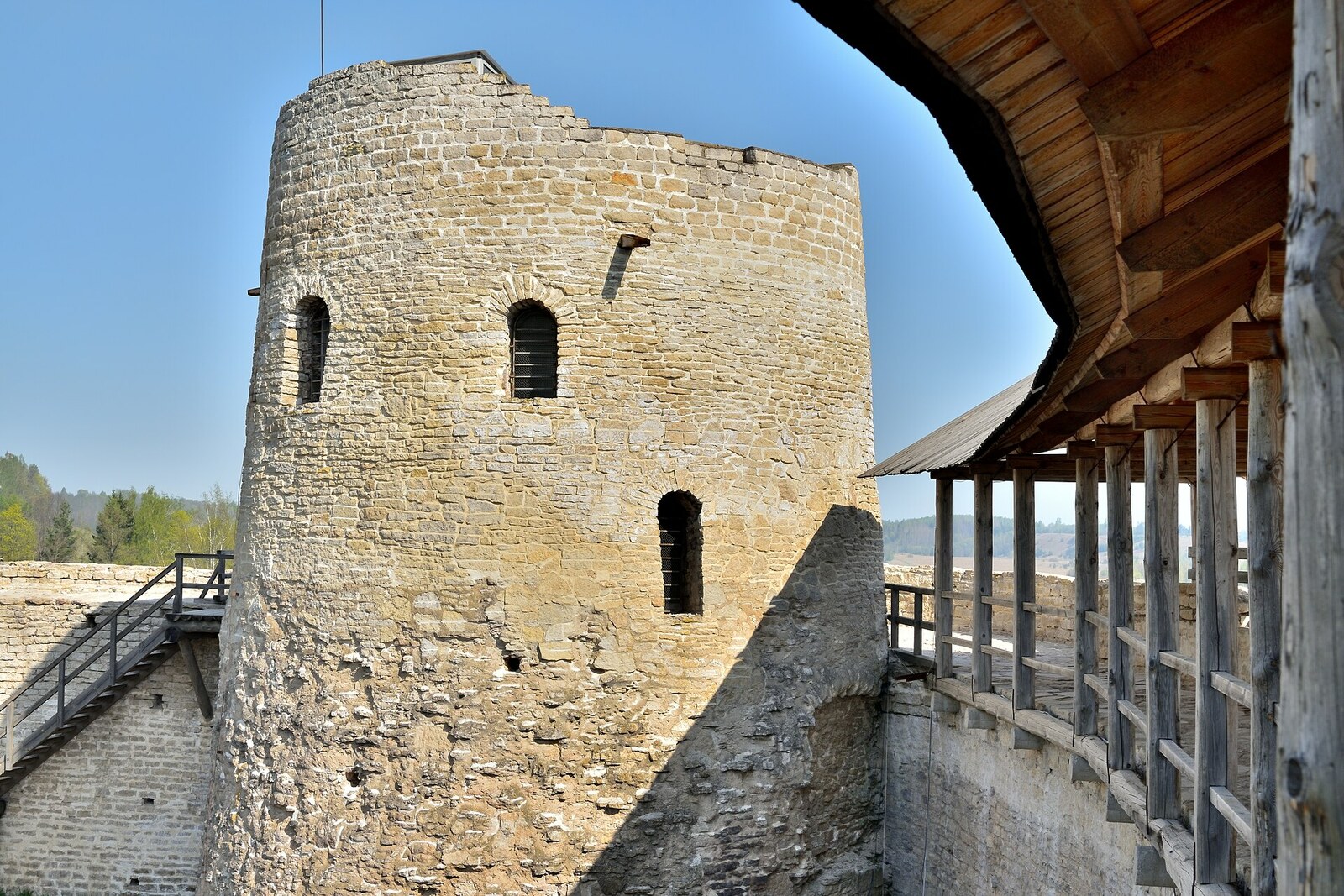
Look around first
What to notice
- Round Lukovka Tower
- Sealed lower embrasures
- Stone vault of the secret passage
- Steps to the spring
The story of the place
Lukovka Tower stands inside the fortress courtyard. Such a position is unusual for a combat tower, and it remains from early Izborsk: at first, the tower marked the edge of the fortification, and when the builders expanded the fortress, they ran the new wall outside it. The lower embrasures, now facing the courtyard, were sealed up. At the beginning of the sixteenth century, a powder magazine was cut beneath the tower—"zelie" was the name used for gunpowder. Muskets, fuses, and lead were stored there as well.
The secret passage on this side of the fortress appeared after a siege during which the defenders had almost nothing to defend themselves with without water.
In August thirteen forty-two, Yuri Vitovtovich, a prince allied with Pskov, decided to capture a prisoner to learn the enemy's strength. He took willing men from among the people of Pskov and Izbor and went out to meet the Livonian army. At Mekuzhitskoye Field, the scouts encountered a large host. Sixty men were killed, while Yuri and a small retinue managed to take refuge in Izborsk.
The next day, the Livonian army surrounded the fortress. The besiegers brought stone-throwing machines, called poroki in the chronicle, and cut off the people of Izbor from water. The siege lasted ten days. The remnants of the prince's detachment and the people of Izbor held out behind the walls, although the chronicler states directly that there was already no water in the town.
Then the besiegers burned their machines and supplies and left. They never learned what condition the defenders were in. The chronicler explained the retreat as the help of the Holy Trinity and St. Nicholas the Wonderworker. He says nothing about military cunning: all that is known is that the people in the fortress did not surrender, and the enemy left, unaware of the lack of water.
After this siege, the people of Pskov and Izbor laid out a covered descent to a spring beneath the wall. This passage did not save Yuri Vitovtovich and his men—it did not yet exist then. The surviving gallery was a consequence of the siege they endured: about forty meters of steps beneath a stone vault, a descent of sixteen meters, and a spring well at the foot of the slope. In the next siege, people could go from the fortress to fetch water.
Useful on site
Inside Izborsk Fortress; use the fortress opening hours and the actual tower access on the day of your visit as a guide. Checked 2026-06-24.
Checked: June 24, 2026. Check the official source before visiting.Do not enter a closed or unlit passage on your own: access to the gallery may be restricted. The stone steps may be damp and slippery.