 Guide On Map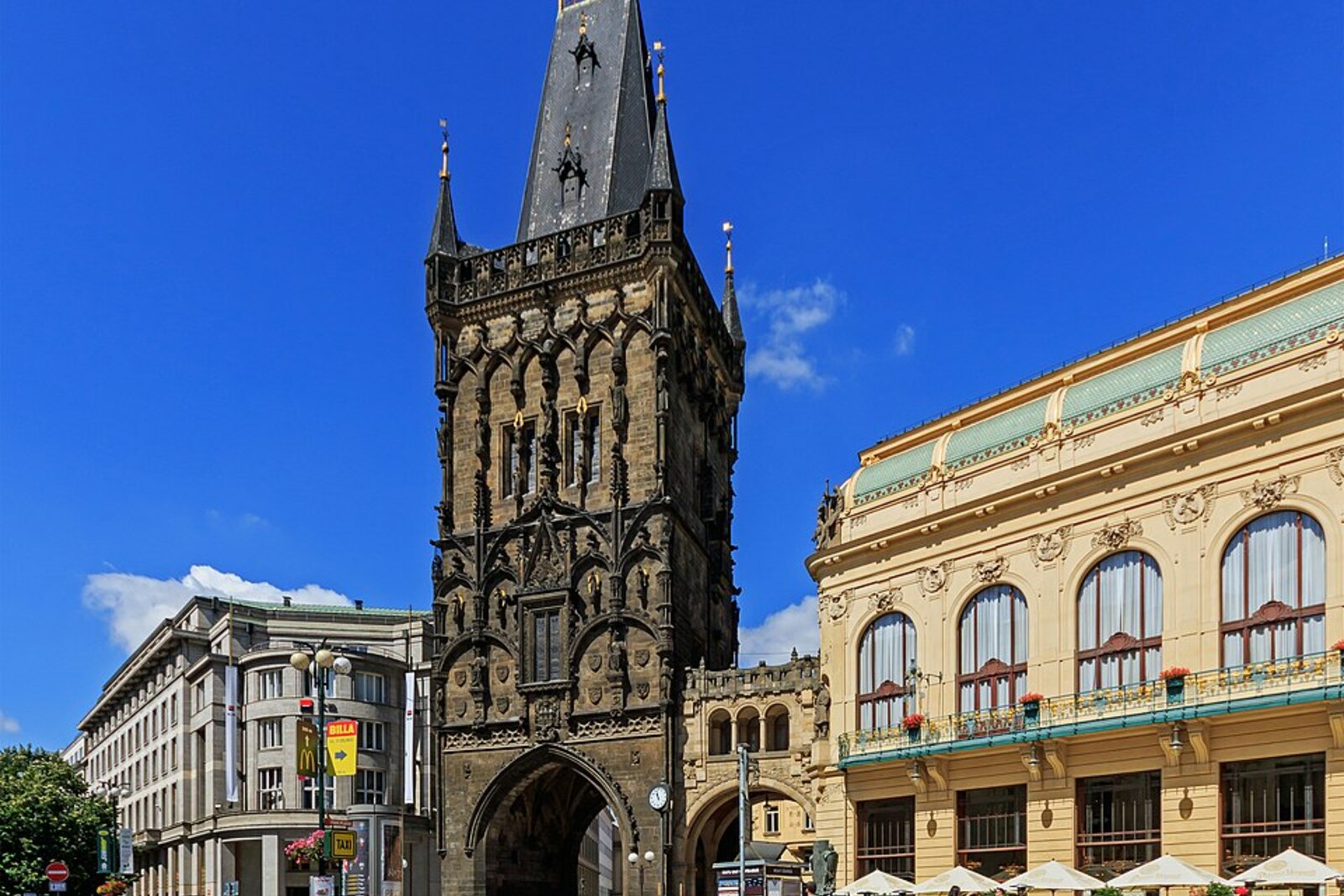
Look around first
What to notice
- Stone cornice with the inscription
- Bust of Matěj Rejsek
- Inscription above the arch
- Walkway gallery
The story of the place
On the façade facing Celetná Street, the inscription and stone bust of Matěj Rejsek, a teacher at the Týn School, have survived; for him, this work became his first major construction project. Beneath the present pavement, the level of the former moat remains: the tower’s foundation lies almost nine meters below the street, and a bridge once led to the passageway. The arch here opened the coronation road along which heirs to the throne traveled through the city to St. Vitus Cathedral. The tower was named the Powder Tower much later because of a presumed store inside, although there is no archival proof that gunpowder was actually stored here.
On March twentieth, fourteen seventy-five, King Vladislav II Jagiellon laid the first stone here for a new gate. The event was recorded directly on the stone cornice. Beside it stood the Royal Court, a residence on the site of today’s Municipal House. Old Town councilors wanted to give the king a fitting entrance while also replacing a dilapidated city tower.
Its predecessor was called the Mountain Gate because the road to the silver mines of Kutná Hora began here. When the masonry started to crumble, another name appeared: the Tattered Gate. The defensive importance of this line had already diminished: the New Town had long since grown up beyond the old wall. The new tower was conceived as a ceremonial entrance and a place to collect tolls. It was built directly in the former moat, about nine meters below the present street level; a bridge led to the passageway.
Master Václav supervised the construction. A year later, the city council called in Matěj Rejsek, rector of the Týn School, to assist him; Rejsek knew how to draw designs and carve stone. He had not followed the usual path from apprentice to master: until then, Rejsek had earned his living by teaching, and the tower became his first known major construction project. At first, he was assigned only to carve “flowers and images” for the façade. Rejsek achieved more, and in fourteen seventy-eight he was given charge of the entire work. Above the arch, he left his own bust and an inscription in which he called himself a Prague bachelor.
Yet the tower’s purpose depended on the man who laid its first stone. Vladislav was the Catholic king of a country where most inhabitants belonged to the Utraquists, followers of the Hussite tradition who gave laypeople communion in bread and wine. Seeking the pope’s recognition, the king tried to replace the Hussite city councils. In September fourteen eighty-three, the people of Prague rose in revolt, killed several royal councilors, and installed their own. Vladislav did not dare return to Prague for a whole year.
After returning, he settled not in the Royal Court but behind the fortifications of Prague Castle. The ceremonial gate remained beside the deserted residence. By fourteen eighty-eight, work had stopped, and only a year later could Rejsek temporarily finish the top of the tower. He then left for Kutná Hora, where he was commissioned to complete the Church of St. Barbara; he worked there until his death and was buried there as well.
Coronation processions continued to pass through the gateway. From here, future kings of Bohemia traveled through the city to St. Vitus Cathedral, which is why the Royal Route begins here. Ferdinand V was the last to follow this route before his coronation, in eighteen thirty-six.
The tower acquired its familiar silhouette later. Prussian artillery damaged it in seventeen fifty-seven, and at the beginning of the nineteenth century, the broken carvings were removed. The city even discussed demolishing it. Then the architect Josef Mocker completed the tower in the form he believed the medieval masters had intended. The present roof, walkway gallery, and a substantial part of the sculptures appeared during his work from eighteen seventy-five to eighteen eighty-six.
The tower came to be called the Powder Tower only in the eighteenth century, because of a presumed gunpowder store inside. No written evidence confirming that such a store operated has survived. Above the arch on the Celetná Street side, another name remains: Matěj Rejsek of Prostějov, Prague bachelor. The name “Powder” appeared more than two centuries after his inscription.
Useful on site
The tower is open seasonally: January–March 10:00–18:00, April–May 10:00–19:00, June–September 9:00–20:30, October–November 10:00–18:00, December 10:00–19:30. The adult ticket on the verification date is 200 Czech koruna; the building is not barrier-free. Checked 2026-06-29.
Checked: June 29, 2026. Check the official source before visiting.The main meaning can be read from the street; leave climbing inside as a separate choice if you are prepared for the stairs.