 Guide On Map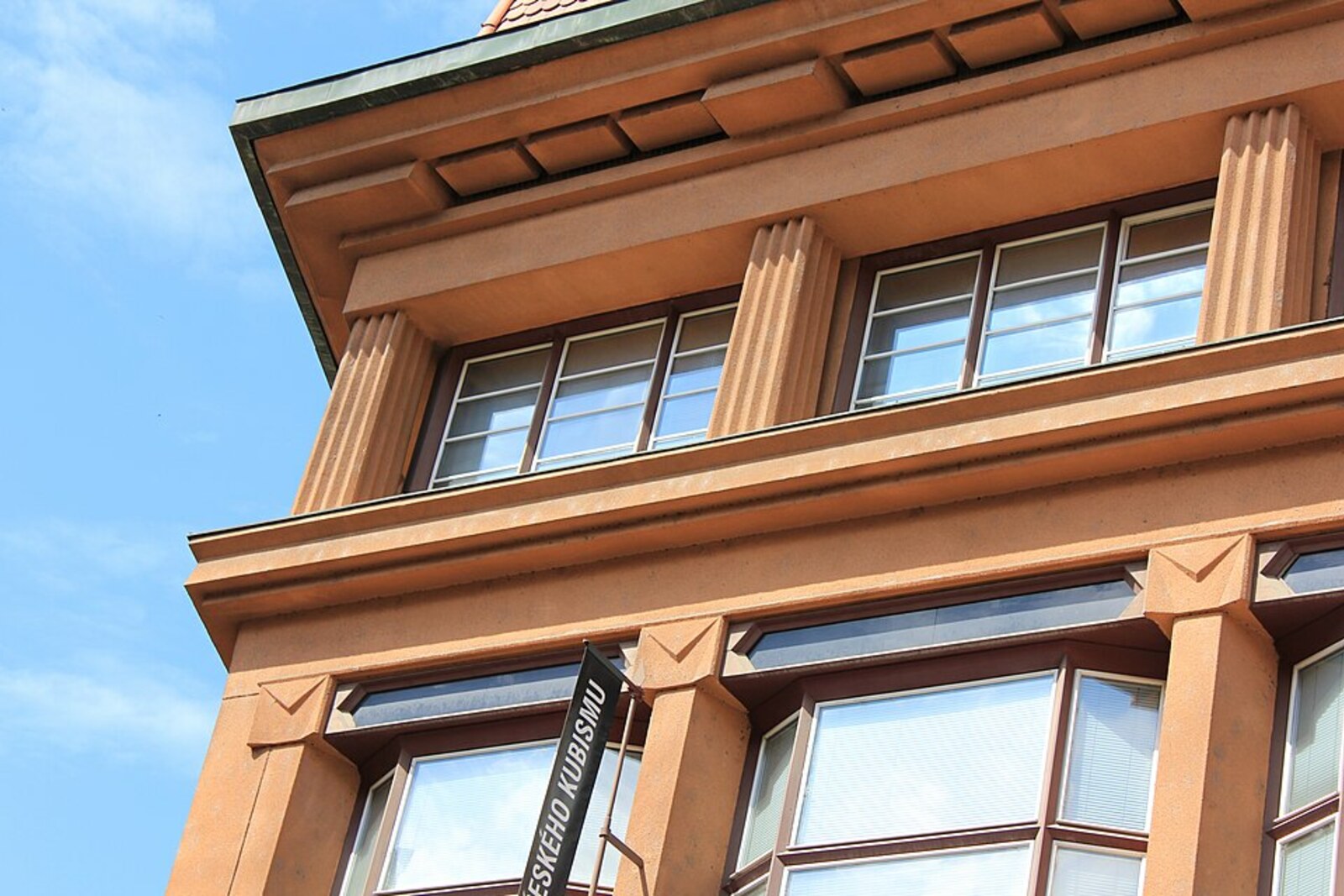
Look around first
What to notice
- The figure of the Black Madonna
- The gilded grille
- Faceted bay windows
- The stepped mansard roof
The story of the place
Behind the gilded grille on the corner stands a polychrome copy of the Black Madonna; only the name survived from the former Baroque house. The present facade is composed of faceted bay windows, angular details between the windows, and a stepped mansard roof that maintains the line of the neighboring roofs. Behind it, a reinforced-concrete frame once provided large sales halls without frequent supports, and later these premises became banking offices and ordinary offices. A café now operates below again, while above, the museum brings together Czech Cubism, including works in which furniture, paintings, and light fixtures were conceived together.
Celetná Street got its name from people who earned their living here long before coronation processions. In the thirteenth or fourteenth century, bakers known as caltneri settled along the street. They baked calty—braided buns. The street was first called Caletná, and later its pronunciation changed to Celetná.
At the beginning of the twentieth century, the wholesaler František Josef Herbst decided to expand the trade on this corner. He commissioned a department store: sales halls were planned below, with a café, a wine cellar, fabric and ready-made clothing shops, offices, and the caretaker's living quarters above. The former Baroque house was demolished to make way for construction. Defenders of old Prague tried to stop the demolition and sharply criticized the city council, but they lost.
Herbst entrusted the design to Josef Gočár, a thirty-one-year-old architect. The client needed spacious rooms without frequent interior supports; Gočár proposed a reinforced-concrete frame. At the same time, he had to obtain permission for a modern building amid the old development of Celetná Street.
The first design did not satisfy Luboš Jeřábek, the regional monument conservator, who sought to ensure that the new store would not disrupt the street's appearance. He found the large windows and projecting cornice excessive, the pillars of the upper floor too angular, and the roof too shallow.
Gočár answered unexpectedly: instead of disguising the frame as a Baroque palace, he intensified the Cubism. The second version featured faceted bay windows, angular capitals between the windows, a jagged portal, and grilles with a sharp geometric pattern. At the same time, the stepped mansard roof retained the familiar roofline of the neighboring houses. The officials approved the design, and on October ninth, nineteen twelve, Herbst opened the store. It became Prague's first major Cubist building.
Commercial success proved shorter-lived than the architecture. As early as nineteen fourteen, the premises began to be altered, and in nineteen twenty-two the house ceased to serve as a department store. Banking offices took over Grand Café Orient and the sales halls, and then the building was divided into ordinary offices. Most of the Cubist interior decoration was destroyed. A café now operates here again, and on the upper floors a museum presents Czech Cubism—furniture, paintings, and objects from the period when Gočár designed even the counter and light fixtures as parts of a single building.
The house inherited its name from the destroyed predecessor. At its corner stood a wooden figure of the Mother of God with the infant Christ, made around seventeen hundred; the dark color of her face gave it the name Black Madonna. Gočár incorporated the saved house sign into the new facade behind a gilded grille. A polychrome copy made in two thousand is now installed outside. The old house is no longer here, but its name remains on the corner of the building for whose construction it was demolished.
Useful on site
Museum of Decorative Arts at the House of the Black Madonna: Tuesday 10:00—20:00, Wednesday—Sunday 10:00—18:00, Monday closed. Adult ticket on the verification date — 150 Czech crowns. The outside stop is accessible without a ticket. Checked 2026-06-29.
Checked: June 29, 2026. Check the official source before visiting.The facade explains the idea well on its own; treat the café and museum as separate visits.