 Guide On Map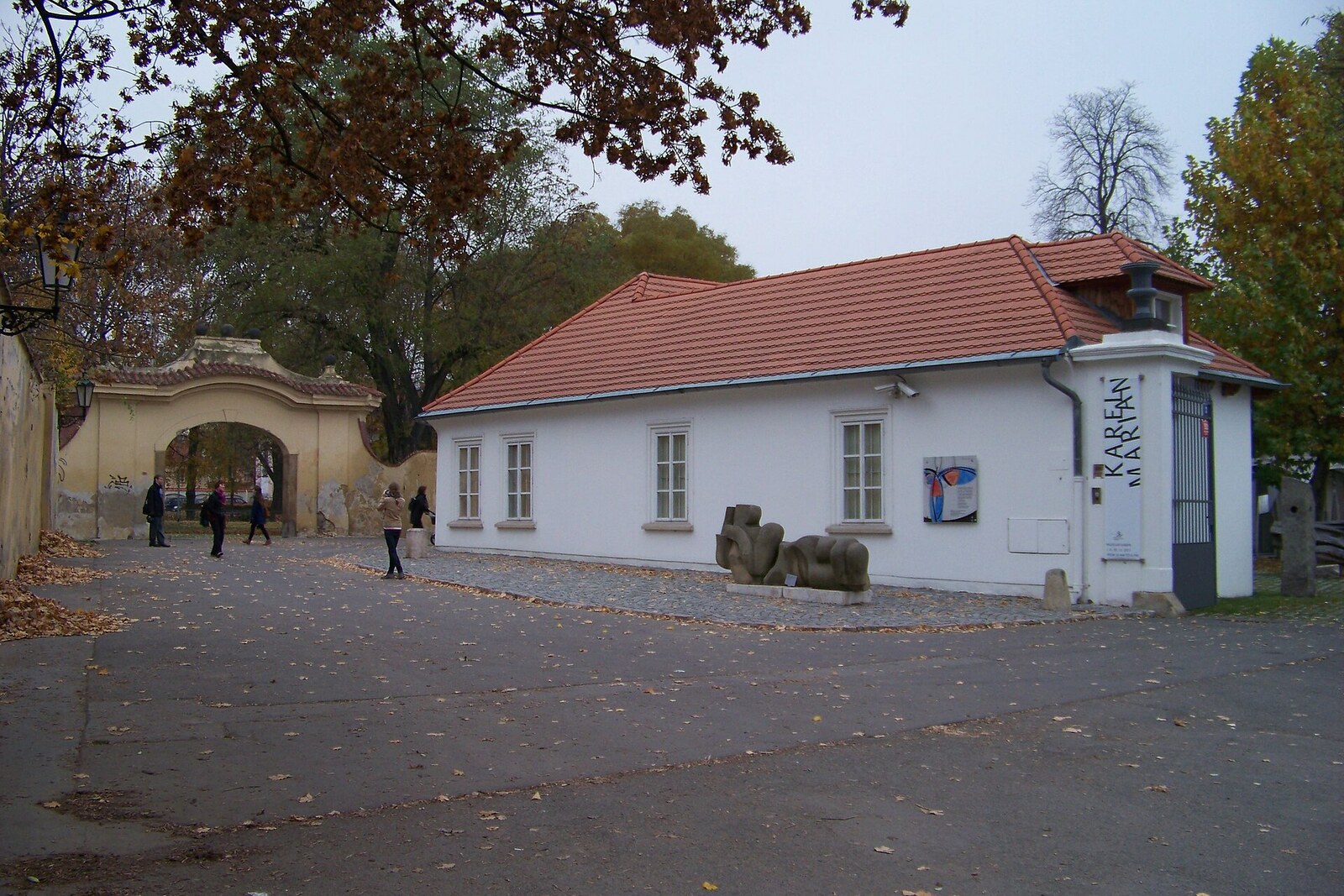
Look around first
What to notice
- The wing of Sova's Mills
- The stair tower
- The glass cube above the tower
- František Kupka's Cathedral
The story of the place
The Sova in the name of these mills is a surname, not a bird. In fourteen seventy-eight, Prague city councilors transferred a plot devastated after the Hussite Wars to their colleague and master, Václav Sova of Liboslavi. Sova wanted to establish a profitable enterprise here: he built a house, a workshop with a water-powered hammer, and a mill. The deal came with a condition: he had to grind flour for the townspeople. Later, a sawmill, a sharpening workshop, and fulling workshops appeared nearby. Sova bequeathed the property to his daughter, and other owners succeeded her as well, but the surname of the first restorer became attached to the mills.
The present museum came about thanks to another person who received a building that had already lost its former purpose. After the communist coup of nineteen forty-eight, what kept Meda Mládková, a Czech art historian and collector, abroad was not a desire to break with her homeland, but the impossibility of returning on her own terms. In Paris, she began buying works by the Czech artist František Kupka, and later, while living in Washington, D.C., she sought out artists in Czechoslovakia who were not allowed to exhibit freely.
Mládková did not spend someone else's fortune without restraint on paintings. Her husband Jan Mládek, an economist at the International Monetary Fund and the collection's other creator, earned a good salary. Meda herself bought neglected houses in Washington, D.C., remodeled them, and sold them. For Cathedral, a painting by František Kupka, the couple sold their own house in Georgetown. That was the price of one canvas now kept here.
Jan died in nineteen eighty-nine, a few months before the changes in Czechoslovakia. He wanted the art they had collected to return to Prague. This wish left Meda with a difficult task: to give the collection to the city and find it a permanent home. At first, she counted on a former monastery, but an agreement could not be reached. Sova's Mills became available when the previous applicant withdrew, and Mládková leased the complex from Prague for ninety-nine years.
The reconstruction turned into a dispute that lasted for years. Prague heritage-preservation specialists objected particularly strongly to the glass cube above the stair tower: it rose higher than the roof and changed the familiar silhouette of the Lesser Town. Mládková had no intention of backing down. After several commissions rejected it, the minister of culture authorized its installation, and in March two thousand two, a helicopter lifted the metal frame onto the roof.
On June twenty-seventh, Mládková handed over two hundred fifteen works by Kupka to Prague. The full opening of Museum Kampa, named after the island, was scheduled for September eighth. But on August thirteenth, at four in the morning, employees were forced to leave the building because of flooding. The following day, they could inspect the storage rooms only from a boat.
Kupka's collection remained safe, but the water destroyed the technical rooms, furniture, and some of the works on display. Inside and in the courtyard lay a fifteen-centimeter layer of silt. Employees and volunteers carried it out for two weeks; for several days after the main work, employees of the American embassy helped them. Mládková's own apartment was flooded as well, with her papers and personal belongings still inside. On returning to Prague, she immediately began looking for money for repairs.
As early as November, exhibitions were held here with temporary heating and lighting. The museum opened fully in September two thousand three. The glass cube above the stair tower is the very one Mládková fought to have installed above the roof. Behind it is kept Cathedral, gifted to Prague and bought at the price of the couple's house in Washington, D.C.
Useful on site
Museum Kampa: daily 10:00–18:00, last entry 17:30; check prices and temporary exhibitions before your visit.
Checked: June 28, 2026. Check the official source before visiting.You can understand the history of the complex from outside. Plan the Museum Kampa exhibition as a separate visit and check access in advance.