 Guide On Map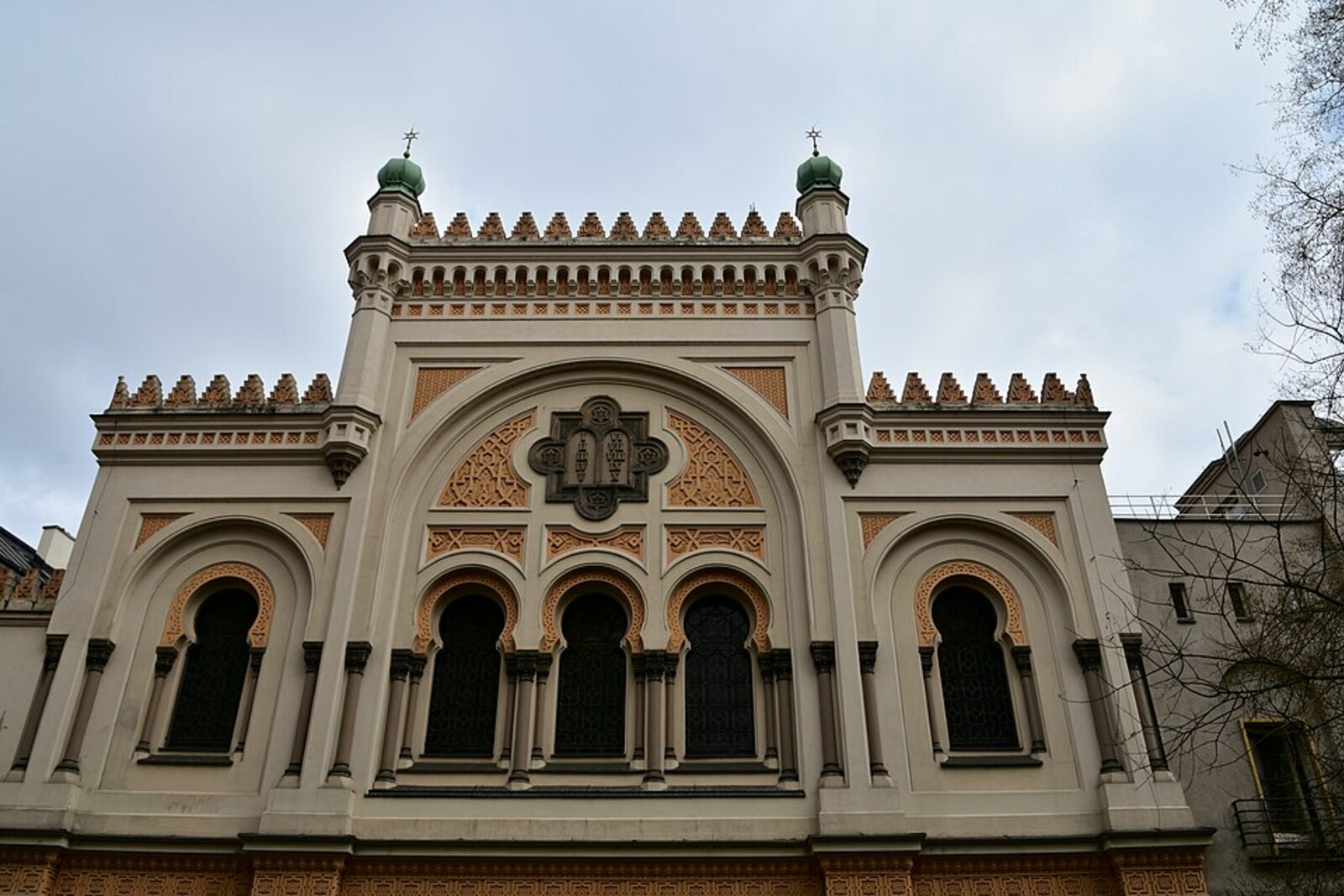
Look around first
What to notice
- Rows of benches
- Raised platform by the eastern wall
- Organ in the gallery
- Gilded arabesques
The story of the place
The history of the present Spanish Synagogue began with a dispute over seats. In eighteen thirty-two, fifty-four Prague Jews—manufacturers, merchants, and scholars—formed an association that needed its own worship service: with a German-language sermon, a predetermined order, a trained choir, and music.
For this, they chose the Old School that stood here—the name of Prague's oldest synagogue. At the time, it stood outside the boundaries of the Jewish Town, so the community's traditional leaders could not oversee what happened here as directly as they could in the synagogues of the ghetto.
Yet the building belonged to the entire community, while the seats inside belonged to individual families. A synagogue seat was considered inheritable property; it gave its owner prestige and the right to take part in community elections. The reformers had to exchange and buy back these seats; some owners refused to give them up. Only in January eighteen thirty-five did officials permit the renewed German-language service to be held here. Even then, the invited preacher still had to answer to Prague's senior rabbis.
The association invited Leopold Zunz, a Berlin scholar of Jewish texts, who was to draw up a new order of service and conduct marriages, blessings, and funerals here. Zunz sought independence and lifelong employment. The preacher's salary was to become his income, but the service left him less and less time for the scholarly work that he valued no less.
The preliminary contract promised him independence. When Zunz arrived in Prague in September eighteen thirty-five, the reconstruction of the Old School had not yet begun, while officials had already rejected the promised authorization. He drew up a thirty-page order of worship, but managed to preach here only four times. He resigned on January first and left Prague in June, taking the manuscript with him. It never came into force.
He was succeeded by the young preacher Michael Sachs. At first, Sachs agreed to conduct marriages only with the senior rabbis' permission, while the association continued to submit petitions. In March eighteen thirty-nine, Sachs was recognized as Prague's fourth rabbi and released from his former subordination. He served here until his departure for Berlin in eighteen forty-four, maintaining ties with part of the traditional community as well.
The association remained on this site. The Old School was demolished in eighteen sixty-seven, and the present building opened a year later. In the new hall, benches were arranged in rows, the raised platform for reading the Torah was moved to the eastern wall, and an organ was installed in the gallery. This created the space for the service whose right the association's members had sought for more than thirty years.
At first, the building was called the Israelite Temple, or the Israelite Temple on Dušní Street, after the street where it stands. The Moorish ornament, with gilding and arabesques, appeared only in eighteen eighty-two and eighteen eighty-three. The present name is usually associated with this decoration, which recalls the Spanish Alhambra. Scholars also name another possible reason: an old, erroneous version claiming that the Old School had a community of emigrants from the Iberian Peninsula. No Spanish rites were held here; the congregants were Prague Jews of the Ashkenazi tradition.
Regular services ceased in nineteen forty-one, when the occupation administration turned the hall into a warehouse for items confiscated from Jews. Since nineteen fifty-five, the building has been managed by the Jewish Museum in Prague. Now, beneath the dome, there is an exhibition about the Jews of the Czech lands in the nineteenth and twentieth centuries, and the restored organ is used during concerts. No walls of the Old School remain; Zunz's manuscript is kept in Jerusalem, while this site has preserved the hall for which he tried to establish a new order.
Useful on site
Seasonal hours of the Jewish Museum in Prague; check events and concerts separately.
Checked: June 26, 2026. Check the official source before visiting.The facade does not convey the richness of the hall, so a separate admission inside is needed for the full impression. During services, events, or concerts, follow the established visiting rules.