 Guide On Map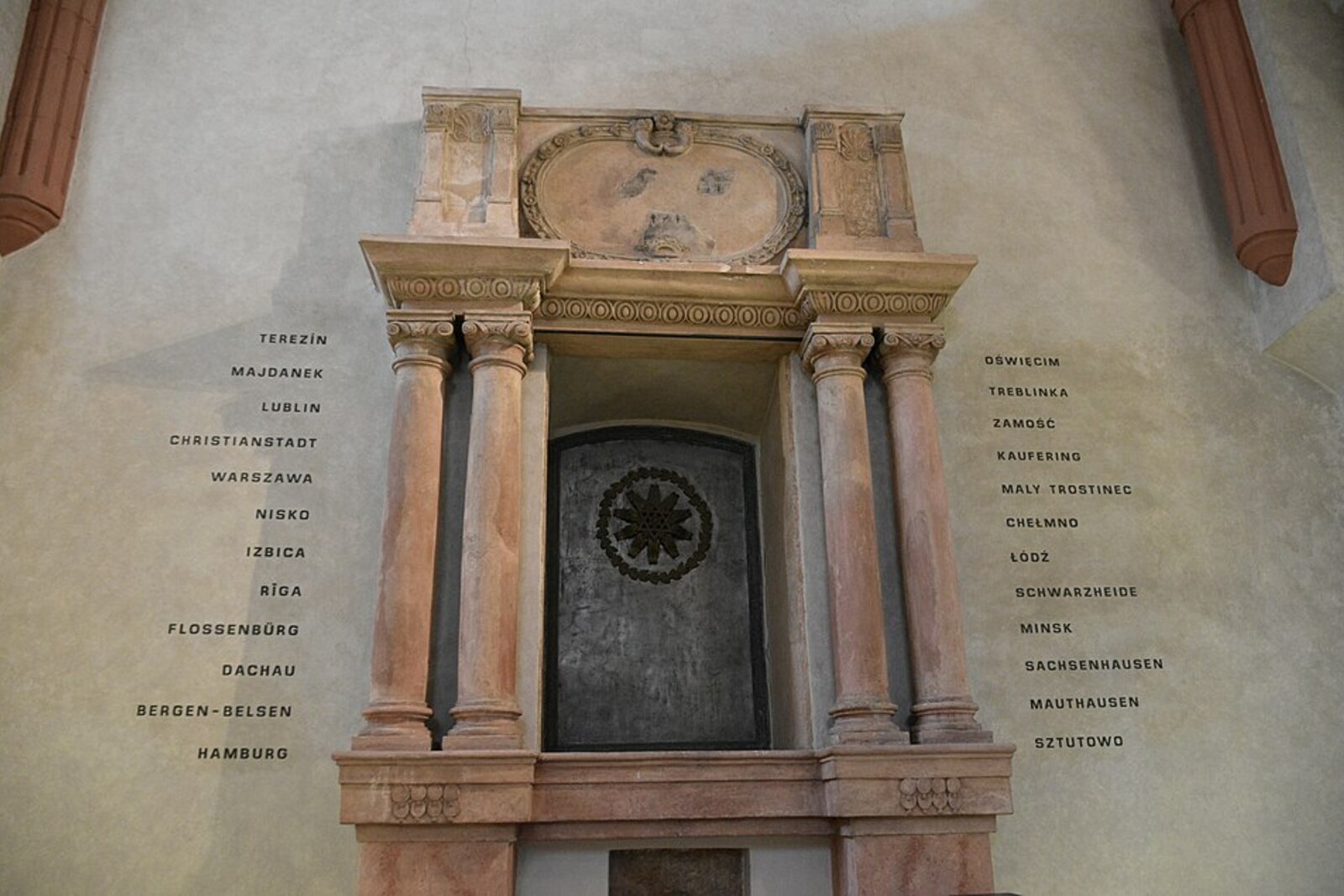
Look around first
What to notice
- Red surnames
- Black letters and numbers
- Yellow stars
- Dates beside names
The story of the place
In the early nineteen fifties, the state nationalized the Jewish Museum in Prague and ordered an exhibition on the Second World War to be installed in Pinkas Synagogue. The museum's director, the art historian Hana Volavková, sought something different: to name, one by one, the Jews of Czechia and Moravia murdered by the Nazis.
For her, this was not an abstract museum subject. Volavková joined the Jewish Museum, controlled by the Nazis, in nineteen forty-three and was among the few members of its staff who survived the war. Her relatives and friends were among those killed. After the war, her team prepared an exhibition in Terezín about the persecution of Czech Jews, but officials banned it: victims were to be commemorated without stating their origins, with priority given to Communists who had passed through the prison in the Small Fortress. After that, Volavková decided to create a Jewish memorial in Prague.
She chose Pinkas Synagogue: the former prayer hall right beside the Old Jewish Cemetery could be turned into a symbolic tombstone for people who often had no grave left. Obtaining permission depended on the same officials who had closed the Terezín exhibition. Volavková spoke to them in a language they understood: she reminded them of the monument to the Warsaw Ghetto uprising, referred to the possible propaganda effect and to the interest of the foreign press. The project was approved.
The synagogue itself appeared long before the memorial. In fifteen thirty-five, Aaron Meshullam Horowitz, an influential member of the Prague Jewish Community, and his wife Nechama enlarged the family prayer hall that stood here. The exact origin of the present name has not been established. Most likely, it is connected with Aaron's grandson, Rabbi Pinchas Horowitz; there is also a tradition about Israel Pinchas, the former owner of the House at the Coats of Arms that stood on this site.
Volavková entrusted the design to two young artists—Jiří John and Václav Boštík. They rejected an abstract monument in favor of a list of names. The material was gathered from postwar cards compiled from transport documents, registration lists, and survivors' testimonies. Then, for several years, John and Boštík themselves transferred more than seventy-seven thousand entries onto the walls.
They arranged the dead by their last place of residence. Prague families filled the main hall, while residents of other towns in Czechia and Moravia filled the side nave and gallery. Surnames and the first letters of given names were written in red, the remaining letters and numbers in black; families were separated from one another by a yellow star. Dates of birth and death were placed beside each name. The exact day of murder was usually unknown, so the date of deportation was given instead—the last news of the person preserved in the documents.
The memorial opened in nineteen sixty. Six years later, groundwater rising up the walls forced the synagogue to close for repairs. After the invasion of Czechoslovakia in nineteen sixty-eight, officials refused to restore the memorial to its former state. Over the following two decades, most of the inscriptions were lost. Volavková did not live to see their restoration.
After the change of regime, restorers reapplied the names following John and Boštík's design and completed the work in nineteen ninety-five. The present list continues to change: museum staff add names they have found and correct dates. Most of the lettering on the walls has been restored, but the deportation date beside many surnames still remains the last line that could be found.
Useful on site
Seasonal hours at the Jewish Museum in Prague; closed Sat and Jewish holidays.
Checked: June 26, 2026. Check the official source before visiting.The main part is inside. Allow time for a silent look around and follow the current photography rules; this is a memorial, not an ordinary exhibition hall.