 Guide On Map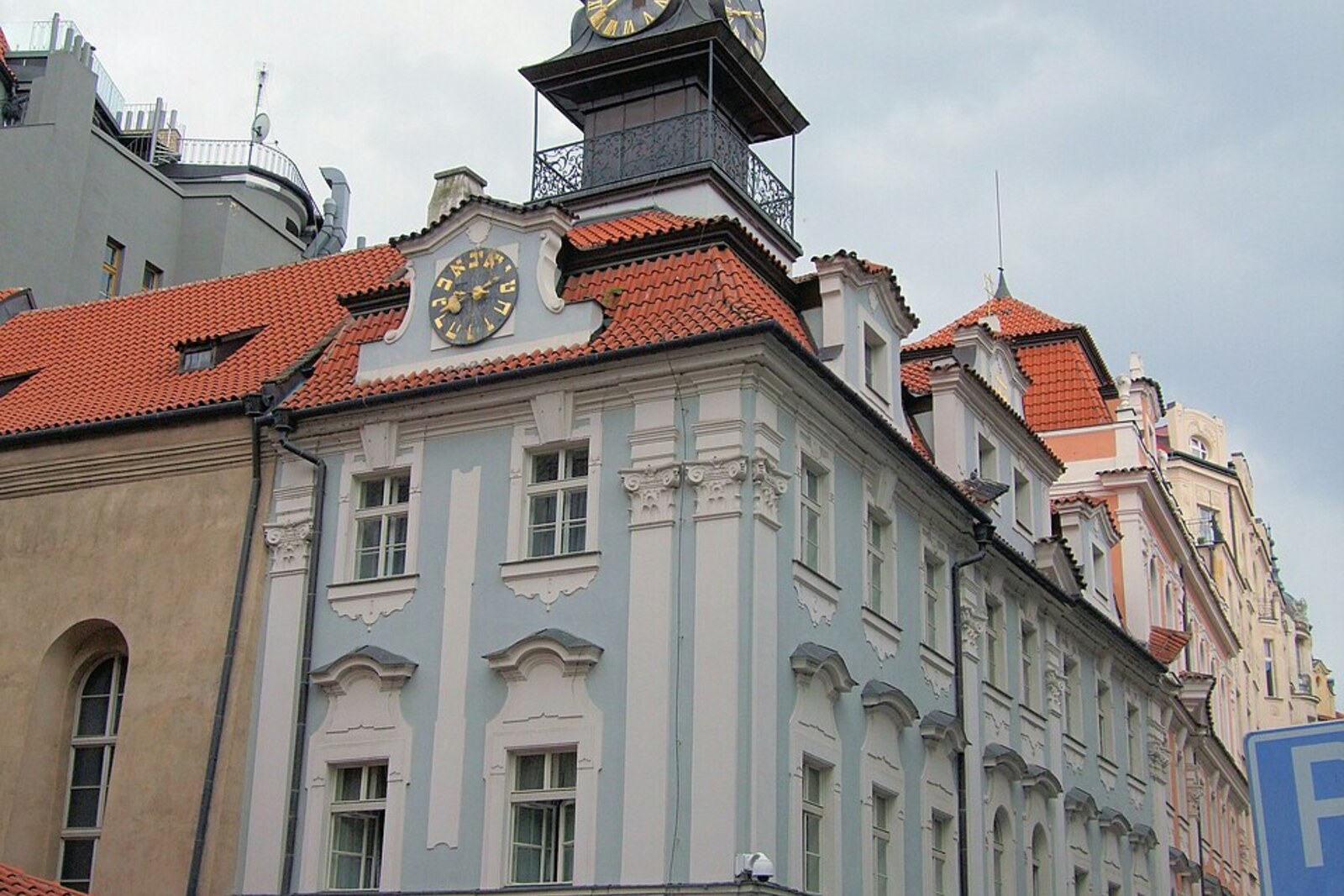
Look around first
What to notice
- Turret with a bell
- Upper dial with Roman numerals
- Lower dial with Hebrew letters
The story of the place
Behind the façade of the Jewish Town Hall, the offices of the Prague Jewish Community are still at work. In the sixteenth century, the Jewish Town had its own council of elders, court, and administration. The council met here, while its members prayed in the neighboring High Synagogue. At first, the synagogue was entered directly from the upper floor of the town hall: both parts formed a single complex.
It was paid for by Mordechai Maisel—the primus, that is, the head of the Jewish Town—who wanted to give the community a permanent home for its council and court. Maisel made his living from trade and bank loans. His clients included Czech nobles and the court of Emperor Rudolf II, which needed money for the war with the Ottoman Empire. In the fifteen seventies, Maisel invested the money he had earned in rebuilding the town hall and the High Synagogue.
His relationship with the emperor brought him a rare privilege: childless Maisel was allowed to dispose of his property himself. He drew up a will in favor of his nephews. But in sixteen oh one, immediately after his death, Rudolf II ordered the confiscation of his former banker's estate—about half a million guilders and many houses. The nephews who were his heirs were placed in custody, and for decades afterward the family litigated over what remained of the property. The town hall, already paid for by Maisel, continued to serve the community. It was the largest functioning institution among all that he had managed to turn his money into.
The turret above the roof appeared after another human story. In sixteen forty-eight, Swedish troops captured and plundered Prague Castle, Hradčany, and Lesser Town on the left bank of the Vltava. They then spent fifteen weeks trying to break into Old Town and New Town on the right bank. Behind the fortifications stood the homes and shops of the Jewish Town's residents.
The participation of Prague's Jews in the defense is sometimes reduced to a striking battle scene on Charles Bridge. Documents describe work on which the city's survival depended: day and night, ghetto residents kept fire watches, put out fires after bombardments, and repaired the fortifications. The Swedes never took the right bank.
After the siege, Emperor Ferdinand III, who was rewarding Prague's defenders, allowed the Jewish community to raise a turret with a bell above the town hall. The turret of sixteen forty-eight did not survive: the town hall burned and was rebuilt. Its present form appeared after the fire of seventeen fifty-four.
Ten years later, the court clockmaker Sebastian Landsperger made clocks for the restored town hall. The upper dial received Roman numerals and a conventional direction of movement. On the lower dial, Hebrew letters that denote numbers stand in place of numerals; their sequence runs from right to left, and the hands move counterclockwise. Inside the town hall, the mechanism of seventeen sixty-four has been preserved: above the community offices at work, it drives one dial to the right and the other to the left.
Useful on site
Exterior viewing from the street; do not plan for public entry.
Checked: June 26, 2026. Check the official source before visiting.Step back far enough to see both dials at once. The building is best viewed from outside, without blocking the passage near the entrances.