 Guide On Map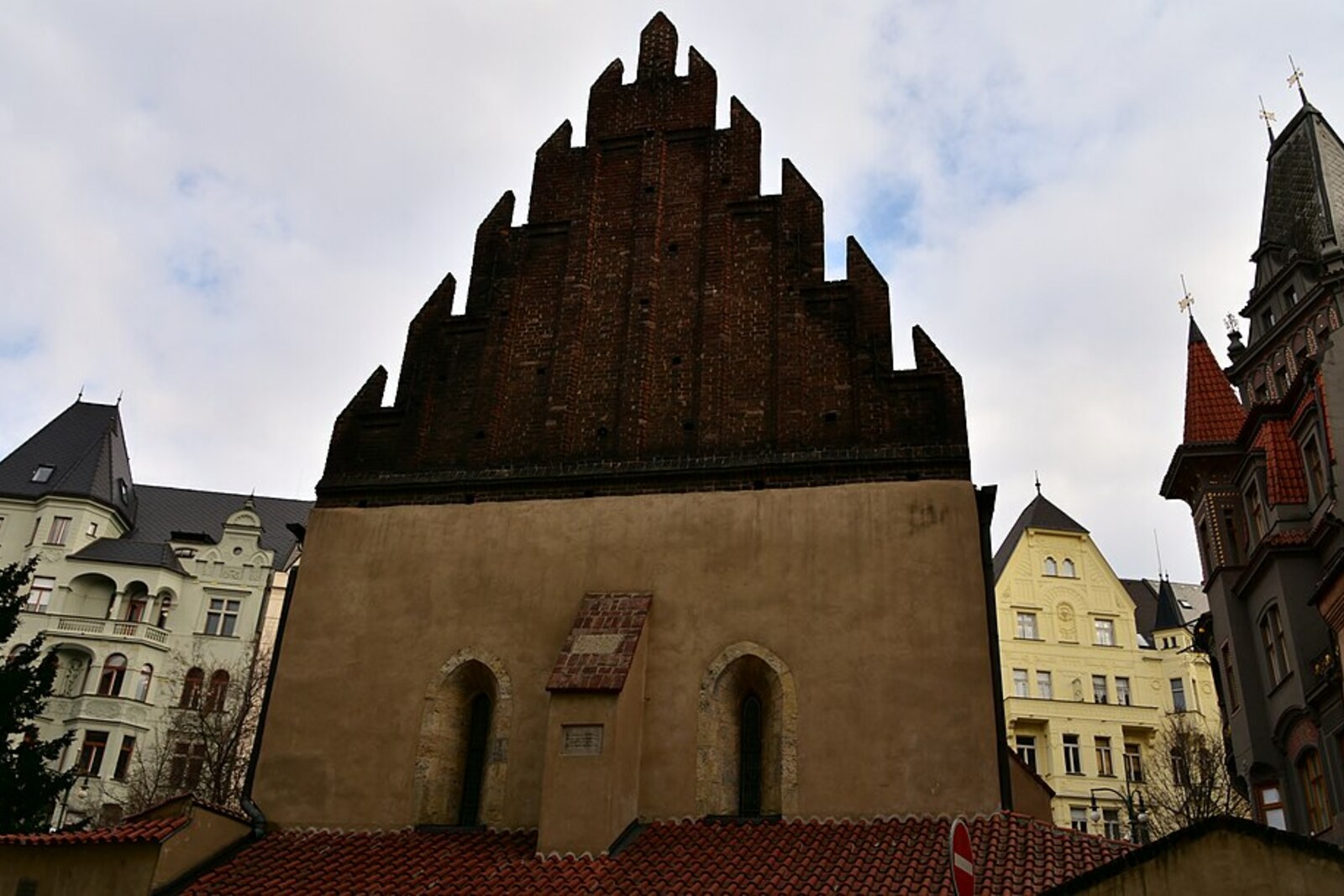
Look around first
What to notice
- Central raised platform
- Gothic grille
- Stone walls of the prayer hall
The story of the place
The stone walls of this hall were built by masters from the royal construction workshop in the second half of the thirteenth century. For more than a century it was the Jewish Town’s main place of prayer, and when other synagogues appeared in the city, the former New Synagogue came to be called the Old-New Synagogue. In the center of the hall rises a platform for reading the Torah and leading the service, enclosed by a Gothic grille. An active community still gathers here.
Once a year, during the second half of Yom Kippur—the day of fasting and repentance—this prayer hall resounds with “Et kol ha-tela'ah,” “All the Calamities.” The text appeared after the Passover pogrom of thirteen eighty-nine. It was written by Avigdor ben Isaac Kara, a teacher of Jewish children and a religious poet, who was destined to turn the recent death of Prague’s Jewish community into a prayer.
That year, Jewish Passover coincided with Christian Easter. The pretext for the attack was an accusation of insulting the Host—the consecrated bread carried in a Christian procession. Medieval accounts contradict one another in the details, but there is no doubt about the consequences: a mob burst into the Jewish Town, killed men, women, and children, looted homes, and set prayer buildings on fire. King Wenceslaus IV was absent from Prague, and the royal protection promised to the Jews did not save them. The number of victims is unknown: different records name anywhere from several hundred to three thousand people.
A legend later arose that people were killed in the Old-New Synagogue itself, and that blood remained on its walls. There is no reliable confirmation for this part of the story. What is certain is something else: Prague’s Jews linked the memory of the pogrom to worship in their main house of prayer.
Avigdor ben Isaac Kara is often called an eyewitness to the massacre, although the documents do not allow this to be claimed without qualification. His poetic plea for financial assistance has survived, and researchers date it to after the attack. In it, Avigdor ben Isaac Kara names his occupation: he earned a living by teaching children. After the devastation, a man who had lived on payments from the parents of his pupils asked another community to support him. He later joined Prague’s rabbinical court, but the pogrom’s chief legacy was the penitential prayer he wrote.
At first, it was read during a minor summer fast, then it was included in the daytime service of Yom Kippur. Prague’s Jews themselves did this: the account of the dead no longer depended on a single list or a single reader. Each year, a new service leader recited it before those gathered.
In Avigdor ben Isaac Kara’s time, the building was called the New Synagogue or the Great Synagogue. Masons from the royal workshop built it in the last third of the thirteenth century, and for more than a hundred years it had already served as the Jewish Town’s main house of prayer. At the end of the sixteenth century, Prague’s Jews built other synagogues; then the former New Synagogue received its present name—the Old-New Synagogue.
It remains an active synagogue today. In the center of the hall stands a raised platform enclosed by a Gothic grille, from which the Torah is read and the service is led. In thirteen eighty-nine, this was the New Synagogue for Avigdor ben Isaac Kara. Now his prayer is recited in the Old-New Synagogue—in the same prayer hall.
Useful on site
Seasonal hours; closed Sat and Jewish holidays, Fri usually closes earlier before Shabbat.
Checked: June 26, 2026. Check the official source before visiting.This is an active religious site: follow the posted rules at the entrance. The attic associated with the legend of the Golem is not part of the usual visit.