 Guide On Map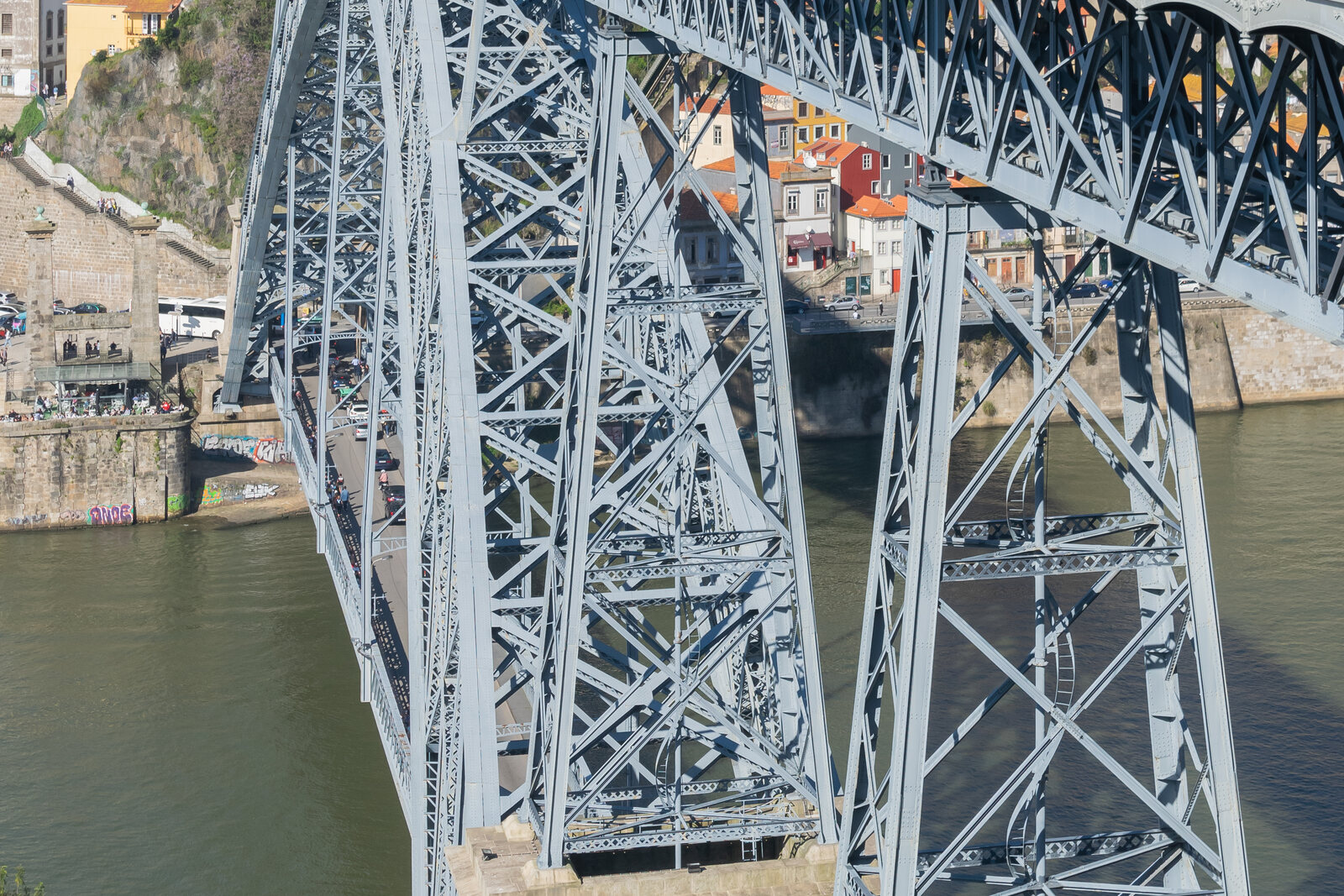
Look around first
What to notice
- The two levels of Dom Luís I Bridge
- Steel plaques on both banks
- The bronze relief Alminhas da Ponte
- Candles beneath the iron canopy
The story of the place
The lower deck of Dom Luís I Bridge leads directly onto the Ribeira waterfront. The upper one passes above the rooftops and links the cathedral district to the top of the opposite bank. These two levels appeared after earlier crossings had for centuries made people and goods descend all the way to the water.
In eighteen oh six, the company managing the Upper Douro wine trade commissioned a floating bridge here. Twenty barges were set across the river, tied together with steel cables, and covered with a wooden deck. The central section could be opened for vessels, and during high water it could be dismantled and the boats moved to the banks. For the porters, boatmen, and merchants of Ribeira, this deck shortened the route to Gaia's wine warehouses and the roads south. It also remained the only bridge across the Douro.
On March twenty-ninth, eighteen oh nine, this everyday crossing became a way out of the occupied city. Marshal Nicolas Jean-de-Dieu Soult, commander of the Napoleonic army, sought to take Porto and continue the advance through Portugal. His soldiers broke through the defenses, held mainly by the city militia. French cavalry drove the retreating soldiers and townspeople down toward Ribeira.
The Portuguese defenders tried to break the deck so that Soult's cavalry could not cross to the south bank. But soldiers, women, elderly people, and children were already streaming toward the water. People stopped before the break in the crossing, while more refugees continued pressing forward from behind. Part of the deck gave way. The current carried off those who fell; meanwhile, Portuguese artillerymen on the Gaia bank fired at the French cavalry behind the crowd.
The exact number of deaths could not be established. Cautious estimates speak of hundreds, while city tradition speaks of several thousand. The French took Porto and held it for about a month and a half. The crossing was then reassembled, this time on thirty-three barges: without it, livelihoods on both banks and the delivery of goods were interrupted.
A little downstream from the present bridge, the line of the old crossing is marked by two steel plaques set opposite each other on the banks. In the wall of Ribeira is Alminhas da Ponte—“Souls of the Bridge”: a bronze relief beneath an iron canopy, made in eighteen ninety-seven. It shows people falling from the deck, and candles are still left beneath the image.
After the floating bridge, a suspension bridge served here, but growing Porto needed a crossing at two different heights. Gustave Eiffel proposed a single-level bridge by the water with an opening section. The project was rejected: it would once again have made all traffic descend into Ribeira. In the international competition, Eiffel was beaten by his former partner Théophile Seyrig, an engineer with Société de Willebroeck. Seyrig ran one roadway between the waterfronts and the other between the upper districts of Porto and Gaia. His solution is the one that stands above the Douro; it is mistaken to attribute this bridge to Eiffel.
The bridge was dedicated to Luís I, King of Portugal during its construction. It is said that the king did not attend the opening and that offended residents removed the form of address “Dom” from its name. This is a city legend. The name “Luís I” was used even before the opening, and other structures honoring the royal family were also named without a courtly form of address. The official name in old Portuguese spelling survives on the stone plaques at the entrances to the lower deck: “Luís I Bridge.”
Useful on site
The waterfront is crowded and noisy; when looking at the relief and the remains of the old bridge, do not block the way of pedestrians.