 Guide On Map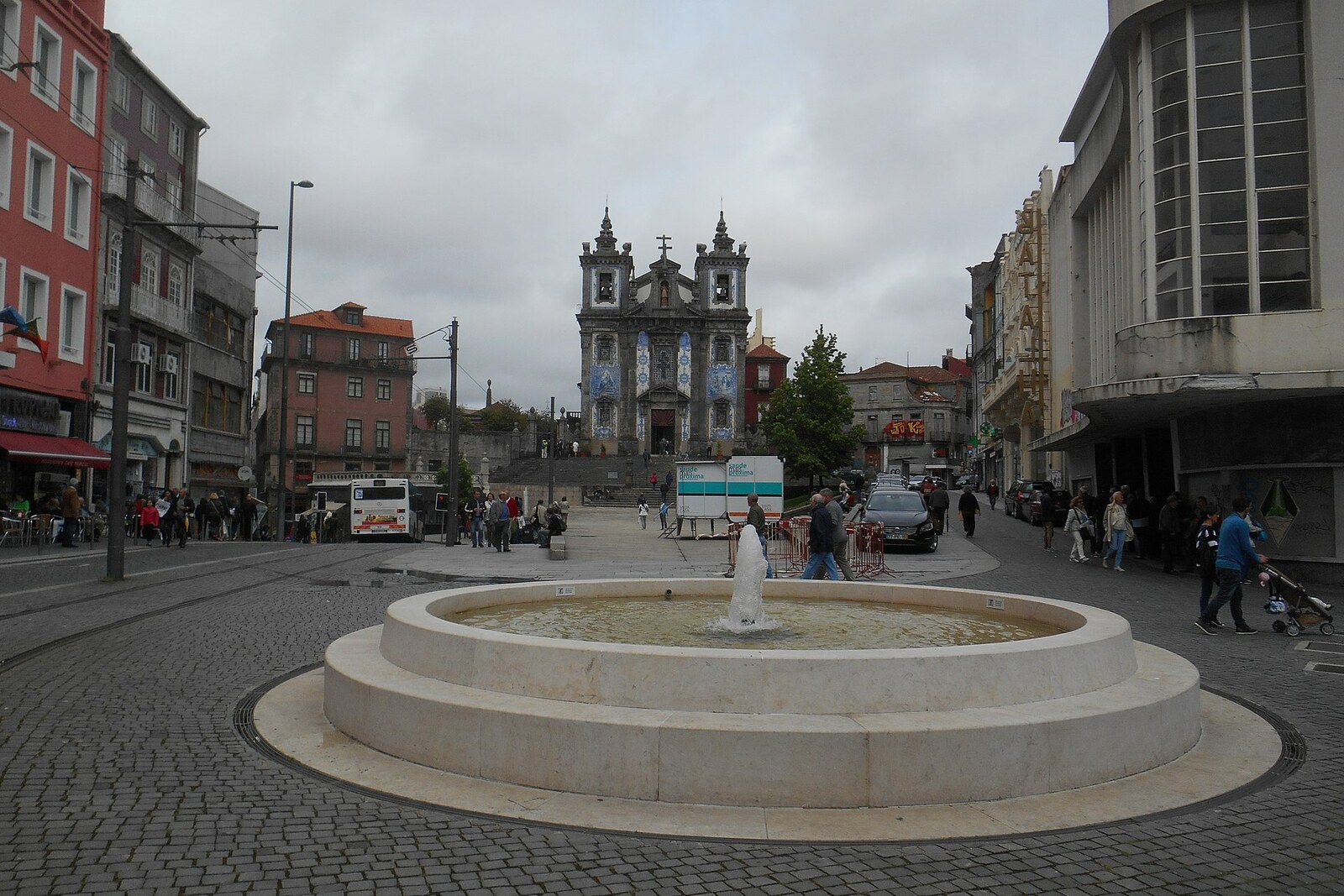
Look around first
What to notice
- The pink palace
- The stone coat of arms
- The square's open space
The story of the place
The open space appeared when the city dismantled part of the wall here, by one of the main entrances into old Porto. The cleared site linked the historic center with the eastern districts, and a theater, a cinema, a post office, and hotels gathered around it. The pink palace with the stone coat of arms once served as the central post office, and now a hotel operates in its rooms.
“Batalha” means “battle.” According to a local legend, in the tenth century the people of Porto tried to stop the army of Al-Mansur, a military commander and the de facto ruler of the Caliphate of Córdoba. The defenders were defeated, and the city was sacked. It is known that in nine ninety-seven, Al-Mansur did indeed gather land forces in Porto, along with ships that had arrived by the Douro, before his campaign against Santiago de Compostela. However, it is legend rather than a document that confirms a battle on the site of the present-day square. Neither a wall nor a grave remains here from it. The name remains.
The square itself appeared later, by the Simu di Vila Gate, one of the main entrances into walled Porto. In the eighteenth century, the municipality dismantled this section of the fortifications, and roads from the old city and the eastern districts met on the cleared site. That is why a theater, a cinema, a post office, hotels, and a large open area in front of them appeared here.
On the eastern side stands a pink palace with a stone coat of arms. Its most powerful story began in eighteen thirty-two, when Porto found itself at the center of a civil war. Former king Pedro IV of Portugal sought the return of the Portuguese crown to his daughter, Maria II of Portugal, and the restoration of the Constitutional Charter. His brother, Miguel I of Portugal, held the throne and defended the absolutist order. The family that owned the palace supported Miguel I of Portugal and left the city after Pedro IV of Portugal's army arrived. The liberals occupied the vacated house and set up a military hospital there.
On September eighth, the Miguelists attacked the positions at Serra do Pilar, on the other bank of the Douro. The defense was commanded by Bernardo de Sá Nogueira, a career officer and the military governor of Porto; service in the army was his profession. He wanted to hold the height, without which it would have become harder for the besieged city to defend the river crossings. A bullet shattered his right arm. Sá Nogueira continued to command until the end of the battle, after which he was taken across the Douro to the hospital on Praça da Batalha. In these rooms, a surgeon amputated his arm.
The Miguelists did not take Serra do Pilar that day. Sá Nogueira survived the operation and, only two months later, was appointed minister of the navy in Pedro IV of Portugal's besieged government. In the spring of the following year, he was granted the title Baron of Sá da Bandeira for defending the height; later he became a marquis and headed the country's government several times.
The stone coat of arms on the pink façade belonged to the previous owners. In the twentieth century, the palace housed the central post office; now there is a hotel inside. No separate building remains from the military hospital: the wounded Sá Nogueira was carried into this very palace.
Useful on site
The public space is open around the clock.
Checked: June 17, 2026. Check the official source before visiting.The façades can be viewed from the square, but the restored paintings are inside the cinema and may be inaccessible without an event or a separate visit. Tickets for a performance or screening are not included in the walk and, if desired, should be arranged independently.