 Guide On Map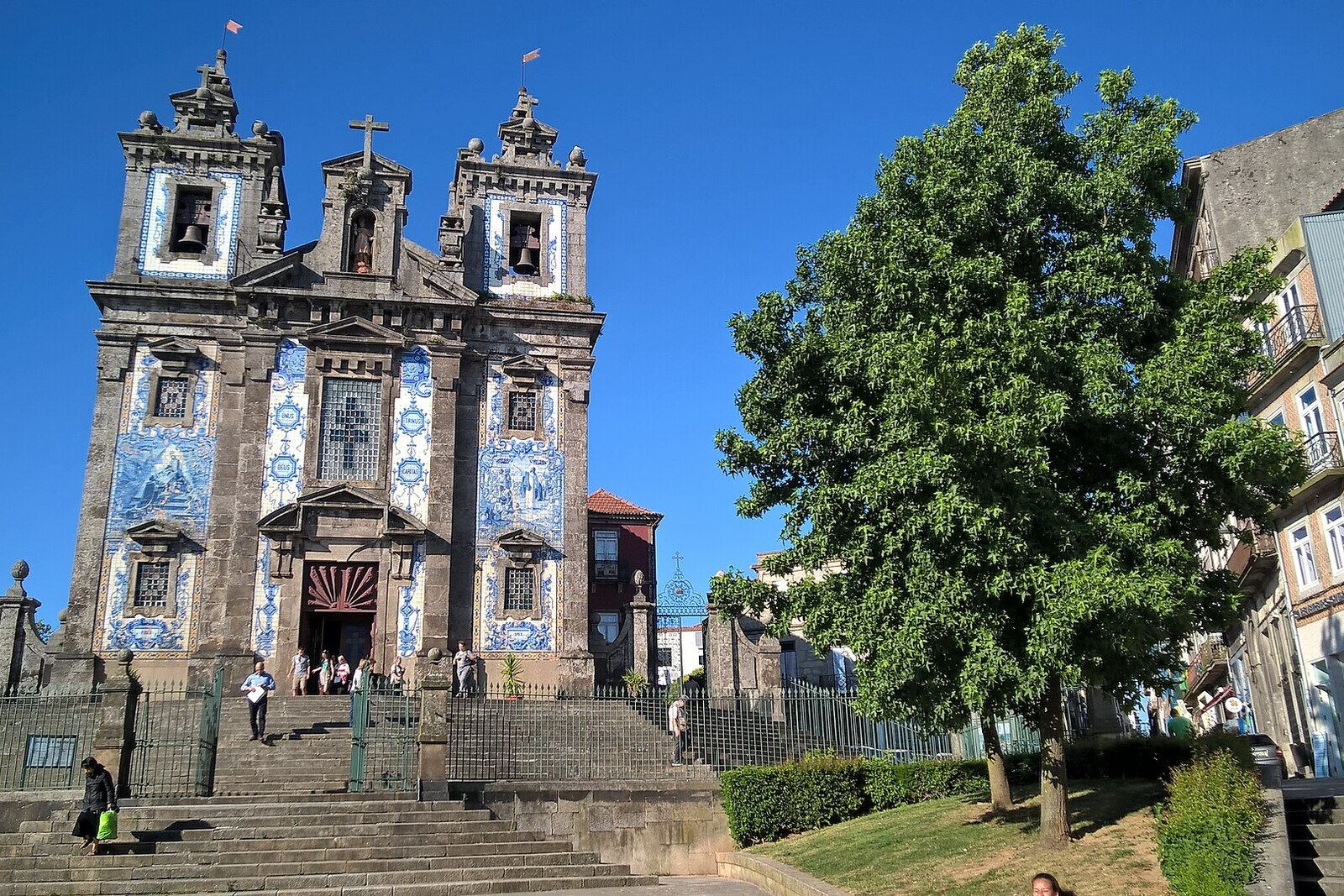
Look around first
What to notice
- The inscription above the main entrance
- The figure of Ildefonso in the niche
- Blue-and-white tiles
- The gilded retable of the main chapel
The story of the place
The name of this parish church was inherited from the Chapel of Santo Alifon, mentioned in city sources as early as twelve ninety-six. This was how Porto pronounced the name of Ildefonso, the bishop of Toledo whose figure stands in the niche above the main entrance. The blue-and-white façade appeared only in nineteen thirty-two, when the artist Jorge Colaço covered it with around eleven thousand tiles. Their subjects bring out into the street the church's two foundations: the life of its patron saint and the sacrament of Communion.
On July eleventh, seventeen forty-five, the Parish Brotherhood of the Lord Jesus and the Blessed Sacrament signed a contract with Miguel Francisco da Silva, a Lisbon woodcarver. The church had been consecrated six years earlier, but the main chapel still needed a carved altar wall—a retable. The Brotherhood was responsible here for the veneration of the Eucharist, the sacrament of Communion, and wanted a worthy setting for worship.
Miguel earned his living through church commissions: he designed altars himself or translated other people's drawings into wood. For the work at Church of Santo Ildefonso, he was to receive one million one hundred thousand réis. For that sum, he was to make the retable and the carved decorations for four doors, two balconies, and the upper openings. The deadline was set for the feast of Pentecost in seventeen forty-six.
The drawings were prepared by Nicolau Nasoni, an Italian architect and decorator who was already working in Porto. He was also to inspect the result. The contract specifically stated that if Nasoni required corrections, Miguel had to make them so that the work would be judged well executed. The woodcarver had both a substantial fee and his professional reputation at stake.
Miguel completed the commission in seventeen forty-six. The gilded retable survives in the main chapel; at its center is an image of Ildefonso, while above it angels hold a monstrance for the consecrated gifts. The name of the architect of the whole church remains unknown, but the Brotherhood's contract preserved the names of the person who devised the altar and the craftsman responsible for every carved detail.
Ildefonso, depicted in the altar and in the niche above the façade, was a seventh-century bishop of Toledo. He sought recognition for the teaching on Mary's perpetual virginity and wrote a theological treatise in its defense. According to church tradition, Saint Leocadia appeared to him and said, “Ildefonso, thanks to you my Lady lives.” This very phrase is carved above the main entrance. Another part of the tradition tells that the Virgin Mary gave Ildefonso a liturgical vestment as a reward for his defense; this is tradition, not a confirmed episode of his biography.
The dedication arose here long before the present building. By twelve ninety-six, sources already mention a Chapel of Santo Alifon standing on this site—this was how Porto rendered the name of the same Ildefonso. The new parish church inherited its name.
In nineteen thirty-two, the artist Jorge Colaço covered the façade with around eleven thousand blue-and-white tiles. He brought outside the same subjects the Brotherhood had commissioned for the altar: the life of Ildefonso and the Eucharist. Above the door remains the phrase from the tradition; behind the door is the retable approved by Nasoni, and the name of the old chapel now occupies the entire façade.
Useful on site
Mon 15:00–17:15; Tue–Fri 09:00–12:15, 15:00–17:15; Sat 09:00–12:15, 15:00–18:30; Sun 09:00–11:00.
Checked: June 17, 2026. Check the official source before visiting.The ceramic cycle is fully visible from outside. The church remains active: if the doors are open, keep quiet and do not enter during a service with the audio playing. The graves beneath the narthex are not a separate accessible site—their presence must be imagined while standing at the entrance.