 Guide On Map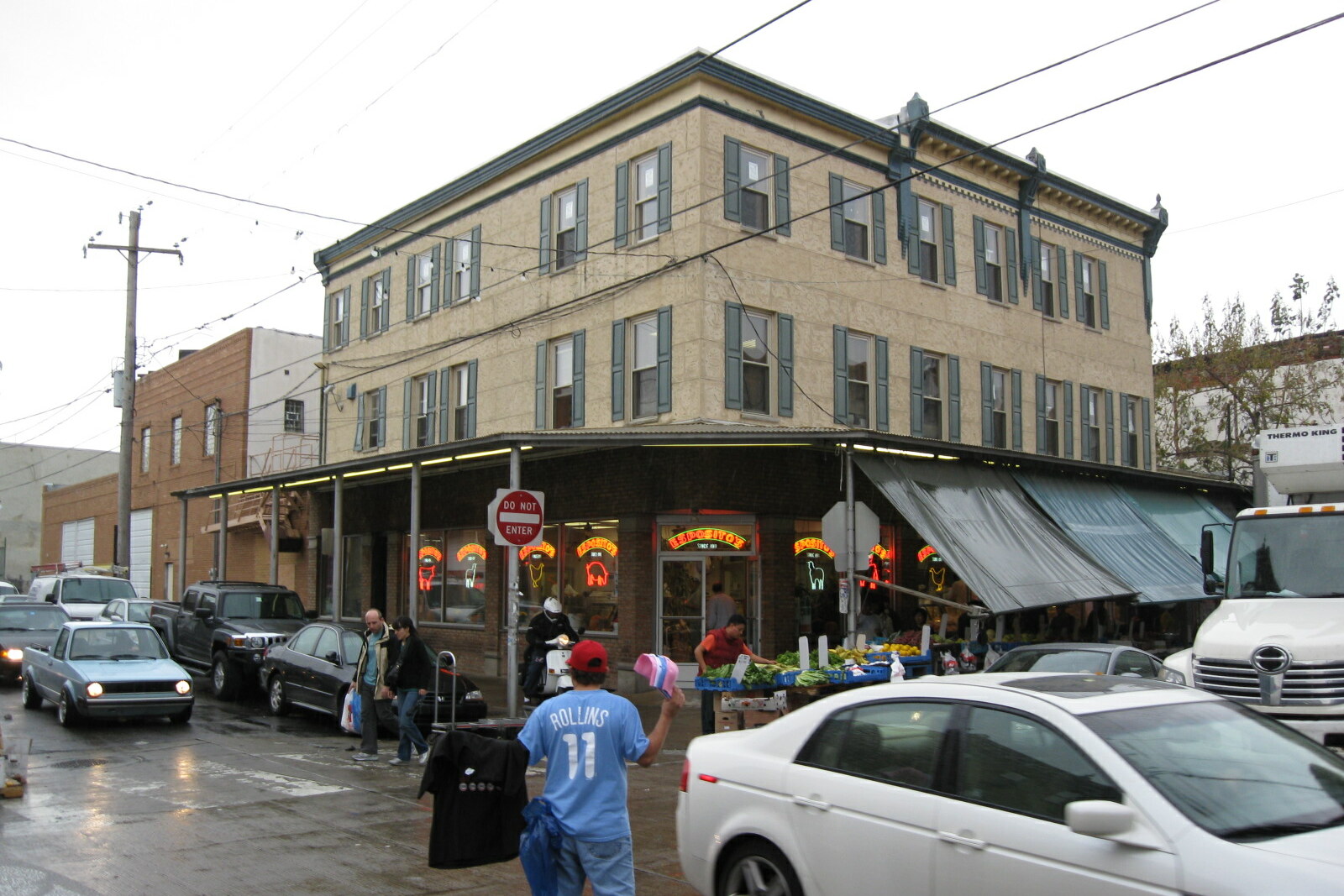
Look around first
What to notice
- Church façade
- Figure in the niche
- Parish schoolyard
The story of the place
St. Paul's Church appeared on Christian Street before this neighborhood became part of Philadelphia. In eighteen forty-three, Moyamensing stood here—an independent municipal district beyond the city’s southern boundary. The population was growing, many of the new residents were Irish Catholics, and the nearest parishes remained far away. Bishop Francis Patrick Kenrick instructed the priest Patrick F. Sheridan to gather a parish for them.
Sheridan chose a site between Ninth and Tenth Streets for two reasons: the future parishioners lived nearby, and Moyamensing’s administrative center stood opposite. Nine district leaders met in Commissioners Hall, elections and court hearings were held there, and the local guard was based there. The church was built facing the institution around which a new urban neighborhood was taking shape.
On May seventh, eighteen forty-three, Kenrick blessed the cornerstone and placed the parish under the patronage of Saint Paul the Apostle. He was a former persecutor of Christians who, after his conversion, began preaching among peoples beyond the original Jewish community. The surviving chronicle does not explain why Kenrick chose him specifically for the new parish. A figure of Paul was placed in a niche on the façade only half a century later.
Sheridan celebrated the first Mass here at Christmas, when the building was still unfinished. A few months later, the unfinished church was threatened with destruction. In the spring of eighteen forty-four, opponents of Irish immigration and Catholicism staged riots in Philadelphia. The dispute began over which translation of the Bible should be read in public schools, and ended with the arson of Catholic homes, a school, and two churches.
On May ninth, General Robert Patterson ordered Captain Fairlamb and his detachment of militia to guard St. Paul's Church. The order authorized the use of force against anyone who tried to damage the building. The militiamen held the church, but the unrest halted construction. Sheridan was able to carry it through to consecration only on July fourth, eighteen forty-seven.
The parish was needed even before the building was completed. Ten years later, there were so many parishioners that the bishop carved a new church community out of its vast territory. Another year later, Moyamensing’s residents lost their separate municipality: the act of eighteen fifty-four annexed the district and other surrounding settlements to Philadelphia. Sheridan had gathered a parish for a rapidly growing suburb, but continued serving in an expanded city.
Seventeen years later, fire did come here after all. In November eighteen sixty-one, while Sheridan was in Ireland, the church burned out; only the walls remained. The parishioners moved Masses to the school chapel and restored the building. In September of the following year, it reopened for worship. Sheridan led the parish until his death and was buried in a crypt on the church’s east side.
By the beginning of the twentieth century, Irish families were gradually leaving the neighboring streets, and Italians were moving into their homes. Pastor Michael Donovan opened evening classes for the new parishioners, then a school with a chapel, gymnasium, and twenty-two classrooms was built across the street. It held more than eight hundred children of Italian descent. Commissioners Hall, opposite which Sheridan had once placed the church, was later demolished; the parish schoolyard remained on its site. Masses are still celebrated on one side of Christian Street, while on the other, the children of the families were educated whose arrival here was followed by the South 9th Street Italian Market.
Useful on site
The church operates as a parish. Regular Masses are listed for Saturday evenings, Sundays, and weekday mornings; outside services, entry may be closed. Checked 2026-06-30.
Checked: June 30, 2026. Check the official source before visiting.The main account can be followed from outside. Do not count on free entry during a service or parish event; plan an interior visit separately.