 Guide On Map
South Philadelphia’s Immigrant Market
From South 9th Street and Catharine Street to the Singing Fountain on Passyunk Avenue
Guide On Map on your phone
Open the walk like a regular app
It takes about 10 seconds to install. No app store needed.
The whole path
Route map
About the walk
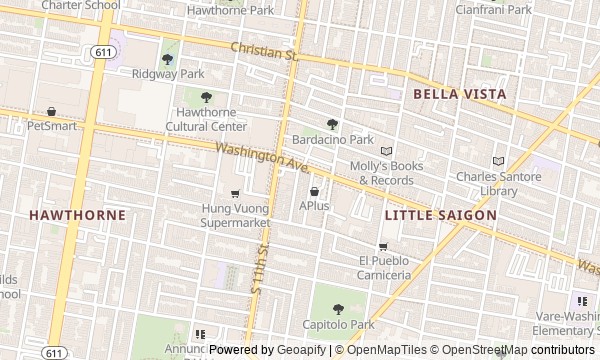
You will walk South 9th Street from north to south: from the first address for Italian newcomers, through the old market, to Passyunk Avenue and the Singing Fountain.
At first, you will be surrounded by row houses, ground-floor shops, and a church on the next street over. Beyond Washington Avenue, the signs will change language, while the market continues behind the same narrow facades. At Passyunk Avenue, the commercial street gives way to two bright counters and a small plaza.
The story rests on family decisions, an old cheese grater, faded awnings, and closed gates. You will learn why a newcomer might need a tag bearing a single surname, how a store got its name before its future owner did, and why restaurants had to save a fountain. Legends will be kept separate from what is known for certain.
By the end, you will be able to walk back along South 9th Street and read its doorways as a record of how a new city address became a parish, a shop, a market, and a plaza.
Why this order
The route begins at the sign on the market’s northern edge, where a newcomer’s first address explains how shops appeared in residential houses. From there, a short detour to St. Paul's Church takes the story forty years back: before the commercial street, the new suburb needed a parish—and one that had to be defended. Back on South 9th Street, at Di Bruno Bros., the next step comes into view: a family counter becomes a tradition. A few blocks south, at Washington Avenue, two outcomes of that tradition meet: the closed gates of an old shop and a business passed down to a third generation. Beyond the avenue, changing ownership unfolds into an entire Mexican commercial stretch. South 9th Street leads to two competing counters, where being neighbors draws customers to both. Then Passyunk Avenue takes you from private windows to the Singing Fountain: the finale shows how owners of nearby establishments worked together to restore a shared plaza to the neighborhood.
Those who want to understand Philadelphia through family commerce Fans of urban markets, old signs, and working shops Those interested in changing immigrant communities along one street
Those looking only for the major landmarks of the historic center Those uninterested in family businesses and food history Those who prefer walks away from commercial streets
Before you go
Most of the route can be read from the street, so comfortable shoes and weather-appropriate clothing matter more than access to interiors. The church and visitor center may be closed or occupied with their own activities; treat going inside as an extra, not a condition of the walk. Restaurants and shops each keep their own hours, and neither seating nor a particular dish is guaranteed. If you want to eat at Pat's King of Steaks, Geno's Steaks, or one of the establishments along the Mexican stretch, decide in advance whether you are willing to wait outside the route’s main timing. On the commercial stretches, do not block the narrow sidewalk, and ask permission before photographing people or counters up close.
When to go
2 hr
Backup plan
If the church is closed, view it from Christian Street and continue the story at the facade without trying to enter the parish rooms. If the visitor center is unavailable, stop at the intersection of South 9th Street and Montrose Street: the connection between family commerce and street celebration can be understood from outside. The southern section does not depend on a single establishment—read it through changing signs, displays, and goods, even if some shops are closed. At the cheesesteak corner, you can limit yourself to watching the service windows and the lines. If the fountain is turned off or fenced off for work, the plaza still makes an important stop: its benches, chess tables, planting, and traces of repairs show how this shared place works.
Route conditions
Surface. Paved — 980 m (data covers 47% of the route)
Elevation. Ascent — 1 m; descent — 3 m
OpenStreetMap extract of June 18, 2026: database data, not a check on the ground. Data © OpenStreetMap contributors, ODbL licence
Walk plan
Open in maps ↗- 1
North of the Market: the House, the Shop, and the First Bed
This is where the story of a street begins, where a bed for a newcomer led to shops and counters. - 2
Saint Paul: a parish for a new city
This stop adds the parish around which the new residents of the suburb gathered to the market’s story. - 3
Ninth and Montrose: Commerce Becomes Tradition
Using one family as an example, you will see how an everyday grocery store became a well-known cheese shop and kept its original address. - 4
Washington Avenue: changing owners and languages
At this stretch, compare two outcomes of family trade: shuttered gates and a business passed on to the third generation. - 5
Mexican Ninth: Shop by Shop
Here, the chain of neighboring businesses will explain why the new commercial quarter grew door by door. - 6
Pat's and Geno's: Ordering as a Statement
Two counters show how the neighborhood turned a family rivalry into a shared stream of customers. - 7
Singing Fountain
The finale shifts the conversation from individual shops to the square that the owners of nearby establishments saved together.
Route features
Everything you need stays in the browser
Progress, saves and your trip plan are stored on this device.
Add Guide On Map to your home screen so the walk opens outside the browser.
How we handle sources, maps and corrections: our editorial standards