 Guide On Map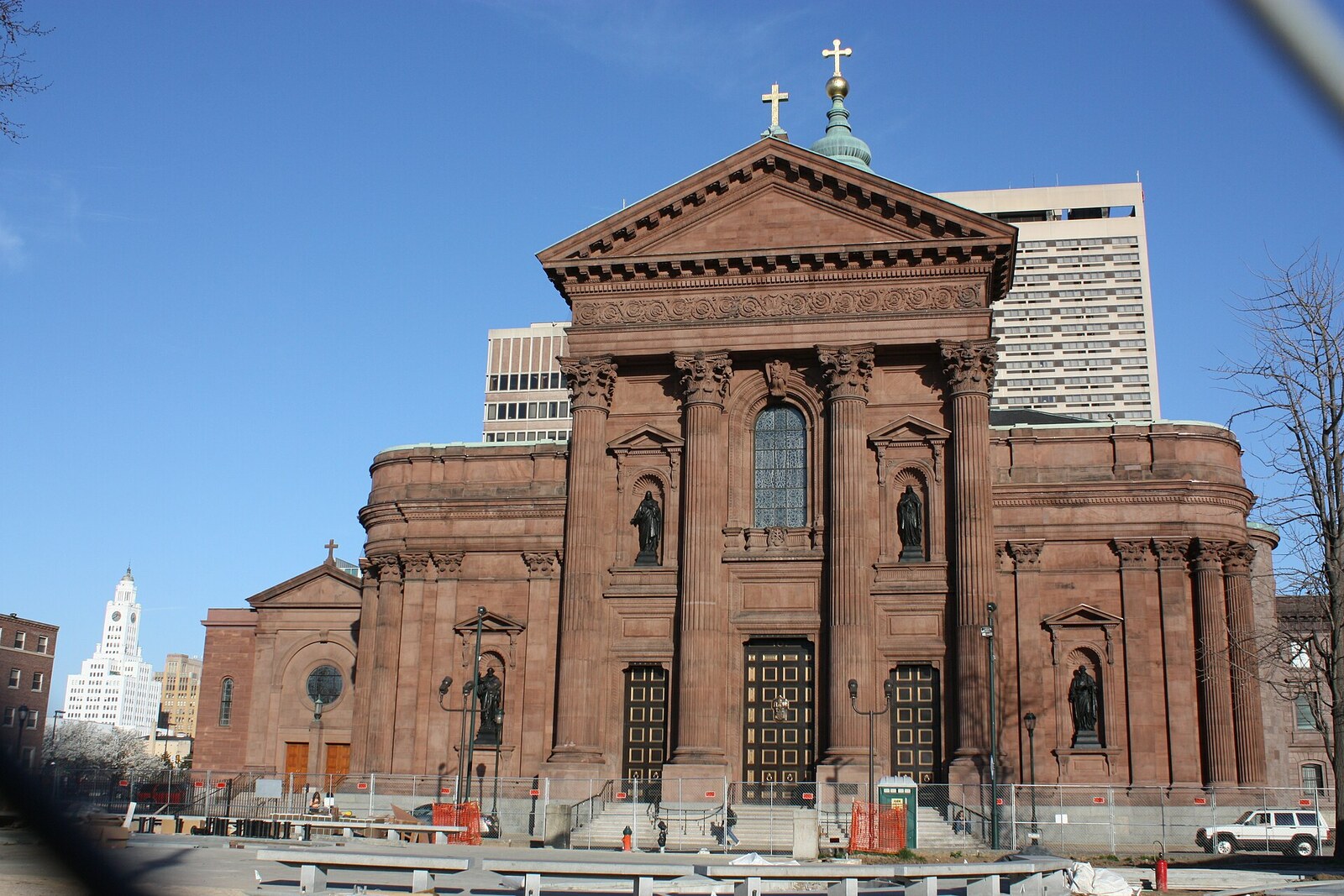
Look around first
What to notice
- Round fountain with eleven jets
- The cathedral dome
- High windows in the side walls
The story of the place
The small city park on Logan Square occupies a site that was previously hardly used; it now has a café, garden, and shallow pool. The dome of the Cathedral Basilica of Saints Peter and Paul rises above the park, and the cathedral itself serves as the shared main church of the Catholic diocese. Donations were insufficient for a long time, construction was halted, and it could be completed only after the diocese agreed to borrow money. In the old side walls, the windows begin almost at the eaves, while the later lower openings appeared only in the apse behind the altar.
The round fountain in the park is designed as a map without borders or continents. Philadelphia is marked at its center, while eleven jets represent its official sister cities: Florence, Tel Aviv–Jaffa, Toruń, Tianjin, Incheon, Douala, Kobe, Nizhny Novgorod, Abruzzo, Aix-en-Provence, and Frankfurt am Main. The jets are placed according to direction and symbolic distance from Philadelphia. These ties are formalized by agreements between mayors and involve exchanges of students, teachers, specialists, and city delegations.
President Dwight D. Eisenhower proposed the international sister-city program in nineteen fifty-six. Philadelphia made its first such agreement with Florence eight years later. This part of Logan Square was dedicated to sister cities during the United States bicentennial celebrations in nineteen seventy-six. The first site remained almost empty and attracted few people. In two thousand twelve, it was remade as a park with a café, garden, shallow pool, and play fountain. The diplomatic agreements found a very everyday use: in warm weather, children run between the partner cities.
From the center of this water map, one feature of the Cathedral Basilica of Saints Peter and Paul is easy to see: its long side walls have almost no windows at street level. The windows were raised almost to the eaves because of an event after which Philadelphia Catholics had to think of a church as a building able to withstand an attack.
In eighteen forty-two, Francis Patrick Kenrick, the Catholic bishop of Philadelphia, sought to prevent Catholic schoolchildren from being forced to read a Protestant translation of the Bible. He asked that they be allowed to use a Catholic edition or not attend those lessons. The city school board agreed. Opponents of Catholic immigration portrayed the decision as an attempt to subject the schools to the Church.
In May eighteen forty-four, mobs attacked Catholic homes and burned two churches, a monastery, priests' homes, and a library. Several people were killed. The unrest stopped only after the governor and five thousand soldiers arrived. At the time, Kenrick was seeking a shared main church for the growing diocese. After the pogroms, the plan acquired another condition: the cathedral had to remain a difficult target.
The priests Mariano Muller and John B. Tornatore, who had studied architecture before ordination, prepared the first sketches with windows only in the upper tier. The young architect Napoleon LeBrun carried this decision into the design. No definitive document explaining it has survived, but cathedral historians consider fear of another anti-Catholic attack the most likely reason. Local tradition adds a scene: supposedly, the builders told the strongest worker to throw a stone straight upward and began the windows above the point he could reach. Different versions name different people as the one who gave the order, so this is a legend, not an established episode.
Kenrick wanted to build the cathedral only with money already collected, so as not to leave the diocese with an enormous debt. On the feast day of the Apostles Peter and Paul, June twenty-ninth, eighteen forty-six, he appealed to Catholics for donations. The cathedral was dedicated to these two disciples of Christ because Church tradition considers them founders of Rome's Christian community. Kenrick needed a local cathedral church linked by its name to the Roman Church.
There was too little money. Work stopped three years later. Kenrick left to lead the Archdiocese of Baltimore; his successor, Bishop John Neumann, kept the rule of building only with collected funds and died without seeing the completed cathedral. By then, the walls had already been raised and a cross placed on the dome.
Completion was entrusted to James Frederick Wood, a bishop with experience in banking. He calculated that constant stoppages themselves increased costs, allowed borrowing, and brought construction to an end during the American Civil War. In November eighteen sixty-four, Wood opened the cathedral; a temporary wooden altar still stood inside, and a significant part of the walls remained without paintings.
Later craftsmen added decoration and stained glass, and in the middle of the twentieth century lower windows were cut into the new apse behind the altar. On the old side walls, the windows still begin where, according to legend, the thrown stone did not reach.
Useful on site
The park is open daily 06:00-01:00. The café and restrooms usually operate from March through October, 09:00-17:00. The fountain and children's pool are seasonal, usually from April through October. The cathedral is open according to the church schedule; Sunday tours depend on services.
Checked: June 29, 2026. Check the official source before visiting.For the main story, viewing from outside is enough. If the cathedral doors are open, keep services in mind and remain quiet: this is an active church, not a mandatory museum interior.