 Guide On Map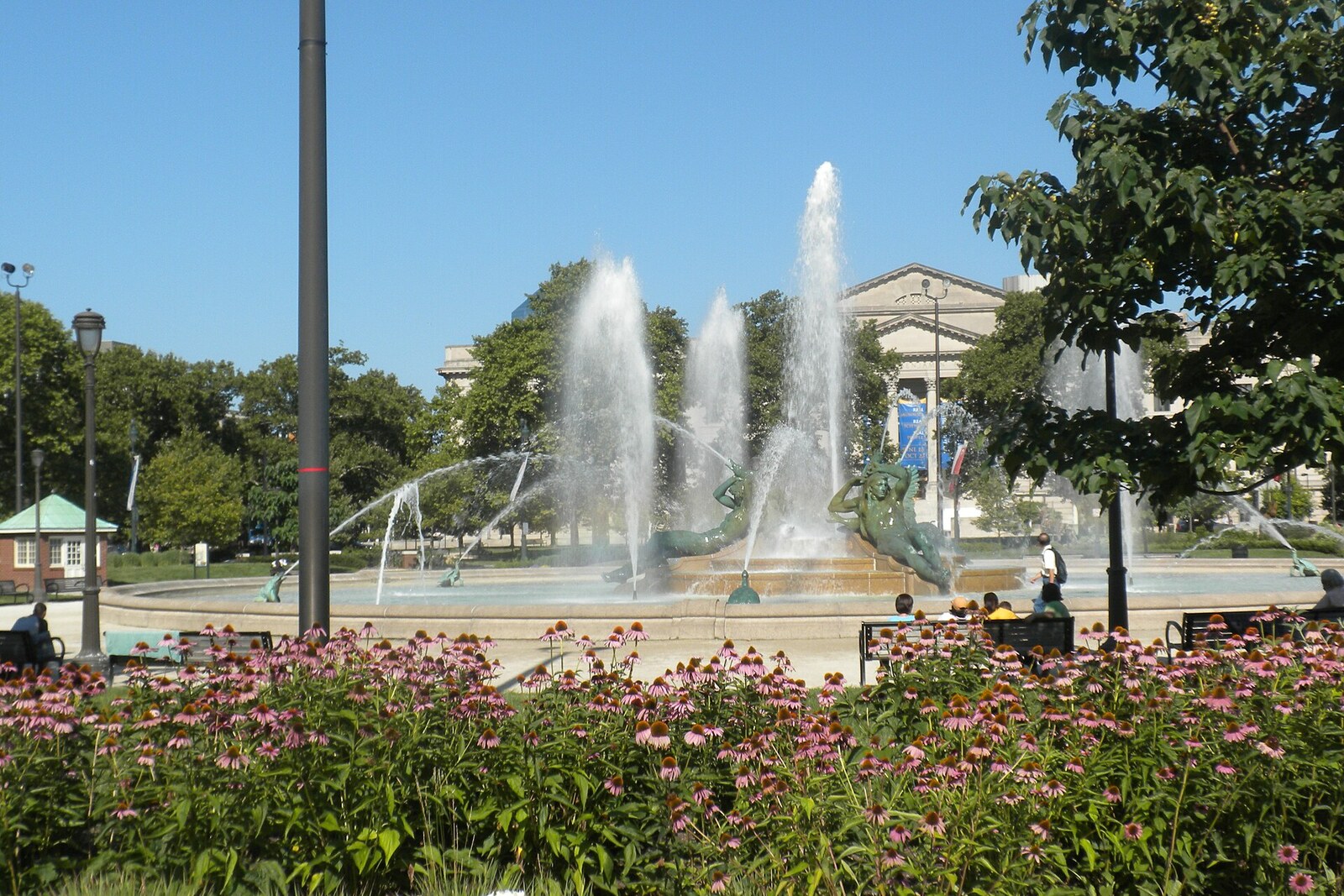
Look around first
What to notice
- The fountain basin
- Three bronze figures
- Bronze swans
- Fish, frogs, and turtles
The story of the place
In the center of the square, water gathers in a broad basin around three bronze figures, which the sculptor Alexander Stirling Calder made into images of two rivers and Wissahickon Creek. Fish, frogs, and turtles send jets toward the figures, while two swans recall the surname of the physician Wilson Cary Swann. He advocated for free water for people and working horses, when at taverns it was often controlled by whoever bought a drink. After Swann's death, his widow left money for a memorial, the city added the shortfall, and the fountain opened in nineteen twenty-four.
Where the fountain's broad basin now lies, a covered street about one hundred sixty-five meters long ran in June eighteen sixty-four. It was called Union Avenue. Pavilions of a huge temporary fair stood on both sides, and almost all of Logan Square was built over for it.
The American Civil War was underway. Soldiers' letters and doctors' reports showed that the federal Union Army, fighting against the seceded Southern states, could not cope with disease, poor food, and the flow of wounded men. It was aided by the United States Sanitary Commission, a civilian organization that collected money, clothing, bandages, and medicine. In two years, the Philadelphia Branch of the United States Sanitary Commission received one hundred thirty-five thousand dollars, but the front required far more.
The executive committee was headed by the merchant John Welsh. His task was to turn the city's business connections into aid for hospitals. About three thousand volunteers, mostly women, divided into nearly one hundred committees. They asked workshops to provide goods, farmers for produce, artists for paintings, shop owners for merchandise, and city residents for money and labor. Logan Square was chosen because only such a large open space could hold a temporary building the size of several city blocks.
In forty working days, volunteer craftsmen erected pavilions, galleries, and a central hall with Gothic arches. Visitors paid admission, bought donated items, and viewed weapons, machines, paintings, and military relics. On June sixteenth, President Abraham Lincoln came here. To increase the fair's proceeds, he provided forty-eight signed copies of the Emancipation Proclamation; they were offered to buyers for ten dollars each.
In three weeks, the organizers raised more than one million dollars to aid soldiers. The pavilions did not immediately lose their purpose: after the fair closed, they briefly housed about three thousand recovering military personnel for whom there was not enough room in city hospitals. The temporary complex was then dismantled. Nothing remains here of Union Avenue and its arches; a historical marker near the fountain recalls the fair.
By then, the square already bore its present name. In William Penn's plan, it was called Northwest Square. In eighteen twenty-five, the city councils renamed it in honor of James Logan, Penn's secretary, a scholar, and a former mayor of Philadelphia.
The Swann name in the fountain's title refers to another person. The physician Wilson Cary Swann advocated for people and working horses to be able to drink free of charge on city streets. In eighteen sixty-nine, he founded the Philadelphia Fountain Society. At taverns, water for a horse was often available to whoever bought a drink; Swann wanted to give drivers another option while also reducing animal suffering. By eighteen eighty, the society maintained about eighty drinking fountains.
After Swann's death, his widow Maria left money in her will for a memorial to her husband. The sum was insufficient for a large structure, so the society kept it invested for many years, until the city agreed to contribute the shortfall. In nineteen twenty-four, the fountain opened in the center of the square.
The sculptor Alexander Stirling Calder depicted three local bodies of water as Indigenous figures: a man represents the Delaware River, an adult woman the Schuylkill River, and a girl Wissahickon Creek. Fish, frogs, and turtles send jets toward the figures. Two bronze swans were added as a play on Swann's surname, which in English sounds almost like the word “swan.”
In the spring of two thousand twenty-six, city services repaired the fountain and turned the water on again. The rules forbid entering the basin, but in summer children still sit among the jets by the bronze frogs.
Useful on site
Open square. Water in the fountain is seasonal and may be turned off for maintenance. Cross only at marked crossings: traffic around the circle is heavy.
Checked: June 29, 2026. Check the official source before visiting.The water does not always run, but the sculptural map can be read even without the jets. View the basin from the sidewalks and traffic islands, watch the traffic around the square, and step carefully on wet stone.