 Guide On Map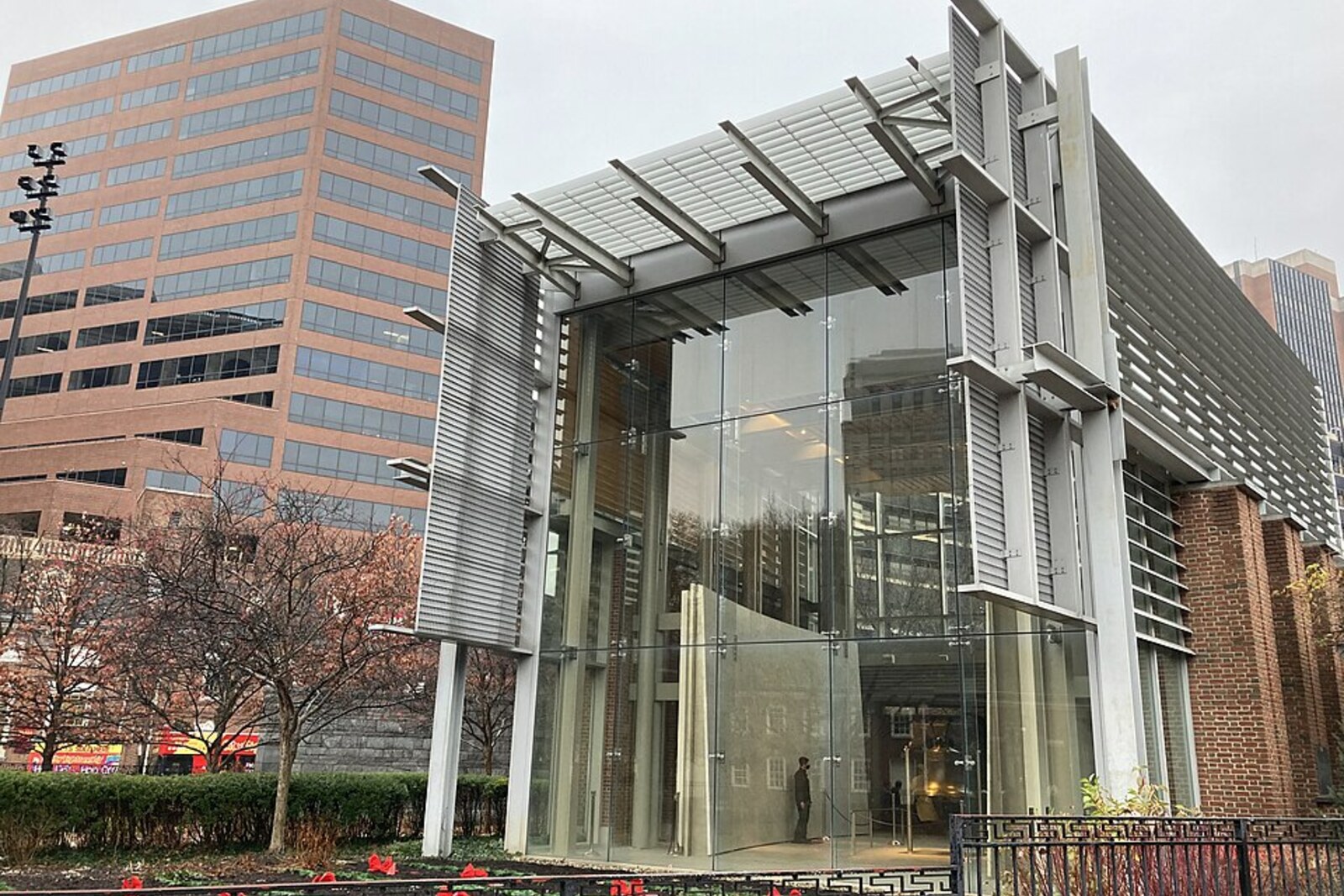
Look around first
What to notice
- The bell
- The wide gap from the repair
- The thin crack above the city's name
- The inscription with the word “liberty”
The story of the place
This bronze bell once hung in the tower of the Pennsylvania State House and served as a city signal: it summoned legislators and called residents to announcements of the news. It now stands separately in a glass hall built opposite the former tower, so its old home is visible behind the metal. A wide gap from an unsuccessful repair is noticeable on its side, and above the city's name runs a thinner crack that is why the bell no longer sounds.
The very same bell stands in the glass chamber, but the English craftsmen who made it would not recognize the present object before them. The bell delivered from London cracked during its first test. In seventeen fifty-three, the work was entrusted to the Philadelphia foundrymen John Pass and John Stow. They earned their living working metal, and now they were responsible for two thousand eighty pounds of public bronze.
Pass and Stow broke up the bell, melted down the metal, and cast it anew. The townspeople disliked its sound, and the mockery of the foundrymen reached Isaac Norris, chairman of the Pennsylvania Assembly, who had ordered the bell. The craftsmen had to repeat the entire job. Norris remained dissatisfied even afterward and ordered another bell from England, but it was no better. The Philadelphia casting was left in the tower. That is why the bronze bears the surnames Pass and Stow, the name of the city, and the year seventeen fifty-three: before visitors is their second attempt.
The bell served as a means of communication. It summoned legislators to the Pennsylvania State House, now Independence Hall, and townspeople to announcements of the news. It was called the State House Bell. There is no evidence that it rang on either July fourth or July eighth, seventeen seventy-six, and participants in the American Revolution did not know the name “Liberty Bell.”
This name appeared almost six decades later. In eighteen thirty-five, an author from the New York journal Anti-Slavery Record climbed the State House tower and examined the bell. His name did not appear beneath the article. His role is known: he wrote for the American Anti-Slavery Society, which brought together Black and white abolitionists who demanded the immediate liberation of enslaved people without payments to slaveholders.
The author read the biblical line cast at Norris's order: “Proclaim Liberty Throughout All the Land Unto All the Inhabitants Thereof.” In the Book of Leviticus, these words refer to the jubilee year, when enslaved people were to be freed and lost property returned. More than two million people remained enslaved in the United States at that time.
The author titled the article “The Liberty Bell.” He did not admire an ancient relic: while one-sixth of the country's residents were enslaved, its solemn ringing seemed to him a mockery of the inscription. This is the first known use of the present name. Abolitionists began printing an image of the bell in their publications, then applied the name to books they sold to raise money for the campaign against slavery. Only afterward did it spread beyond the movement and become common usage.
Thirty years later, in eighteen sixty-five, the Thirteenth Amendment to the United States Constitution abolished slavery in the country. By then, hearing that very ringing was already impossible. In eighteen forty-six, craftsmen tried to stop a thin crack: they widened it and drilled its edges, hoping to restore a clear sound. After several hours of ringing, another crack appeared—from the abbreviated name of Philadelphia upward, through the word “liberty.” It finally silenced the bell. The wide gap on its side is the result of the repair; the fatal crack is much narrower.
The bell was removed from Independence Hall to a separate pavilion in nineteen seventy-six, when there were too many visitors for the cramped space. It was moved to the present Liberty Bell Center on October ninth, two thousand three. The glass chamber was placed directly opposite the former tower. Behind the bell, its old home is visible; on the bronze is the word the abolitionist read, and above the building entrance is the name he devised for the magazine article.
Useful on site
The main details are visible inside the center; allow time for the current entry procedures, and if there is a line, do not block other visitors' view.