 Guide On Map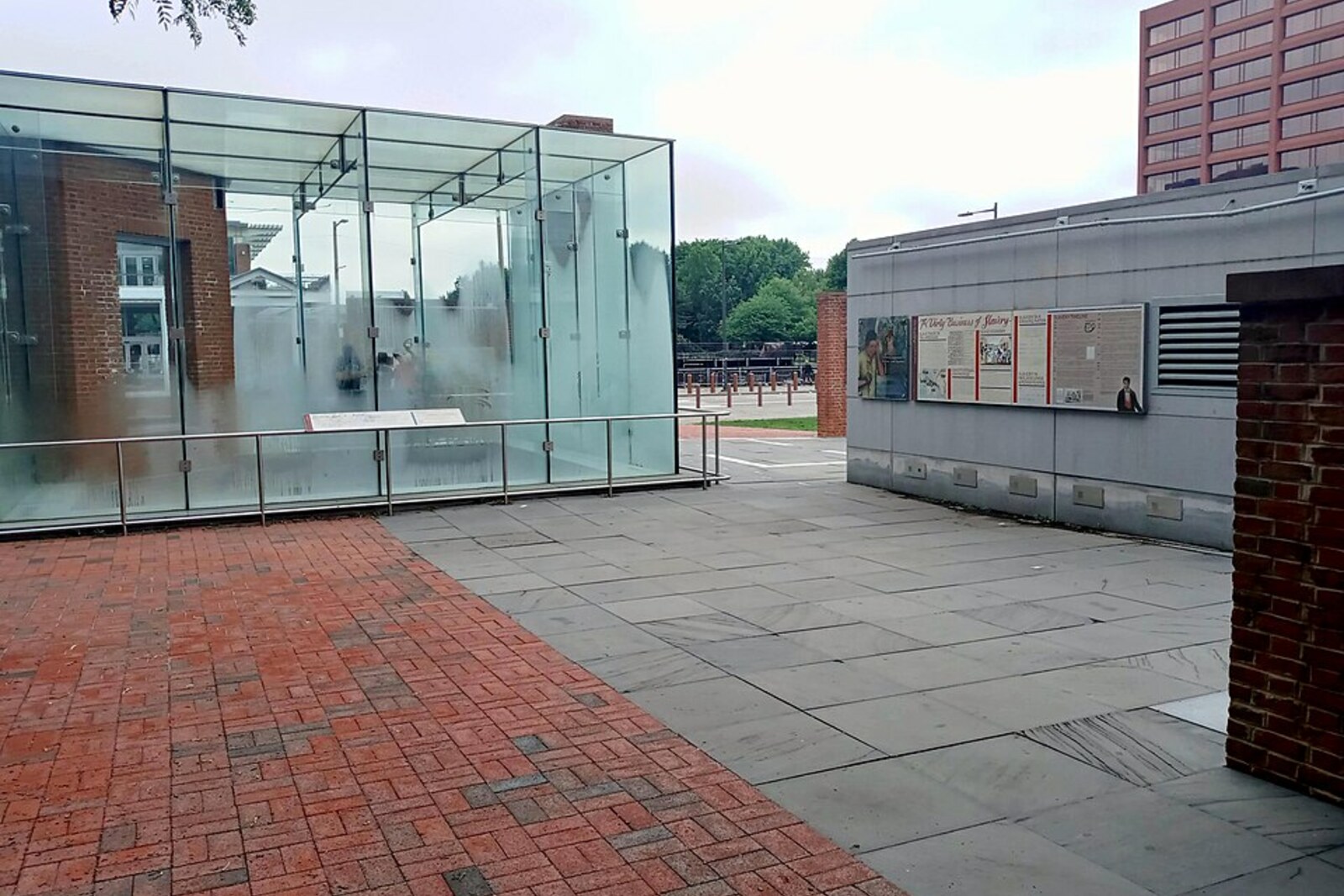
Look around first
What to notice
- Foundation fragments
- Outlines of vanished rooms
- Bronze female footprints
The story of the place
A three-story brick mansion stood here, where the country's first two presidents lived and from which state business was conducted. The house was later demolished, and archaeological work revealed its foundations. The outlines of vanished rooms now run through the open memorial site. Bronze female footprints are set into the paving beside them—a remembrance of the people whose labor sustained the presidential household.
On May twenty-first, seventeen ninety-six, twenty-two-year-old Ona Judge gave her belongings to acquaintances in advance and waited until the family sat down to dinner. She was Martha Washington's enslaved personal servant: she helped Martha dress, cared for her wardrobe, and accompanied her on visits. While the Washingtons sat at the table, Ona left the house.
This three-story brick mansion was called the President's House literally. From seventeen ninety to eighteen hundred, Philadelphia was the temporary capital of the United States. First George Washington, the country's first president, and then John Adams, who succeeded him, lived here and conducted state business. Along with his family and hired servants, Washington housed nine enslaved people here, brought from his Virginia estate, Mount Vernon.
Pennsylvania had the Act for the Gradual Abolition of Slavery. An enslaved person whom an owner from another state kept here continuously for six months could seek freedom. Washington ordered his servants taken out of Pennsylvania before the term expired, and told his secretary to find plausible pretexts for the trips so that the servants themselves would not understand their purpose. An amendment to the law already prohibited such rotation, yet no one compelled the president to free the people in his household.
In Philadelphia, Ona met free Black townspeople. According to her later account, news that Martha intended to give her to her granddaughter Eliza Custis Law led Ona to decide to escape. Returning to Virginia with the Washingtons would have left Ona without friends, ships from northern ports, and Pennsylvania law. So, while her owners packed for the journey, she prepared her own departure. After leaving the house, friends helped her board a vessel bound for Portsmouth, New Hampshire.
Three days later, the manager of the presidential household placed a newspaper advertisement. Ten dollars was offered for Ona's return, and more if she were found far from Philadelphia; captains were warned that she might pass herself off as a free woman and pay her fare. When Washington learned where Ona lived, he instructed Joseph Whipple, the Portsmouth customs collector, to send her back. Ona agreed to return only on the condition that she would be freed after George and Martha died. Washington refused: yielding to a runaway, he wrote, would set a dangerous example for the other enslaved servants.
Three years later, Martha's nephew Burwell Bassett came to Portsmouth intending to take Ona and her young daughter by force. Local friends warned Ona, and she left the city in a hired carriage. Bassett returned without her. Ona married Jack Staines, a free Black sailor, and earned money doing domestic work; her husband's earnings depended on sea voyages. After his death, Ona lived in poverty and received county assistance. Legally, she could have been seized until her death in eighteen forty-eight, but she never returned to the Washington household.
The President's House itself was demolished in eighteen thirty-two. The open memorial site retains the foundations uncovered by archaeologists and the outlines of vanished rooms. Beside them, bronze female footprints are set into the paving—the path of Ona Judge from the house she left during dinner.
Useful on site
This is an open site without a reconstructed house: read the layout on site and keep the passage clear for others.