 Guide On Map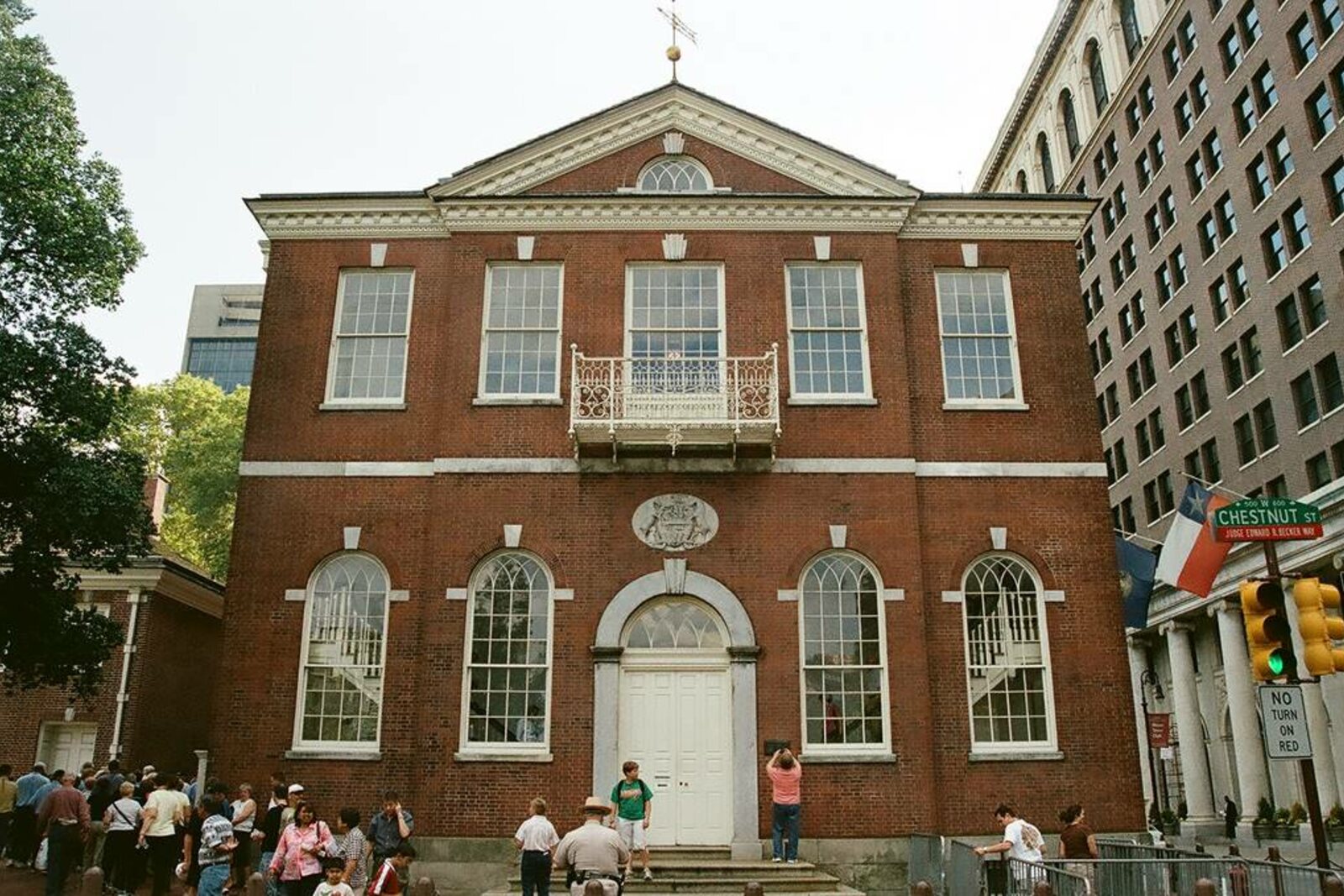
Look around first
What to notice
- The lower hall
- The Speaker's dais
- The marker of the place of the presidential oath
- The Senate chamber
The story of the place
The two-story former county courthouse temporarily became the working home of United States Congress: the House of Representatives occupied the lower floor, and the Senate met one floor above. Philadelphia housed the federal institutions while a new permanent capital was being prepared on the Potomac River. In the lower hall by the Speaker's dais, the site of an important ceremony is marked, and the Senate chamber survives upstairs. After the government left, the county court returned to the building, and the name Congress Hall remained with it.
On March fourth, seventeen ninety-seven, the lower hall was filled all the way to the gallery; some of the public remained outside. John Adams, elected the second president of the United States, was preparing to take the oath of office. Nearby stood George Washington, the country's first president, who had decided to return to his Mount Vernon estate after two terms.
The former Philadelphia County Courthouse was used for this ceremony. United States Congress chose the city as a temporary capital while a permanent one was being built on the Potomac River. The House of Representatives occupied the first floor, and the Senate the second. The building acquired the role that fixed its present name: Congress Hall.
For most of the previous eight years, Adams had been vice president and, by virtue of his office, had presided over the Senate. His usual place here was upstairs. Now he was to descend to the House of Representatives chamber and take an office that only one person before him had held.
Washington declined to take part in the election of seventeen ninety-six. The earlier system did not yet separate votes for president and vice president: each elector named two candidates, the winner became president, and the runner-up became his deputy. Adams received seventy-one votes and Thomas Jefferson sixty-eight. Thus Adams's closest rival, who disagreed with him on nearly every major question, became his vice president.
On the eve of the ceremony, Adams did not sleep. He felt ill and later admitted to his wife that he was unsure whether he could finish his speech. The Chief Justice of the Supreme Court of the United States administered his oath at the Speaker's dais. After the words had been spoken, Adams became president and Washington a private citizen. The United States Constitution provided for a change of the head of state, but until that day the country had not seen one elected president voluntarily yield office to another.
After the ceremony, Washington personally congratulated his successor. That day, it seemed to Adams as though the calm Washington were silently telling him: now I have got out, and you have got in—we shall see which of us will be happier. Five days later, Washington left Philadelphia and went to Mount Vernon. Adams served one four-year term, lost the next election to Jefferson, and also left office.
By then, the federal institutions had already moved to Washington, D.C., and the building was again used as a county courthouse. In today's Congress Hall, the place where Adams took the oath is marked by the dais on the first floor. One floor above is the Senate chamber, where he had formerly presided as vice president.
Useful on site
From outside, its proximity to Independence Hall is easy to see; check separately whether it is possible to see both halls inside.