 Guide On Map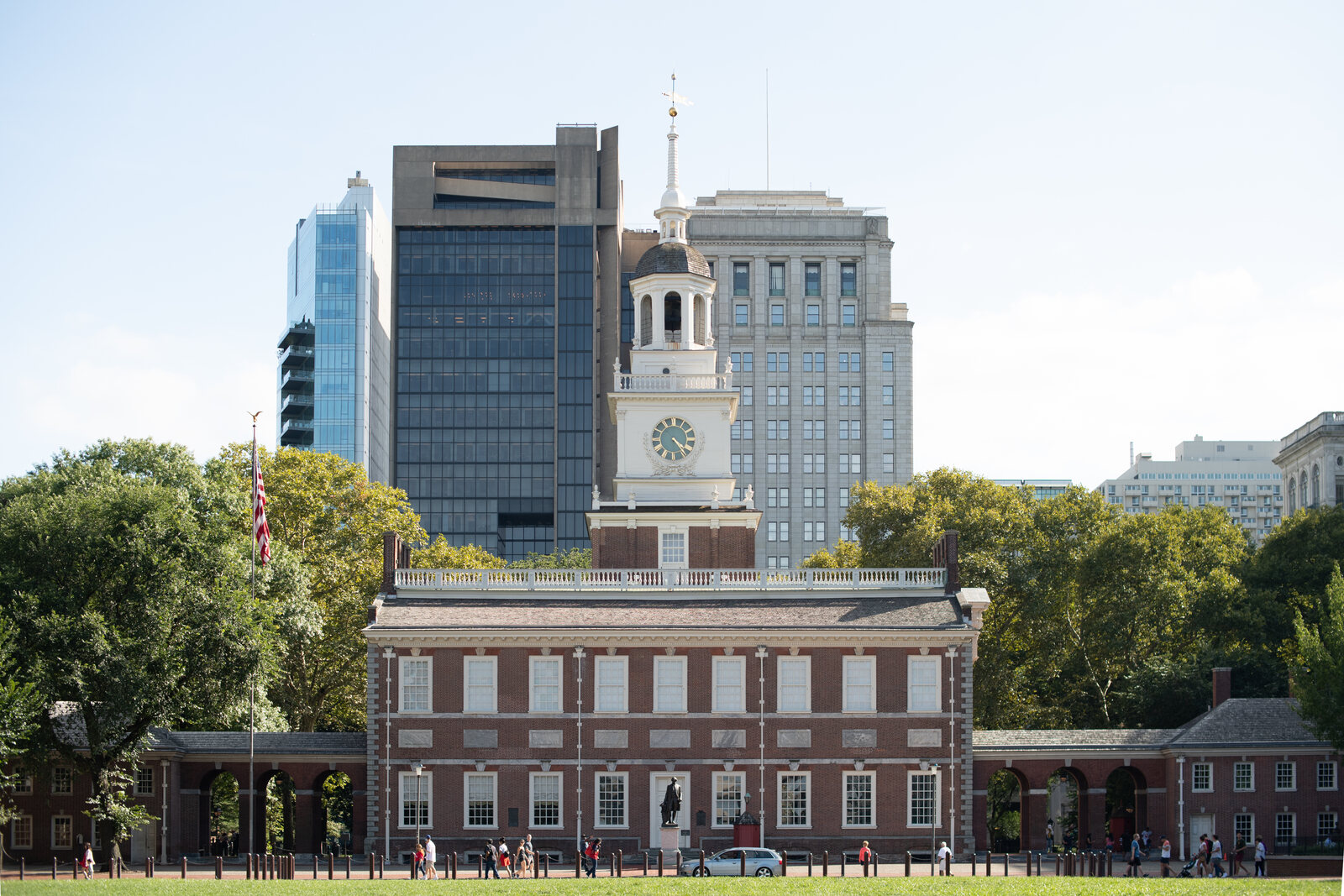
Look around first
What to notice
- Assembly Room
- Rows of tables and chairs
- Silver inkwell
The story of the place
The Assembly Room inside Independence Hall was long the colony's working room: legislators gathered here, the court sat here, and the governor's council operated here. The rows of tables and chairs recreate the appearance of the eighteenth century, although they themselves have not survived from those meetings, and no exact seating plan remains. The west wing holds a silver inkwell believed to be an authentic inkwell from that time. The current name of the whole building came later, when the name Independence Hall extended beyond a single room.
On July first, seventeen seventy-six, John Dickinson, a Pennsylvania delegate who had sought to postpone the break with Great Britain, rose in the eastern room of this building. The war had already been underway for more than a year. Congress had created a common army, British ships were approaching New York, and most delegates were preparing to declare the Thirteen Colonies independent.
Dickinson did not propose laying down arms. Several years earlier, he had won fame through articles against British taxes and then helped prepare documents explaining why the colonists had taken up arms. But independence at that very moment seemed dangerous to him: the colonies still had no firm union among themselves, no treaty with a foreign ally, and no certainty that they could withstand the war.
He had something to lose. A wealthy lawyer and landowner whose income included revenue from estates where enslaved people labored, Dickinson had gained recognition precisely as a defender of the colonists' rights. Now he was opposing those who saw the break with Great Britain as the completion of that struggle. Later, he admitted that he expected the final loss of his already weakened popularity.
Dickinson set out his arguments here, in the Assembly Room of the Pennsylvania State House. This was what the building was called at the time: it had been built for the colony's legislature, court, and governor's council. In May seventeen seventy-five, Pennsylvania delegates made the room available to the Second Continental Congress—a gathering of representatives of the Thirteen Colonies that, during the war, directed the common army and negotiated on their behalf. That is why the decision was made here, in a borrowed room of a functioning institution.
The colonies voted as units: each had one vote, determined by a majority of its delegates. On July first, nine colonies supported independence, Pennsylvania and South Carolina opposed it, the Delaware delegates' votes were evenly split, and the representatives from New York had no authorization to vote.
The next day, Dickinson and another opponent of an immediate break, the Pennsylvania merchant Robert Morris, did not take part in the vote. Among Pennsylvania's five remaining delegates, supporters of independence gained the advantage—three votes to two. South Carolina changed its decision, and Delaware also voted in favor. Twelve colonies supported the resolution on independence; New York still abstained.
After that, Congress spent two more days reviewing the text of an explanation prepared by Thomas Jefferson and four other members of the committee. On July fourth, the delegates approved the Declaration of Independence. Most signatures appeared on its formal handwritten copy on August second. Robert Morris signed it. Dickinson refused.
That refusal cost him his seat in the Pennsylvania Assembly, but he did not become a supporter of Great Britain. Dickinson went to serve as a private in the militia, and six years later he was elected president of Pennsylvania—the title then used for the head of the state's executive council. His political career recovered; his signature never appeared on the Declaration.
The name “Independence Hall” came later. When Philadelphia was preparing to receive the Marquis de Lafayette, a participant in the War of Independence, in eighteen twenty-four, the organizers gave the meeting room the name Independence Hall. Only decades later did that name extend to the entire building.
The current tables and chairs in the room evoke the eighteenth-century setting, but they did not belong to the participants in the vote; even an exact seating plan has not survived. In the west wing, a silver inkwell is displayed that is believed to be the very one used when the Declaration was signed. Robert Morris's quill dipped into its ink. The space for John Dickinson's name remained blank.
Useful on site
You can begin the account in the courtyard; visit the interior only under the current access rules and with a separate reservation, if one is required.