 Guide On Map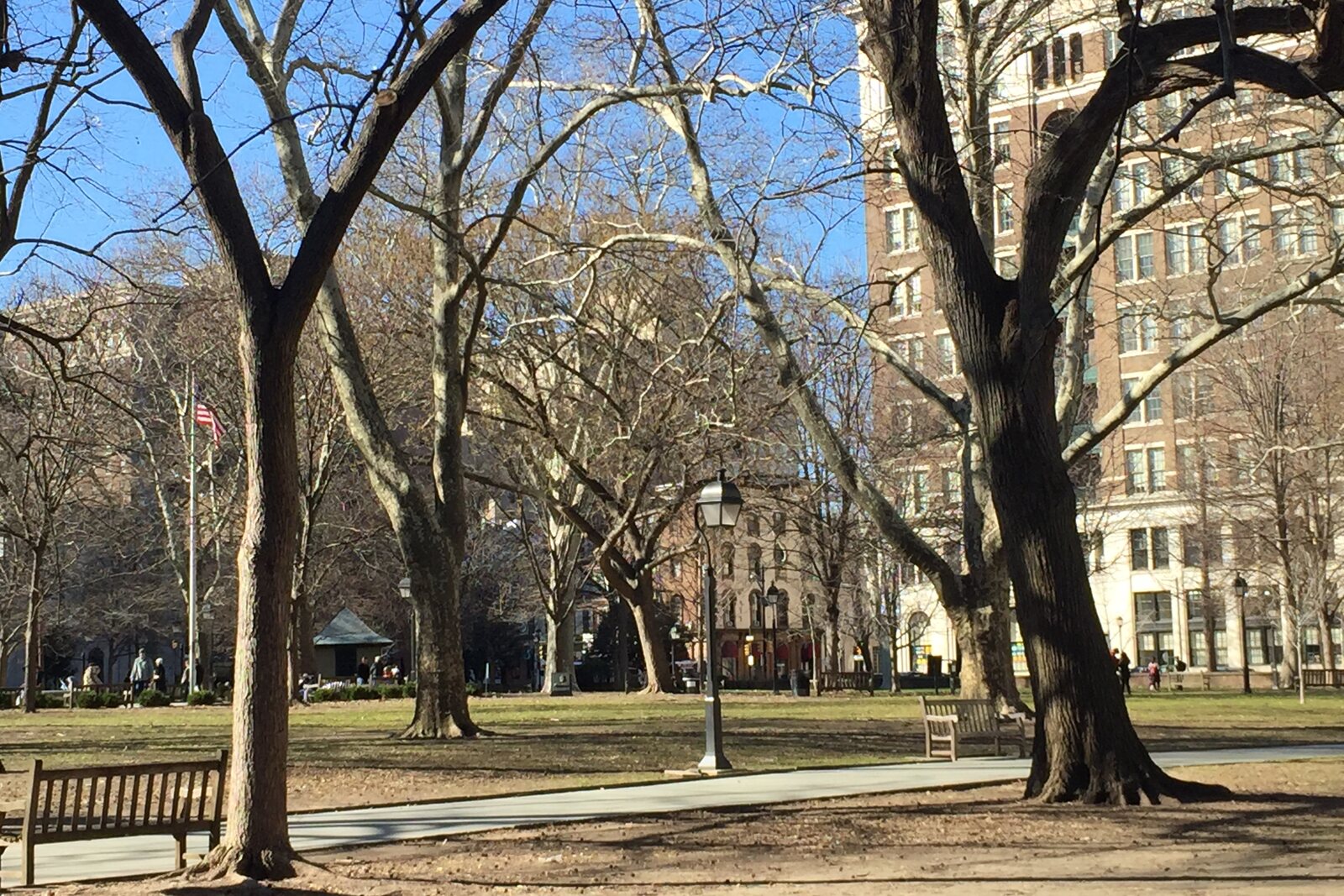
Look around first
What to notice
- Marble sarcophagus
- Bronze figure of George Washington
- Inscription on the sarcophagus
- The square’s lawns and paths
The story of the place
In November nineteen fifty-six, workers dug several deep test pits in Washington Square. They told passersby that they were testing the soil. In fact, Pennsylvania’s staff archaeologist, John Witthoft, was looking for the remains of a person who could be buried in the new Tomb of the Unknown Soldier of the American Revolution. Witthoft insisted that the work be done without publicity: rival parties governed the city and the state, and the excavation permit had been worded so vaguely that police officers who arrived initially ordered everything stopped. Only after a call from their chief did they let the archaeologists back in.
They chose to search here because a city cemetery lies beneath the lawns. In seventeen oh six, the then-Southeastern Square was set aside for people who were not entitled to a place in a parish churchyard or could not afford one: poor people, newcomers, prisoners, and free and enslaved Black people. During the war, gravediggers buried American and British soldiers here. The wounded were brought to Philadelphia after battles, hospitals overflowed, and more people died of disease than from weapons. More than two thousand military personnel from both sides ended up underground. Victims of the yellow fever epidemic were added later. In seventeen ninety-four, city officials closed the cemetery: a new grave could no longer be dug without disturbing an earlier one.
The first bodies Witthoft found belonged to poor people—they had been wrapped in canvas instead of placed in coffins. Then the archaeologists came upon a mass grave. There, among the remains of an oak coffin, lay a man about twenty years old. A trace of a wound, possibly from a musket ball, remained on his skull. That was enough to connect the find with the war, but it was impossible to determine which army he had served in. The young man may have served in the army of the colonies, or he may have been a British soldier who died during the occupation of Philadelphia.
The heads of the local companies that commissioned the memorial chose these remains nonetheless. In nineteen fifty-seven, they were placed in a marble sarcophagus, and a bronze figure of George Washington was installed above it—commander in chief of the colonial army seeking independence from Great Britain. The city had renamed Southeastern Square in Washington’s honor as early as eighteen twenty-five, when the former cemetery was already being turned into a park.
The memorial’s creators carved on the sarcophagus that a soldier of Washington’s army, who gave his life for freedom, rests here. The archaeologists did not prove that. Memorial ceremonies are still held by the sarcophagus today; inside lies the young man found here, while beneath the paths and lawns remain the unnamed graves of both armies. The bronze Washington stands over one of the dead, who may have been his soldier or his opponent.
Useful on site
The park is open without entering a building; walk along the paths and treat the lawns as the grounds of a former cemetery.