 Guide On Map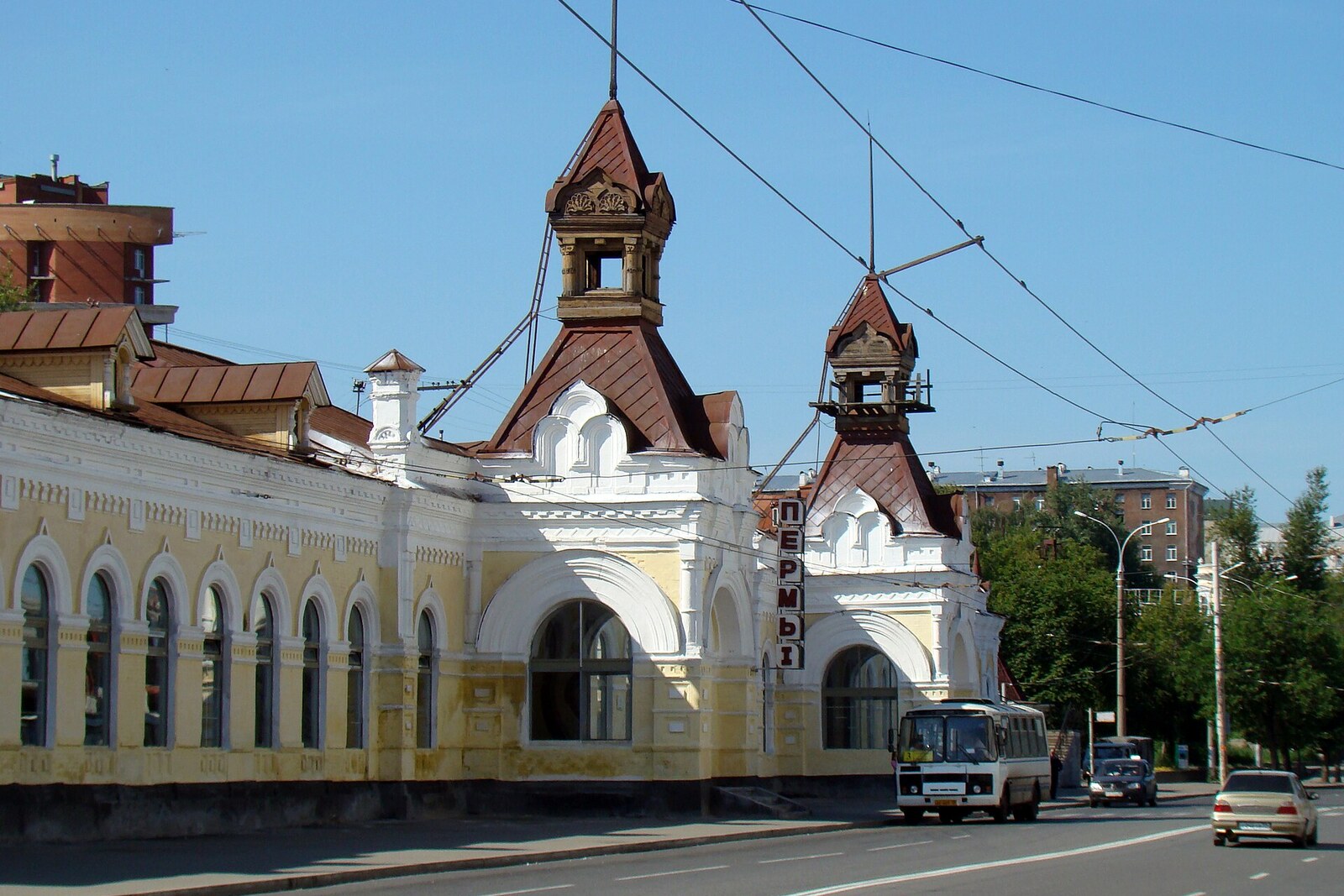
Look around first
What to notice
- Perm River Station building
- Facade of Perm-1 Railway Station
- The steep bank of the Kama River
The story of the place
Above the steep bank of the Kama River, two station facades have survived opposite each other: the river station and Perm-1 Railway Station. The railway station appeared here when trains began running to Yekaterinburg; for journeys farther west, passengers and goods had to transfer from the rails to steamboats and barges. Later, Perm River Station was built opposite, with passenger halls and piers, cementing this route between water and rail. River services have gone, historical exhibitions now fill the interior, and Perm-1 Railway Station still receives trains.
In September nineteen forty-one, a barge carrying several museum collections arrived at this waterfront. Perm was then called Molotov. Its crates held paintings from the State Tretyakov Gallery, the Russian Museum, and other collections; enormous canvases were transported rolled around special shafts, and sculptures in wooden protective framing.
Maria Kolpakchi, a senior researcher, was responsible for the State Tretyakov Gallery's cargo. At first, she was assigned only to choose a vessel for the evacuation. Kolpakchi found an old but sturdy barge with a level deck—and learned that she herself was to accompany the collection. On the first day of the journey, the vessel came under aerial fire near Moscow. Its roof was damaged, but the crates survived. In Gorky, the barge was repaired, loaded with the Russian Museum collection, and sent farther along the Volga River and the Kama River.
On September fourteenth, the barge arrived in Molotov. Perm River Station had already been standing on the waterfront, having opened less than a year earlier, but the city was not yet ready to receive the museum cargo. The decision on the storage location had not arrived in time, and no vehicles could be found for transport. For two weeks, the barge remained by the steep bank while museum staff kept watch beside the crates.
When they were permitted to move the collections to the art gallery occupying the former Spaso-Preobrazhensky Cathedral uphill, Kolpakchi procured two horse-drawn carts. Small crates were taken by horse. The larger ones presented another challenge: the staff themselves had to move the heavy shafts, marble, and protective framing.
A crate containing Mark Antokolsky's sculpture Ivan the Terrible lay on the bank for an especially long time. A horse could not pull it up the slope. For five days, the crate was guarded by Ivan Ovchinnikov, a restorer accompanying the museum valuables, and an elderly man from Perm with a red beard. There was no money for a guard; the man was given bread from their own rations. Then a vehicle appeared, and the sculpture was taken uphill. Unloading was completed on October tenth.
The museum staff settled near the collections. Having left on a short assignment, they had taken almost none of their personal belongings, yet they lived in Molotov for several years. At first, some slept on the crates. They monitored the stoves and humidity, kept watch at night, and reinforced damaged packaging. In the end, the works survived the evacuation and returned to their museums.
That barge was one shipment in an enormous flow. In nineteen forty-one, the city's main reception base for evacuees was set up specifically at Perm River Station. The passenger halls housed a sanitary screening point, a cafeteria, a hotel, and a military commandant's office. People disembarking from vessels were registered, examined, fed, and sent farther into the region. The building, designed for ordinary river voyages, had to be adapted almost immediately after opening for people fleeing the war.
The railway station opposite explains why this transport hub appeared here. In eighteen seventy-eight, the first railway in the Urals opened from here, running to Yekaterinburg. At first, it was isolated from the all-Russian network: goods and passengers traveling farther west transferred by the Kama River from train to steamboat or barge. The station was simply called Perm. It became the first station in nineteen eleven, when Perm-2 was already operating in the city. Later, river transport workers built a large station opposite, cementing the former transfer between rails and water.
Passenger vessels no longer fill the piers here. The former Perm River Station houses historical exhibitions, while Perm-1 Railway Station continues to receive trains. The crate containing the sculpture is no longer on the bank either: after the five-day watch, it was taken up to the gallery and then returned home with the collection.
Useful on site
The railway station operates according to the carrier's schedule; the route is intended for exterior viewing and passage through open urban areas.
Checked: June 24, 2026. Check the official source before visiting.View both buildings as a single stop, but keep their different status in mind: Perm-1 Railway Station remains a transport facility, while the former Perm River Station has changed its purpose. Check entry availability on site.